
Whispers of the Old Woods
In the heart of the rugged East Cairngorms landscape, discarded wood is being repurposed as furniture that stuns with its simplicity, its beauty granted by imperfections in the material that draw the eye. Behind the designs is Tor Workshop, founded to reinvent vernacular furniture styles of pre-industrial rural Scotland for the slow living movement. This is its story.
The chair is an angular cocoon, with a shelf-like hood that wraps around you. It looks protective enough to cosy up in outside, while the weather sweeps over the huge folds of landscape, stratus clouds heaving down upon heathery moor. Now picture the opposite sort of scene: the dark interior of a thatched croft in the 19th century, before the advent of chimneys, with blackened walls trapping thick smoke. The same style of chair sits in the corner, hunched with its back to the room, its structure protecting the sitter from both the smoke and draughts.
But there’s a third scenario. Imagine curling up in the chair and hiding away from the cares of the 21st-century world, letting them ricochet off the sculpted flanks and float into the distance. This was the thinking when craftsman Tom Addy of Tor Workshop in Braemar, East Cairngorms created the piece. It’s known as the Isolation Chair and is a remake of a 19th century design as a response to the pandemic. It’s part of the workshop’s bespoke catalogue of designs that are heavily influenced by the vernacular styles of pre-industrial rural Scotland – the kind of furniture used in the crofts and farmhouses of the Cairngorms for hundreds of years. “These styles championed function over form, and they look good because they work,” says founder Tom. He sees a place for them now, as more people are turning towards the philosophy of slow living.
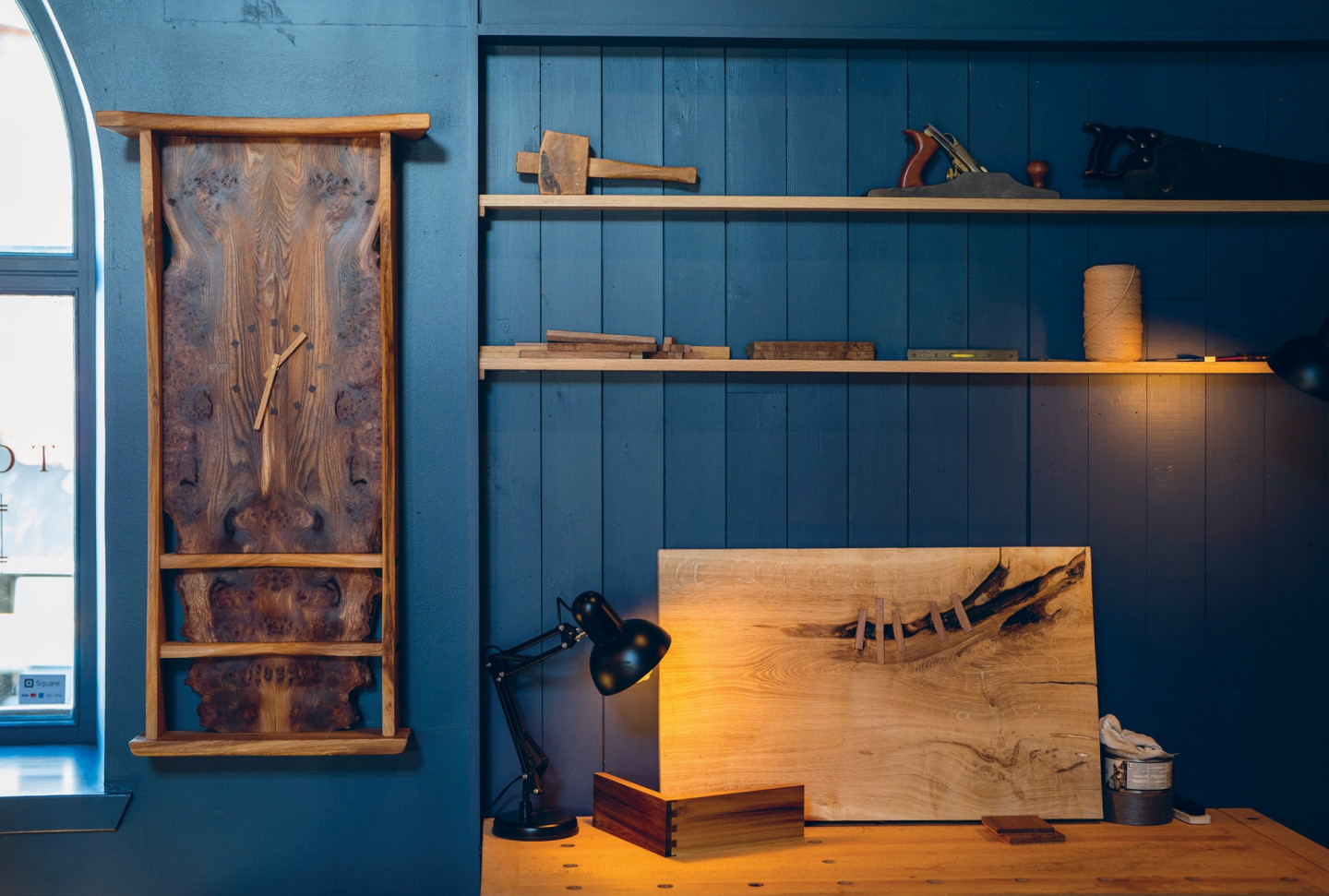
Like most of Tom’s reinventions, the Isolation Chair is sort of exquisite in its imperfection. Made from Aberdeenshire elm that had succumbed to Dutch elm disease, and an Edinburgh walnut bough brought down in a storm, the chair’s knots and splits invite for hours of pondering. This is the other thing about Tor Workshop: its designs embrace the irregularities of wood and celebrate the story of the place as told by the raw material.
All the furniture is made with local wood, mostly sourced from windblow or local tree surgeons who are discarding trees to make way for developments or for public safety reasons. “No trees are felled specifically to make our furniture,” says Tom. “We hope that sourcing this way pays appropriate respect to the tree and gives new life to material that would otherwise rot in the ground or be burned as firewood.”
It’s a method that means Tom can’t be picky about traits other furniture makers would snub – hence the knots and splitting in much of his work. Pieces are instead celebrated for their provenance, embracing the irregularities of the material and honouring the region and its story as told by the wood. Take “A Chair for the Dee”, a commission that embodies the Dee catchment. There’s the frame made with wych elm from Glen Gairn, spliced by birch scales from Glen Tanar that cascade like shells, while the seat is from elm felled at Dess and the inlay details are from Aboyne oak and Glen Tanar birch.
The Dee chair looks intricate, but most of Tor’s furniture, made in an old farm steading on Glen Muick, is plain in design, taking its inspiration from a time when furniture makers were concerned with making simple improvements to a domestic setting and leaving little room for frivolity. “Made simply, and with what was at hand, this style of furniture developed in direct response to the requirements of the day. In re-imagining these styles, we allow the simplicity of the furniture style to really show off the grain and character of the materials used,” says Tom.
A good example is the Creepie stool, a 19th century model that Tom has reinvented in woods like Gairnside wych elm or Aberdeenshire oak. Simple, with four legs, five boards and a small finger hole in the top, it would once have been commonplace throughout the rural Highlands, used by children, in church and at weddings, when guests would “go with the Creepies”, to sit on during the ceremony. The name derives from the old Scots word ‘creep’, meaning ‘to crawl’ or ‘to stoop low’, because, like the inspiration behind the Isolation Chair, one of the Creepie’s roles was to keep the sitter out of the smoke in thatched blackhouses. If you pop into the Auchtavan on Invercauld Estate in Braemar, you can see a preserved example with stained walls and blackened timbers.
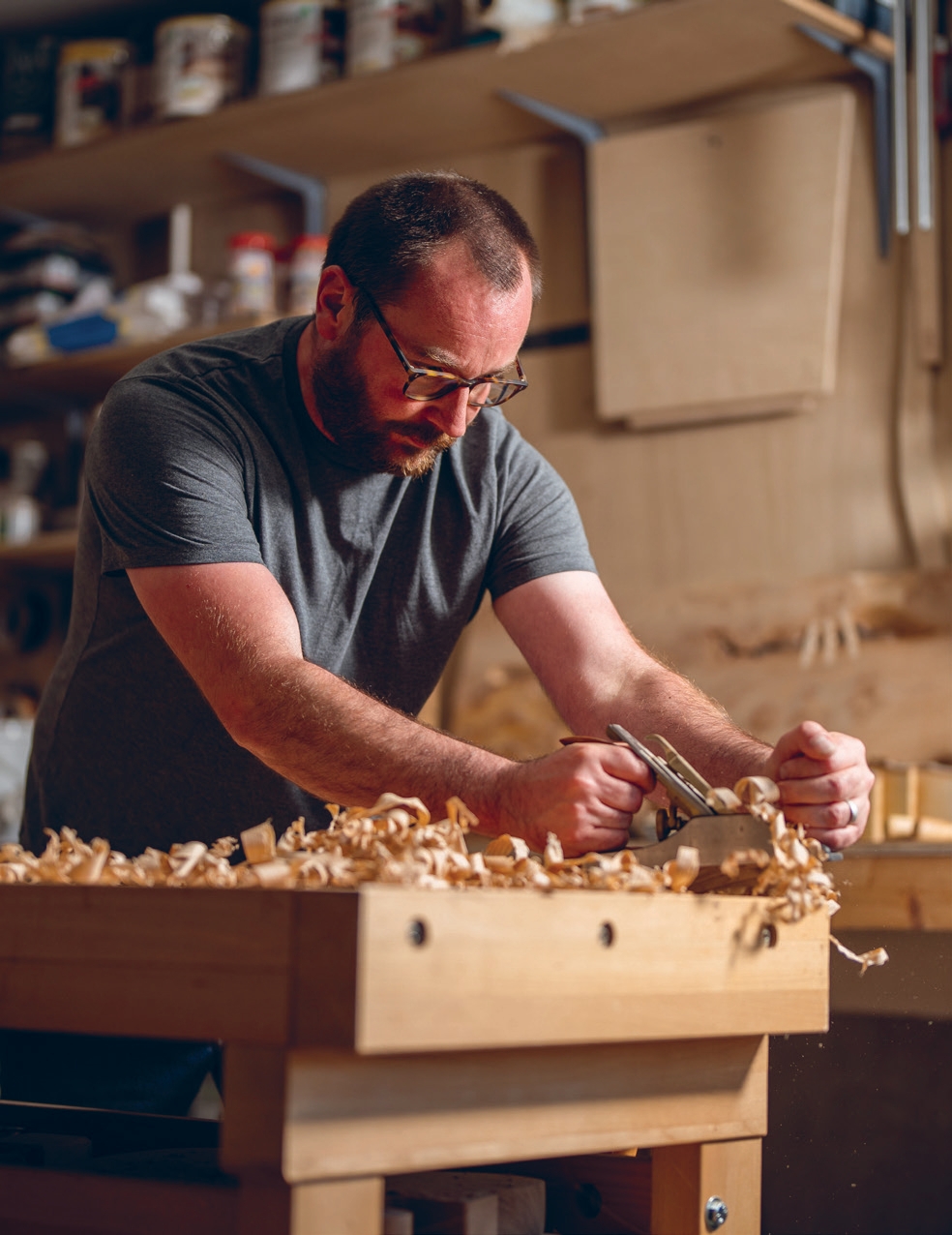
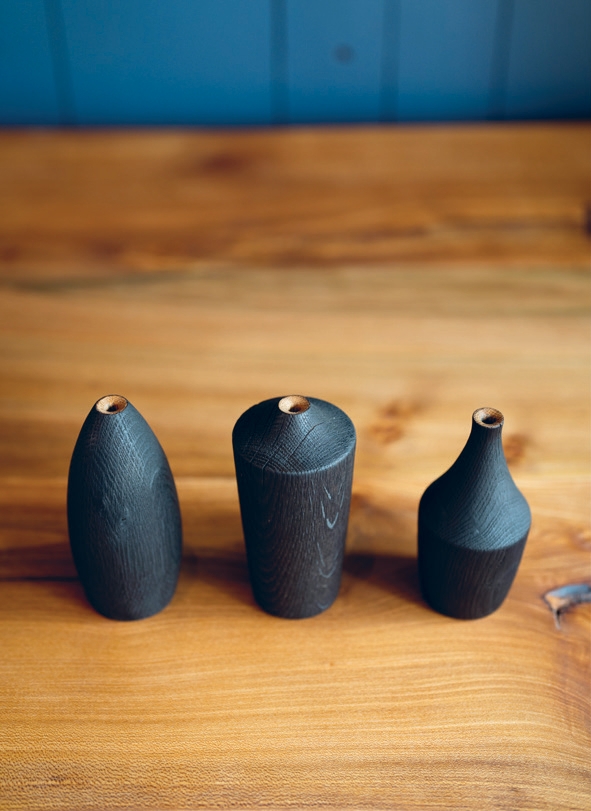
When Tom opened Tor Workshop’s showroom in Braemar in 2020, its aim was to translate stories like these to his customers. The space, in Braemar Mews, is part-gallery, part-showroom. You might be hypnotised by blackened Douglas fir lamp bases, all voluptuous curves gashed open by splits, or book-matched burr elm dining chairs, the spirograph-like shapes in the wood forming their backs. Another reason to visit is to enjoy the meditative quality of watching the items being handcrafted during public demonstrations. Tom describes the sharp planes of the handtools almost whistling as they make petal-like shavings from the wood. “We enjoy discussions with visitors about the design and provenance of materials almost as much as those about commissions,” smiles Tom.
There are usually a couple of projects on the go in the workshop, with Tom alternating between commission pieces and speculative work. He’s accompanied by Ewen Falconer, a skilled woodturner who sees to it that nothing goes to waste: he transforms offcuts from larger pieces of wood into the most beautiful chopping boards, bowls and platters you have ever seen. Tom says it can take up to three weeks to make a dining table, or one or two for a chair, but he enjoys the variety of his work. “The common thread to all our work is that it takes place in a truly beautiful part of the world – this isn’t lost on us, and is something we never take for granted,” he says.
He’s not unlike other locals in the region. There’s a bond between people and the land here, and a shared idea that you come in off the hills and reflect on the experience in writing, painting and creating – a concept that is at the heart of Tor Workshop. Tom grew up nearby, in Aboyne, and after years working abroad as a chef, returned to set up construction contracting company Tor with his brother Ben, the award-winning architect of Moxon Architects. Tom quickly found himself drawn to furniture-making as a creative pastime that provided an antidote to the managerial aspects of his job. “It was a welcome distraction from the day-to-day stresses of construction management – the slowness of making, connection with materials and exploration of traditions,” he says.
At the same time, Tor was part of the team running the Fife Arms restoration project in Braemar. For anyone who doesn’t know, the Fife Arms is a former Victorian coaching lodge, now a five-star boutique hotel. Painstakingly restored by the Swiss fine art dealers Hauser & Wirth, it is detailed with William Morris fabrics, antiques, and bespoke local work – including a Tor-built courtyard and the antler chandelier in The Fog House restaurant, all the way down to a Tor Workshop dram table with chamfered sides and rim detail that is reminiscent of a barrel top. This is all within the surrounds of international contemporary artworks. Of a luxury art project like this in the rural wilds, Tom muses that the juxtaposition of raw nature and the comfort of home has created a culture of its own here – a region that has long attracted creatives with its wild scenery and magical light. That’s why Braemar is something of an arts hub, a stonecottaged honeycomb of fine arts galleries, with a cultural centre and a creative arts festival in celebration of local art.
For Tom, a sense of the local is even more relevant in the new normal we face now, as people have started to look closer to home for food, leisure and travel experiences. And, he adds, there has been a return to many elements of living in the landscape found in the era from when Tor Workshop’s designs originate: when people were invested in the land and the seasons for survival. “There is a movement geared towards slow living, which I welcome,” he says. “Our furniture becomes more relevant in the new normal we find ourselves in.”
It wasn’t lost on him that the additional time afforded by the lockdowns gave him longer to ponder designs, time to study traditional craftsmanship and space to feel a connection with the historical inhabitants of his local area. The unexpected benefits of the pandemic also brought about a shift in spending, with many people swapping disposable fads for investment items that will last for many years. “This is something that sits well with our workshop philosophy,” says Tom. “We hope our furniture can be enjoyed for generations.” It’s heartening to think of dead wood finding new life in homes for many years to come, whispering its stories to those who sit on it, or stand a drink on it, or simply take it outside with a blanket and coorie doon to watch the clouds move across the landscape as the trees look on.
words // Emily Rose Mawson - photography // Jonathan Addie
Promoted Post
Whitehill Farmhouse
Located on Colquhalzie Estate, this 19th Century farmhouse has been lovingly restored into a family home, having previously been home to the Shepherd who lived there for 40 years. We welcome friends and families of up to 8 people on a self-catered basis for at least 4 nights.
-full-1749645255.jpg)
-full-1749413136.jpg)





 Sign in with Google
 Sign in with Email