
In to the Deep - Underwater Gannets
Bouncing around in a small inflatable boat I was heading to one of the remotest coastal cliffs in Shetland, and I was starting to feel a little nervous. There is nothing between these cliffs and Norway, and they get pounded by massive storms and large swells. For me to make the images of diving gannets underwater I had to pick my days carefully, it needed to be relatively calm.
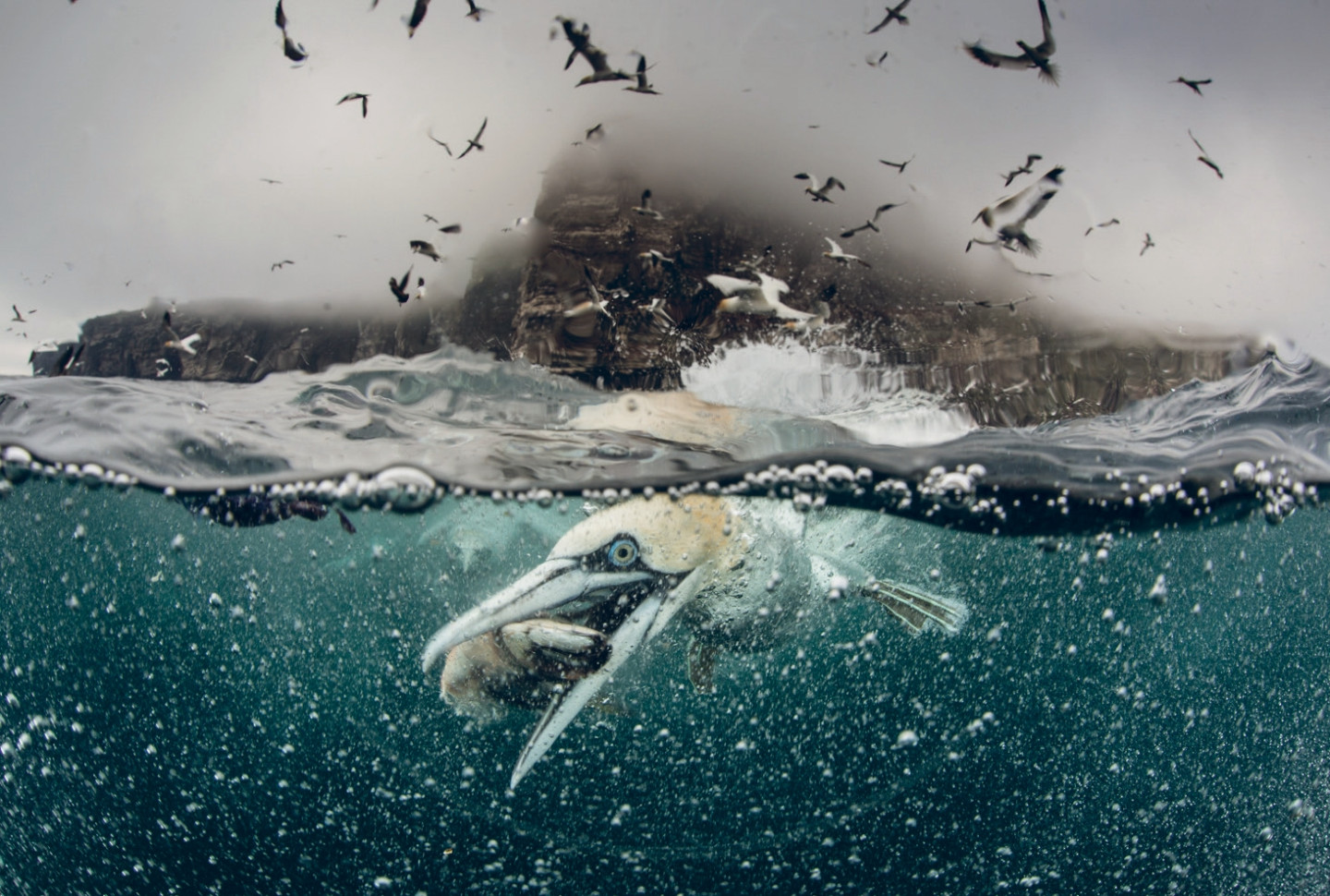
As I ploughed through a wave and a wall of spray hit me in the face leaving me squinting to see the shoreline, I wondered if I had overdone the loading of the boat. Weighted down by the 150 kilograms of mackerel, camera gear and dive kit and the fact that thick fog was making navigating around the headlands difficult, I started to question my sanity. I knew once I made it to the cliffs I would be sheltered, but the fog seemed to be getting denser. I had gambled as the forecast was for the fog to clear.
It was very eerie sat there all alone in dense fog, waves breaking at the base of the cliff, listening to the noisy gannets, and the overpowering smell of guano but not really being able to see them. I felt my sense of hearing heighten, expecting to see the Black Pearl and Captain Jack Sparrow appear through the fog. Three hours later, the constant rolling of the boat and the strong smell of mackerel had me starting to feel a little queasy. I began to wonder what the hell I was doing, feeling very exposed and vulnerable to the elements; perhaps it was time to head back as the fog was not clearing.
Suddenly my feeling of hopelessness eased as I sensed it was becoming brighter. A faded sun could be made out through the white filter of fog; I could see more of the cliffs and more importantly I started to see lots of gannets. Within ten minutes the fog was halfway up the cliffs, and it was getting brighter. I started the boat engine with excitement and headed out, away from the base of the cliffs.
On cue, a swirling mass of gannets started circling the boat. I threw a mackerel into the water, and the gulls and skuas came in. I threw some more mackerel, and within seconds the gannets were diving. It did not take long for it to turn into a gannet frenzy. Several thousand birds circling the boat. Every time a fish went overboard, suddenly a single bird would plunge dive and others would see it as an indicator, then there would be 20, 30, 40 birds diving. Gannets will plunge-dive from 9-15 metres above the water reaching up to 100 kph when they break the surface. They have evolved for this way of foraging, with air sacs in their head and neck that inflate to reduce the chances of impact injuries. Their nostrils are fused, preventing water from entering the sinuses.
Several times gannets were skimming my head and wings hitting me in the face as I tried to capture the raw emotion of the feeding frenzy. All the anxiety was forgotten, and the fog proved to be a blessing more than a hindrance. Filtering the sun to create bright but diffused white light, it protected the image from the harsh direct midday sun which on white birds can cause the highlights to burn out. A couple of hours later, a card full of pictures and 150 kilograms of mackerel lighter I headed back with not a worry in the world.
The above is an account of one of the very first times I went out to shoot a gannet feeding frenzy. Since these early days, I have developed a polecam system, basically a camera on a pole that can be used by anyone to photograph the gannet feeding frenzy. Nowadays I work closely with a good friend and colleague Phil Harris of Shetland Seabird Tours, and we take people out on his luxury boat , compared to my old, small and battered RIB.
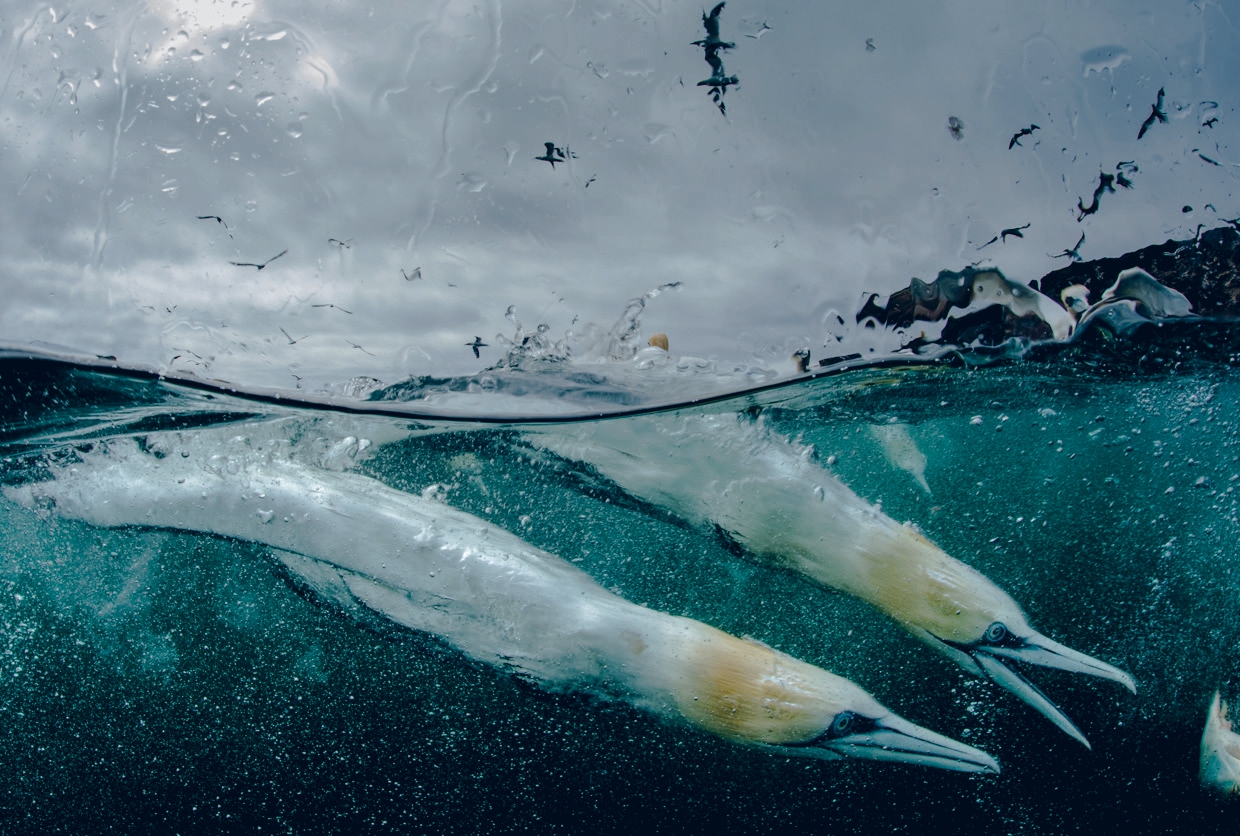
It is one of the wild wonders of Scotland to be under the towering cliffs of Noss. They are the third highest sea cliffs in Scotland at 180m tall, and during the summer over 80,000 seabirds nest on Noss, which includes 25,000 of our largest seabird, the Northern Gannet. No matter what size boat you are on, the cliffs feel huge from the sea and take on a white glow due to the number of gannets nesting there. The noise, the smell and the sight hit all your senses as this magnificent seabird city plays out in front of your eyes. There are always several hundred gannets circling the boat, and as you introduce a few dead mackerel, you see their agility and adaptation of these birds to dive like a torpedo.
The dive itself only allows the bird to reach depths of a few metres, but they can swim very well underwater using both wings and feet for propulsion - this enables them to pursue fish down to around 30 metres. They have two dive types, one described as V-shaped (lasting only a few seconds) and U-shaped dives where the bird swims and can be submerged for around 20 seconds. The U-shaped dive is about 50 per cent more successful at catching prey than the V-shaped dive.
Feeding aggregations are very visible, often attracting gulls and skuas after an easy meal. Despite their large size, gannets are often victims of ‘kleptoparasitism’ – I often watched several being harassed by skuas forcing them to regurgitate their meal. Gannets swallow their fish under the water so they can eat more fish on that dive, to stop other gannets stealing their food and to avoid having their fish taken by skuas or gulls on the surface.
Scottish seabirds have gone through some difficult times over the last few decades, related to changes in sea temperature, affecting food supply. However, gannets are one of the success stories with populations increasing on average around three to five per cent per year due to well-managed mackerel and herring stocks. If you are visiting Shetland, one of the ‘must’ places is a trip to the seabird cliffs on Noss.
words & photography // Richard Shucksmith
Promoted Post
The Best of Skye Guidebook
The Isle of Skye is a place of rare wonder, a wildlife-rich spread of bays, peaks, cliffs and ridges. The views are big, but the prospect of adventure is even bigger. We hope this curated Hidden Scotland guide – which takes in everything from the best walks to the finest restaurants – helps you to have your own unforgettable island escape.

-full-1748964954.jpg)






 Sign in with Google
 Sign in with Email