
Easdale the Roof of the World
This tiny island off the west coast of Argyll once exported slate for roofs across the world. But Easdale is much more than a graveyard for a long-gone industry, it’s a pocketsized portal to another world.
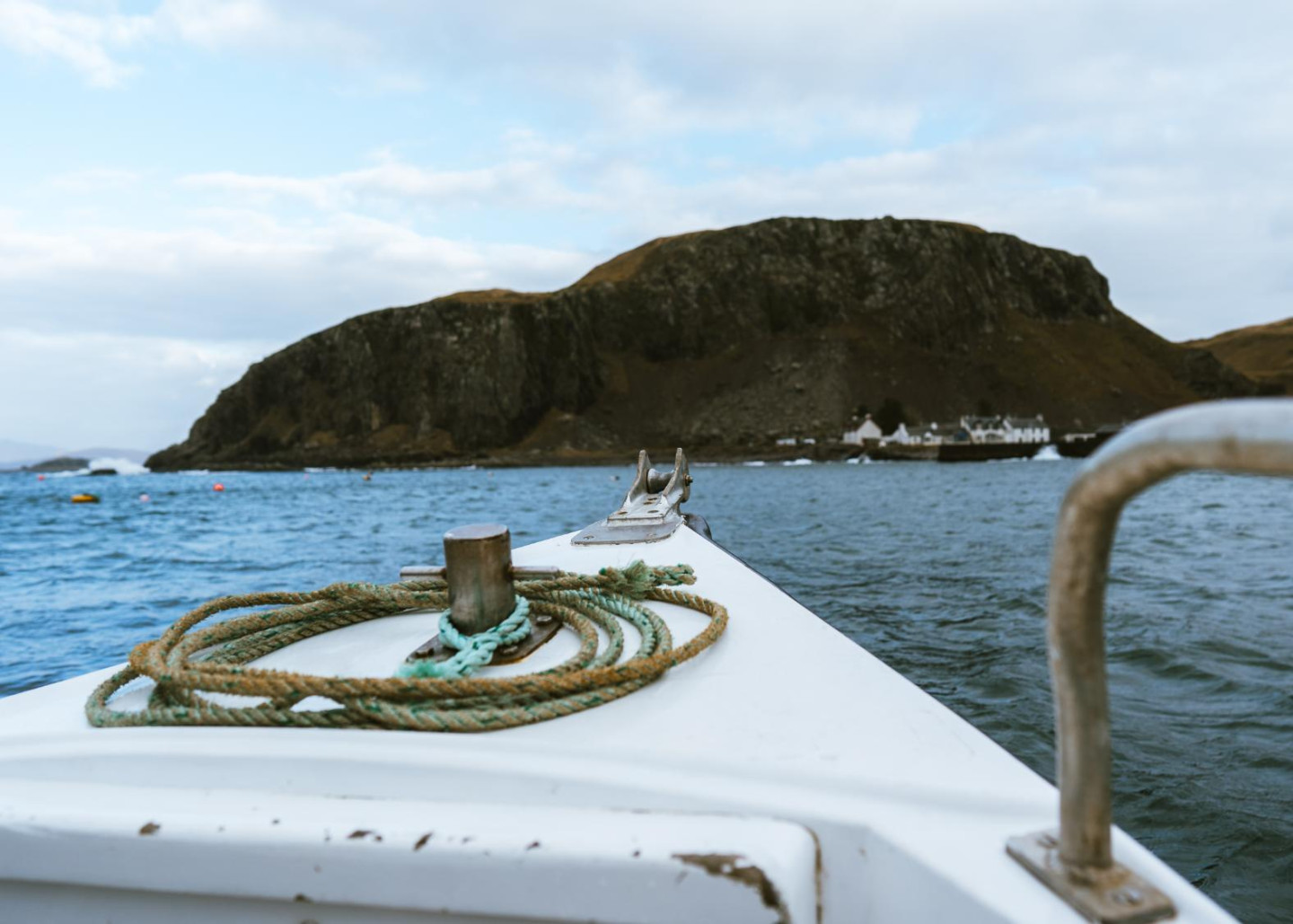
The word ‘quarry’ is distinctly lacking in romance. Picture one and you think of cranes, churning noise and landscapes ripped apart with ugliness. Easdale, one of Argyll’s slate islands, is so pocked with former quarries it’s more defined by its negative space than the land around them. And, against all the odds, it’s beautiful.
The slate islands of Easdale, Seil, Luing, Shuna, Torsa and Belnahua are spattered in the Sound of Lorn, a few miles south of Oban. Easdale is tiny in size – just 10 hectares – but for three centuries it was the epicentre of the Scottish slate industry. At its peak, a community of 500 people lived on the island to work its seven quarries and Easdale slate can be found on roofs as far away as Australia and New Zealand. But one night in 1881, a furious storm hit the island and washed away an entire industry. The islanders’ livelihoods were lost. Slate mining and exporting slowed down to practically nothing. The population of the island dwindled until by the 1960s just four people were recorded as living on Easdale.
Slowly the island has been resuscitated by its inhabitants back into a vibrant community. Today, there are 58 permanent residents across a range of ages and occupations – some work from home or in island businesses, while others commute to Oban and beyond. It has also become a unique spot for second homes for people seeking a quiet moment in its rugged beauty.
Easdale may also be on the cusp of a new islandwide industry, as those in the know travel there for day trips and short stays to explore its unique topography. It couldn’t quite be described as a tourist hotspot yet (thankfully), but the whispers about it as a place to experience are getting louder.
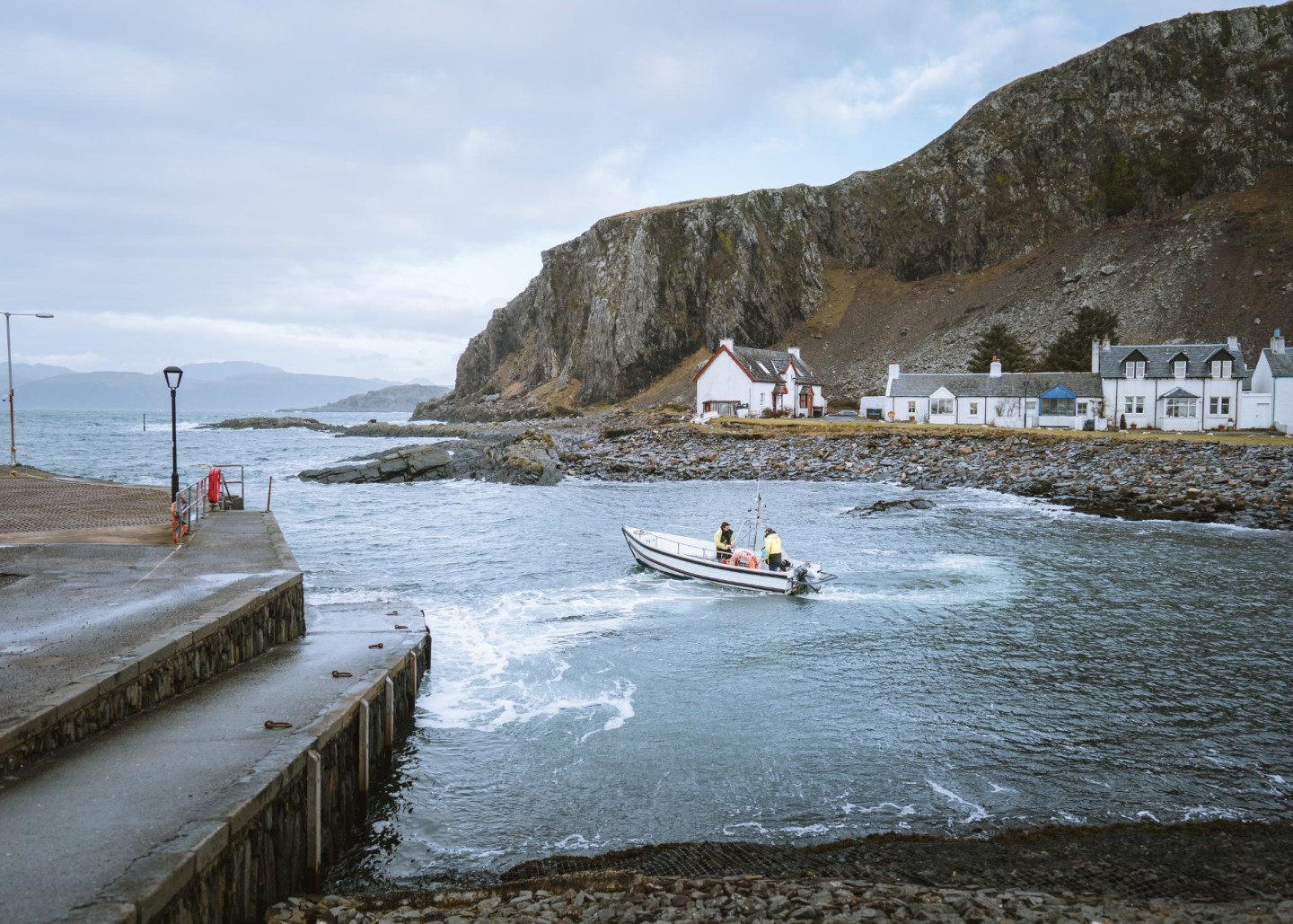
Visitors wanting to explore its alien landscape have to first cross over from Argyll to the ‘island’ of Seil; island in inverted commas because it’s connected to the mainland by Clachan Bridge, or the Bridge Over the Atlantic, an 18th century single track stone bridge that demands nerves of steel to drive across. From there it’s a short drive to Ellenabeich, where you can push a button to summon the 12 person ferry and make the crossing. The ferryman and his helper are always happy to chat, to talk about their home and what brings you to it. It’s the perfect introduction to this friendly little island.
From the sea, Easdale might not look like much. It’s small – easily walkable in an afternoon – painted in greys and greens with white splodges of cottages dotting the horizon. As you draw closer, you realise the slate island is just that, made entirely of slate. The paths are slate, the walls, the roofs, the signs are painted onto large, flat slate pieces and the gardens are rock gardens in the truest sense, with florets of kale and calendula springing from raised beds on top of and constructed out of slate. When you look closely at the slate, you can see colours within the grey: deep blues, patches of orange rust and glittering flecks of fool’s gold. Like the island itself, there’s more to see here than first meets the eye.
A helpful yellow arrow points you in the direction of a coastal path when you first jump off the ferry. Almost immediately, you find yourself walking on a path made of loose pieces of slate piled on top of each other. It’s unnerving at first to feel the floor move as you walk – it feels as though a landslide, or slate-slide, is imminent. Every step is accompanied by a clink-clunk sound as the slates tinkle into a new position. The landscape is infinitely changeable. When I first visit, on a bright summer’s day, the slate is flat and gentle. When I come back in December, it’s blowing a hooley and the slate has been tossed around unceremoniously. One swirl looks as if a Hokusai great wave has been captured in stone.
On Easdale, you’re never not at the coast. You can hear the waves wherever you stand as the sea crashes into the rock. Like all small islands in temperamental seas, Easdale is at the mercy of the elements. Sheltering next to one of the giant ridges of slate on the beach, like a giant fossilised dinosaur spine, you can easily imagine how a great storm washed away an entire industry. Nothing is safe or for granted on an island. Follow the yellow arrows a little further and the true magic of Easdale is revealed. When the storm hit, the slate quarries flooded with water and are now magnificent accidental sea pools. It’s curious that the thing that took Easdale’s industry away is also the thing bringing visitors back to the island. No one is sure why, but the water is a tantalising milky teal colour, reflecting the sky above in an anamorphic illusion where down could become up in a flash.
In summer, groups of swimmers dare each other to jump into the pools and sunbathe on grey slates spotted with yellow lichens and wildflowers. Swimming here is a joy – the shallower water warms more quickly in the sun than the sea (although be warned, it never gets warmer than brisk). Tiny fish brush past your toes as you push out from the shallows. The only sounds are the gentle waves and people gossipping over a crisp picnic on the grass. On my first visit to the island, my friends and I join in the fun, quickly changing into our swimming costumes and inching or bombing into the water depending on temperament. We spend a morning making the most of the unusual Scottish sunshine. My mum, who is visiting from England, sits with the dog on the bank and watches us jump and screech, dive and dunk. When I pull myself out of the water and wrap myself in an old towel to change, I can hear what she’s softly singing to herself: ‘Just a perfect day, problems all left alone, weekenders on our own, it’s such fun.’ Easdale in the summer is an oasis from the world.
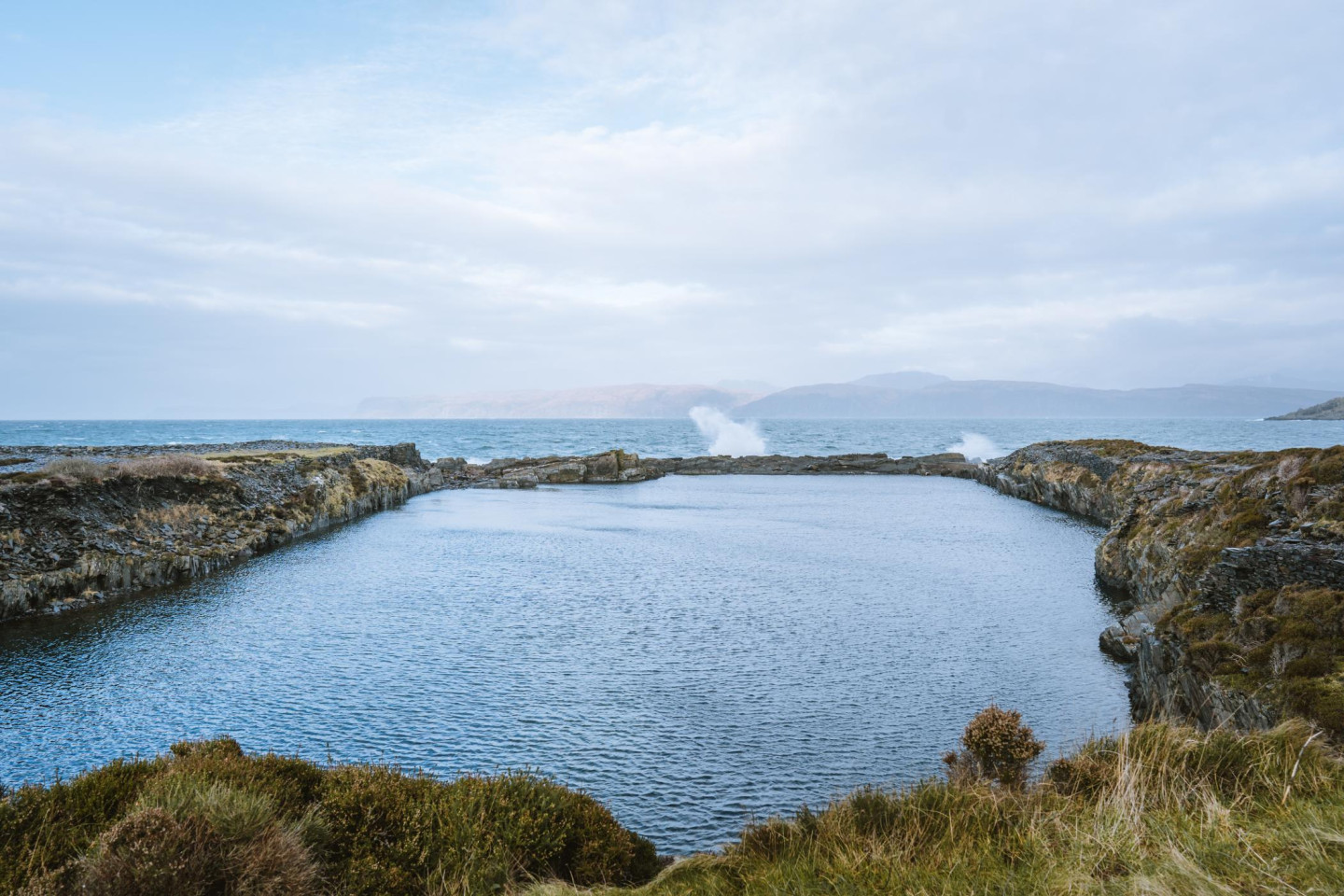
The mood is quite different in winter. The ferryman tells me that, other than a mainlander visiting her newborn niece, I’m the only visitor that day. The air smells of smoke and brine as the islanders keep themselves cosy against the cold and the sound of the wind and waves crashes everywhere. I first notice that it’s raining when the slate I’m looking at starts to polka dot with wet. “It’s different to summer,” the ferryman says. “But it’s got it’s own gloomy beauty.”
Like Dorothy, I follow the yellow arrow path back to the sea pools. I’m surprised to find they’re the same bright turquoise. I thought perhaps they’d darken with the weather and reflect the moody clouds above. The thought of dipping into one sends a shiver up my spine. It’s easy to imagine something more sinister than the tiny fish lurking in the water, especially when you know that the quarries were mined to a depth of up to 300 feet.
Facts like this and plenty more can be learnt at the island’s museum, although it’s only open in winter by arrangement. You can see photos from before the storm of the quarries looking much more quarry-like, with cranes and pulleys at perilous angles on the slate slopes. It must have been a hard way of life, mining for slate through all weathers. My favourite fact is that the quarrymen dug so deep that they were nicknamed ‘The Hellish Rabble’.
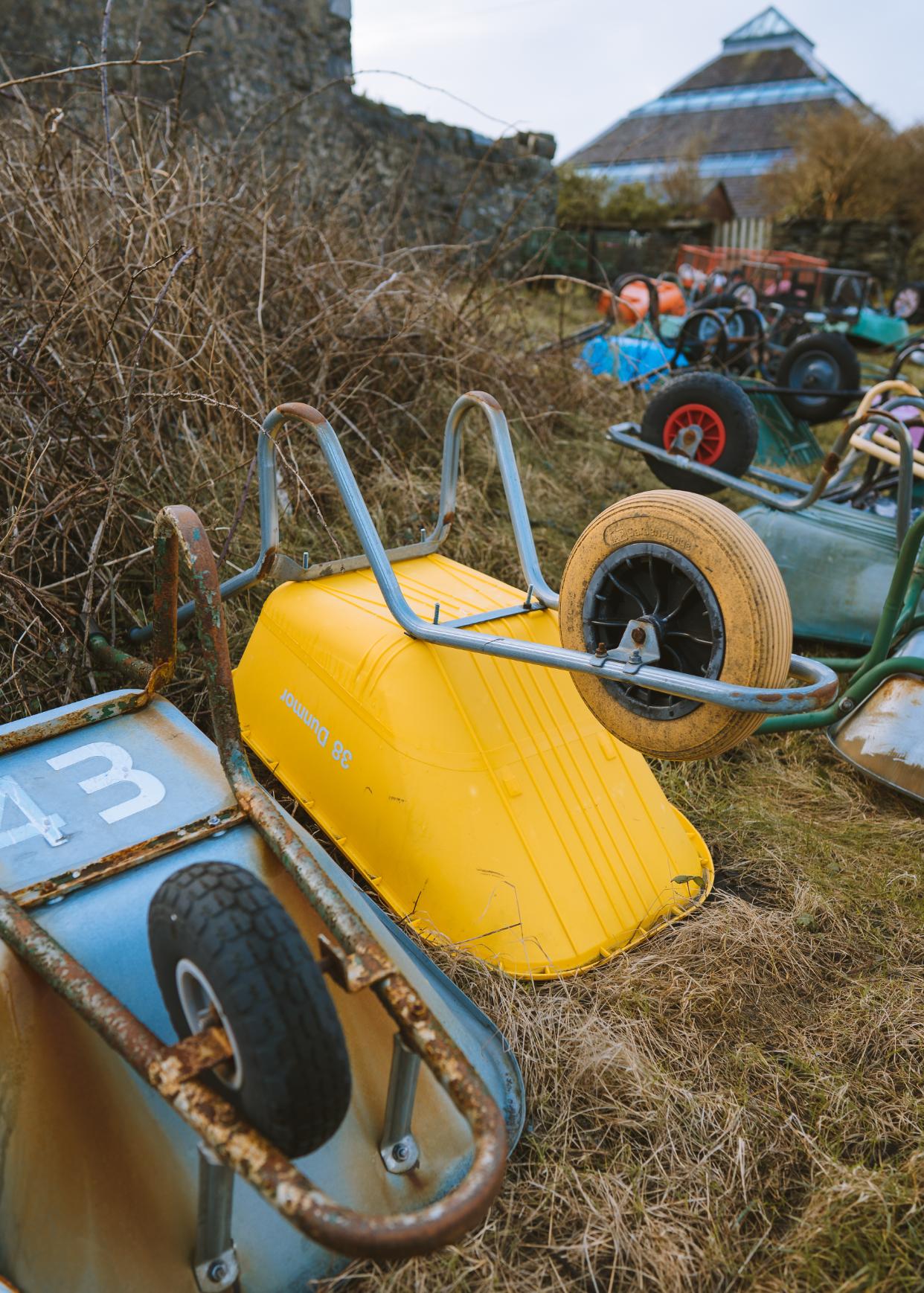
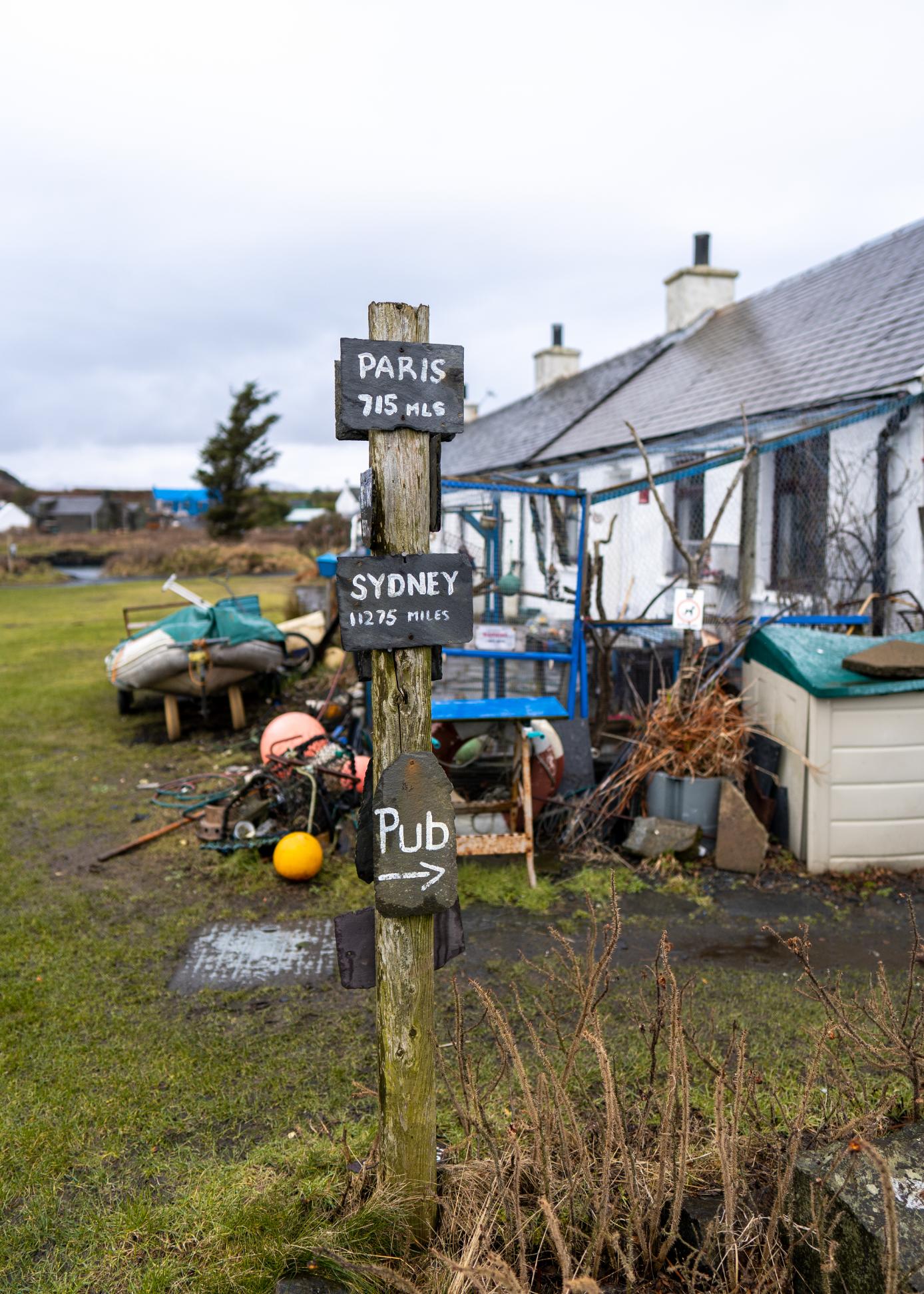
Chalk white houses with – what else? – slate roofs are the only accommodation on the island. Many have been restored from the original quarry workers’ lodgings and they look built to hunker down in, preferably with a dram of whisky. Many have brightly painted doors and colourful wheelbarrows outside to help you carry your luggage – the island is completely pedestrianised. A signpost proudly points the way to Paris, Beijing, Sydney, and the island’s only pub, The Puffer. It’s just changed hands, but will continue to offer food, drinks and Scottish hospitality to the travellers that the island welcomes across.
Once a year, in non-pandemic times, the number of visitors swells when Easdale hosts The World Stone Skimming Championships. Every year in late September, skimming aficionados take advantage of the sheltered pools and abundance of flat rocks to see who can skim a stone farthest across the Skimming Quarry. It’s the kind of gloriously eccentric event that cheers the heart to know it still exists.
For such a small place, Easdale leaves a deep impression. Its otherworldly landscape tells a story of dying industry, freak weather and island resilience if you just dig a little beneath the surface.
Promoted Post
The Scullery
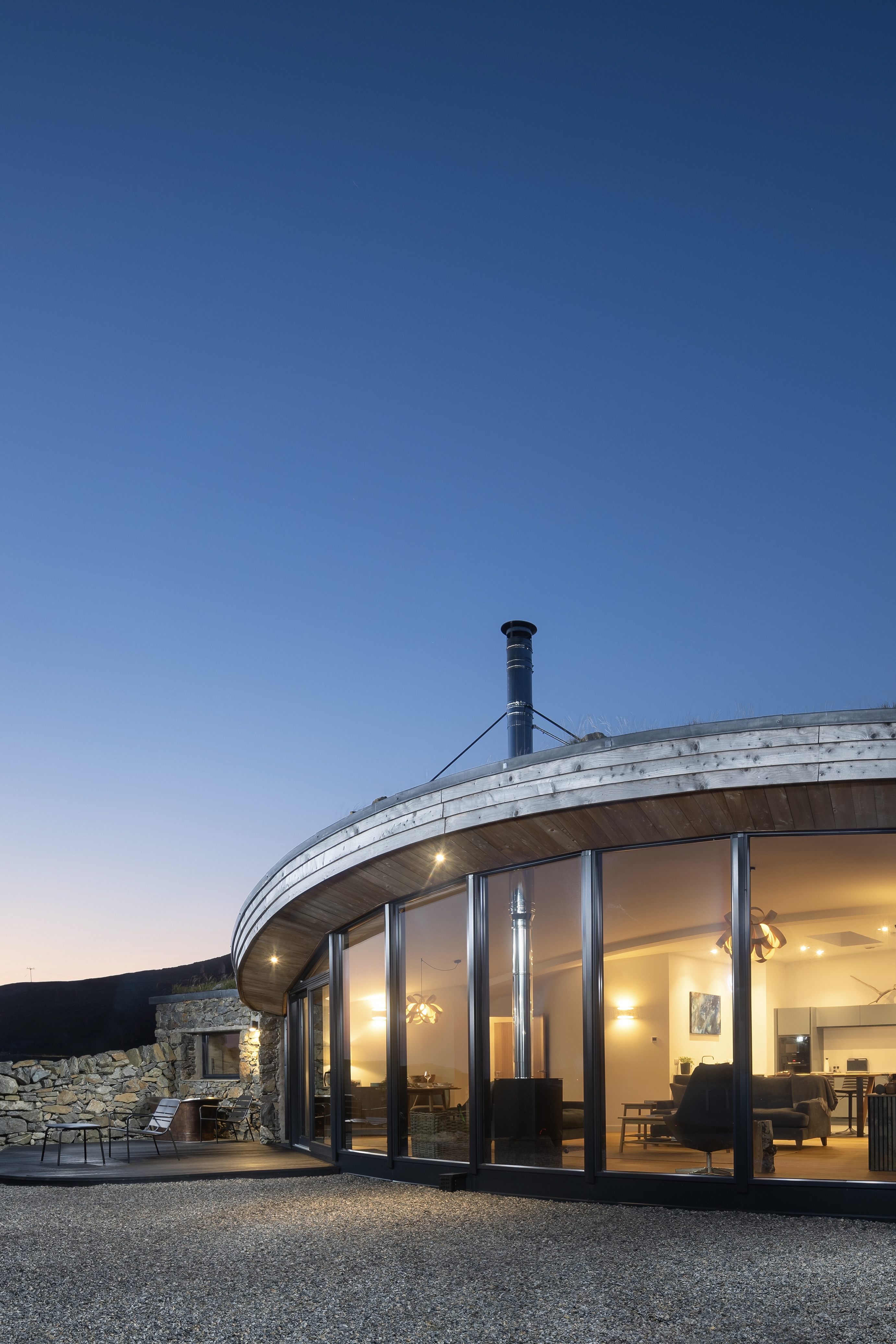
Tucked away in the heart of the Yarrow Valley, The Scullery is a one-bedroom boutique hideaway, eloquently designed for comfort, calm, and connection. Whether you’re escaping the city or craving a countryside reset, this is your space to slow down and just be.
-listable-carousel-1769292770.jpg)
-full-1748964954.jpg)






 Sign in with Google
 Sign in with Email