
Blue Cabin by the Sea
Reached by way of quiet adventure, this secluded cabin stay is guided not by itinerary but by atmosphere. A place to pause, breathe and simply be – where family time meets the living heritage of the harbour it calls home.

Written by Karla Hall
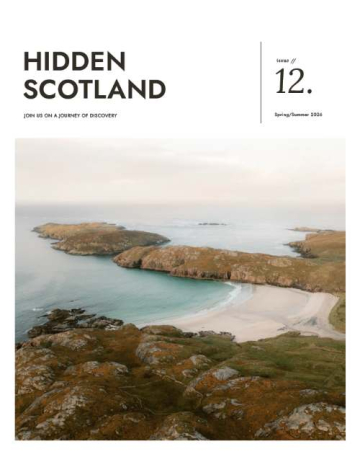
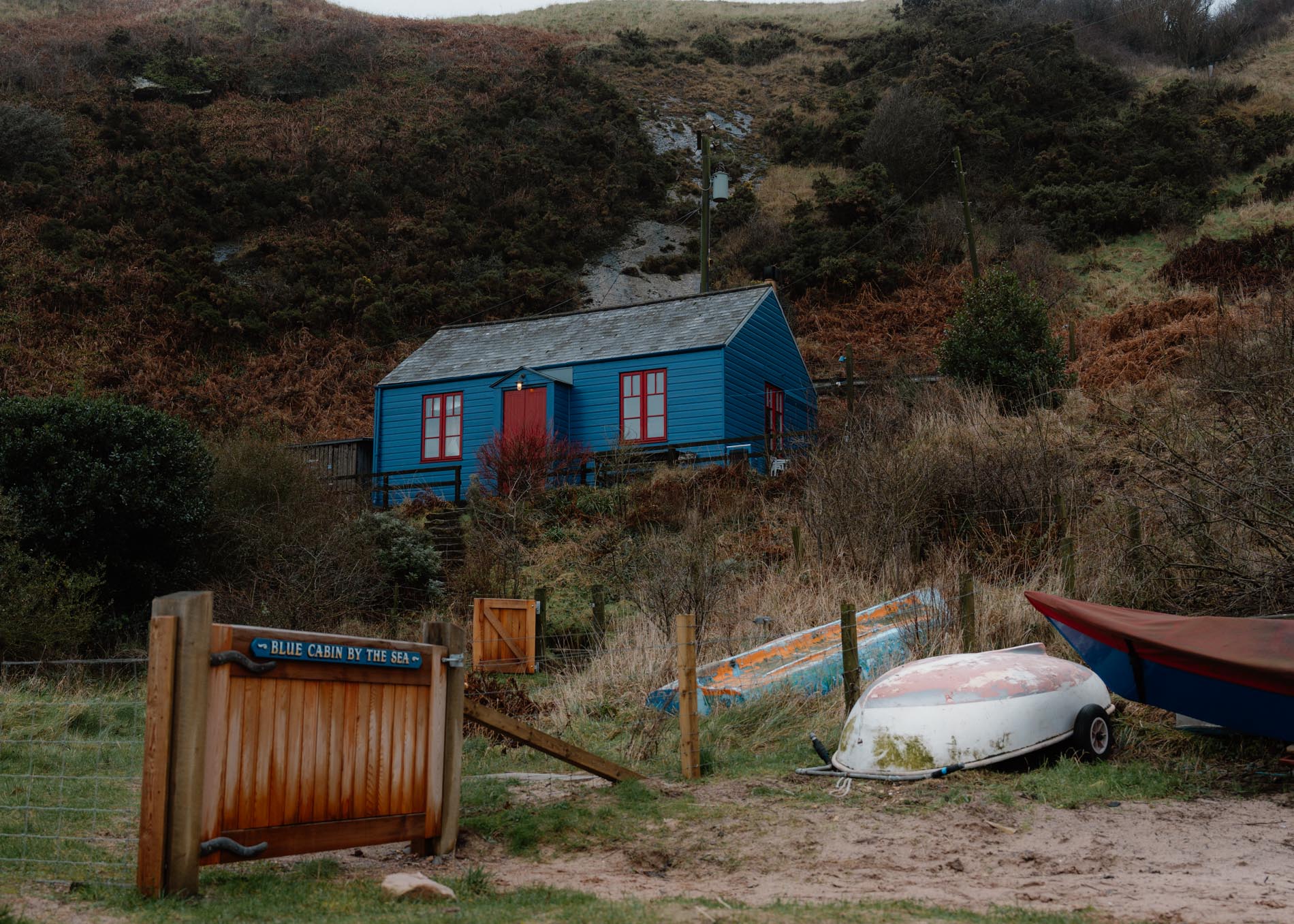
There are spots along the Scottish coast that can make you feel a certain way. They have an atmosphere that takes you out of time and slows life down, a mood that makes you feel as though you’ve been waiting for years to walk their shores. These are places of little fanfare but big views, places where the sky billows out forever, the waves roll rhythmically against the sands, the fishing boats drift in and the rest of the world feels somewhere else altogether.
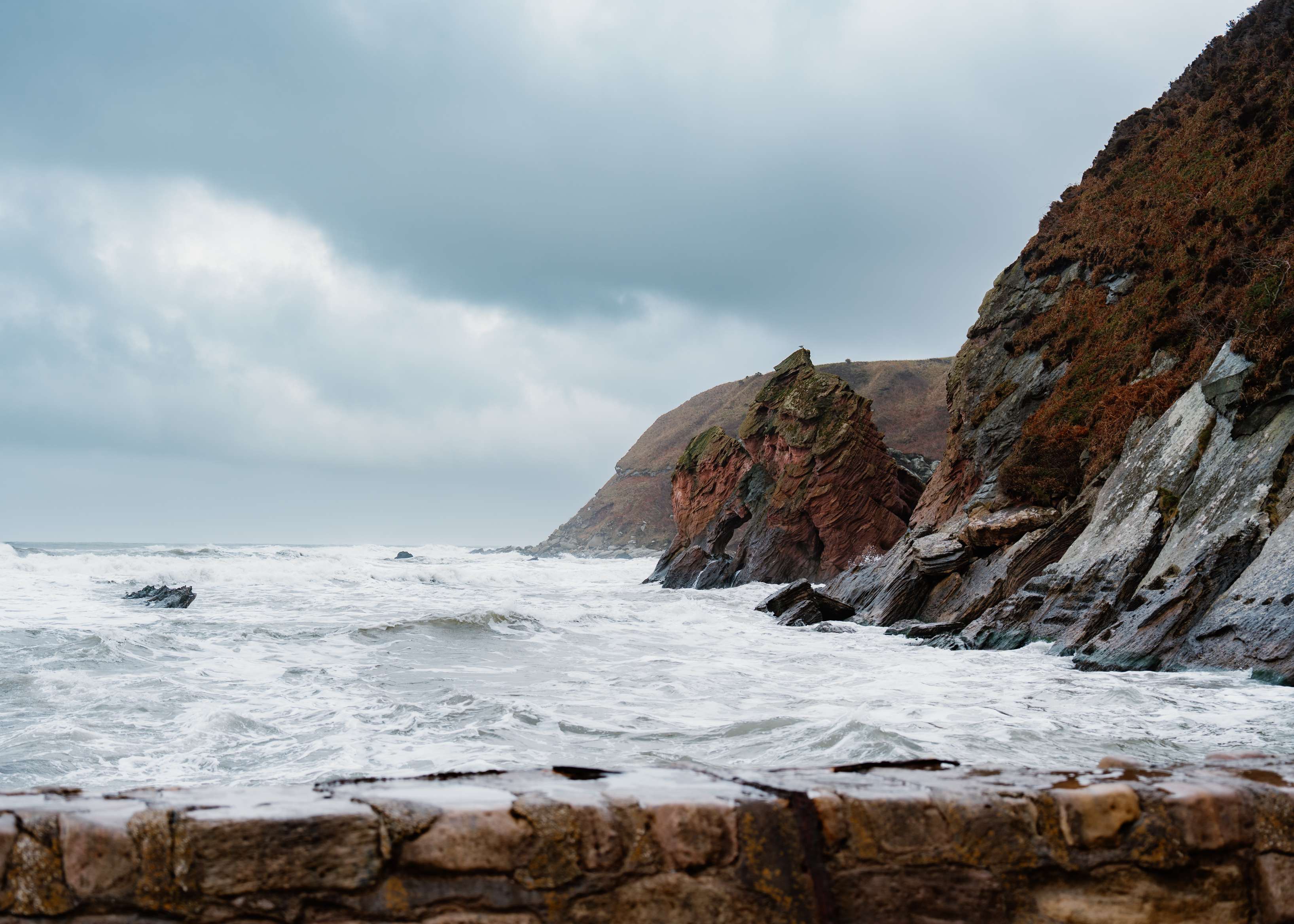
Such is the way with a particular harbour in a historical but well-hidden bay south of Dunbar, around an hour east of Edinburgh. It’s reachable only by sea or by walking through a dark, rock-cut tunnel. It has no pubs, no fish and chip shops and no amusement arcades: it has nothing, in fact, save for a soft crescent beach, curved harbour walls and a scattering of seafacing buildings. And it was to one of these buildings, the fittingly named Blue Cabin by the Sea, that we felt drawn in January.
The winter had been a cold one and our rural Aberdeenshire home was almost snowbound. Living where we do is frequently a joy, being surrounded by pine forests and nature trails, but when the idea of taking a New Year’s break to the sea was suggested – coupled with the prospect of falling asleep to the white noise of the waves – we were pulled towards this coastal corner of the Borders.
Our family of three – my partner Jack and I and our young son Aedan – left home on a drizzly Friday lunchtime with a packed boot and a rucksack full of diggers and tractors for the beach. By the time we’d made our way south over the Cairn o’ Mount and across the Queensferry Crossing – one of the crowning glories of the brilliant engineer Naeem Hussain – with a couple of unrushed pitstops en route, the sun had set. It was dark when we reached our destination – a fitting welcome, perhaps, to somewhere that by its very nature keeps itself concealed.
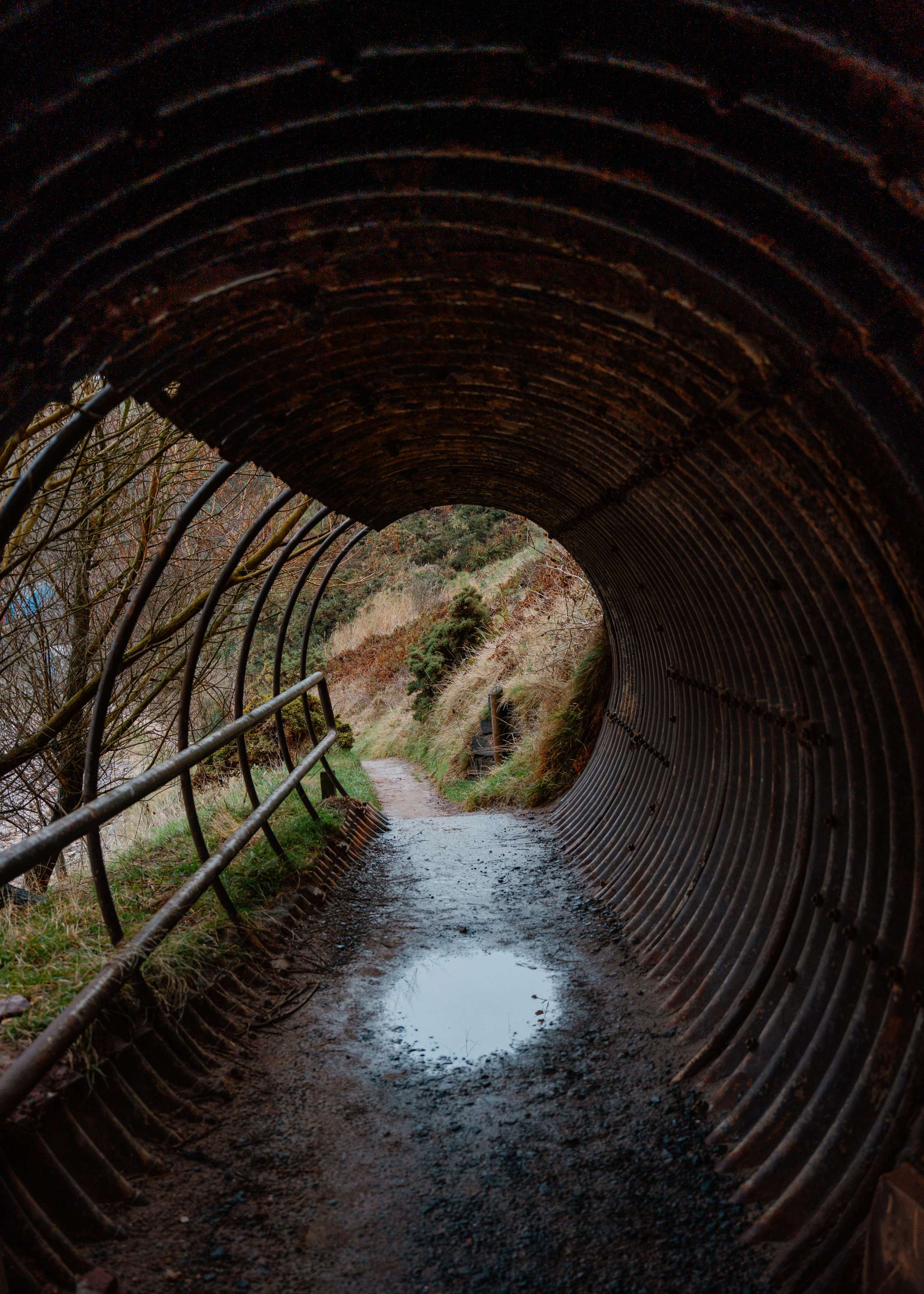
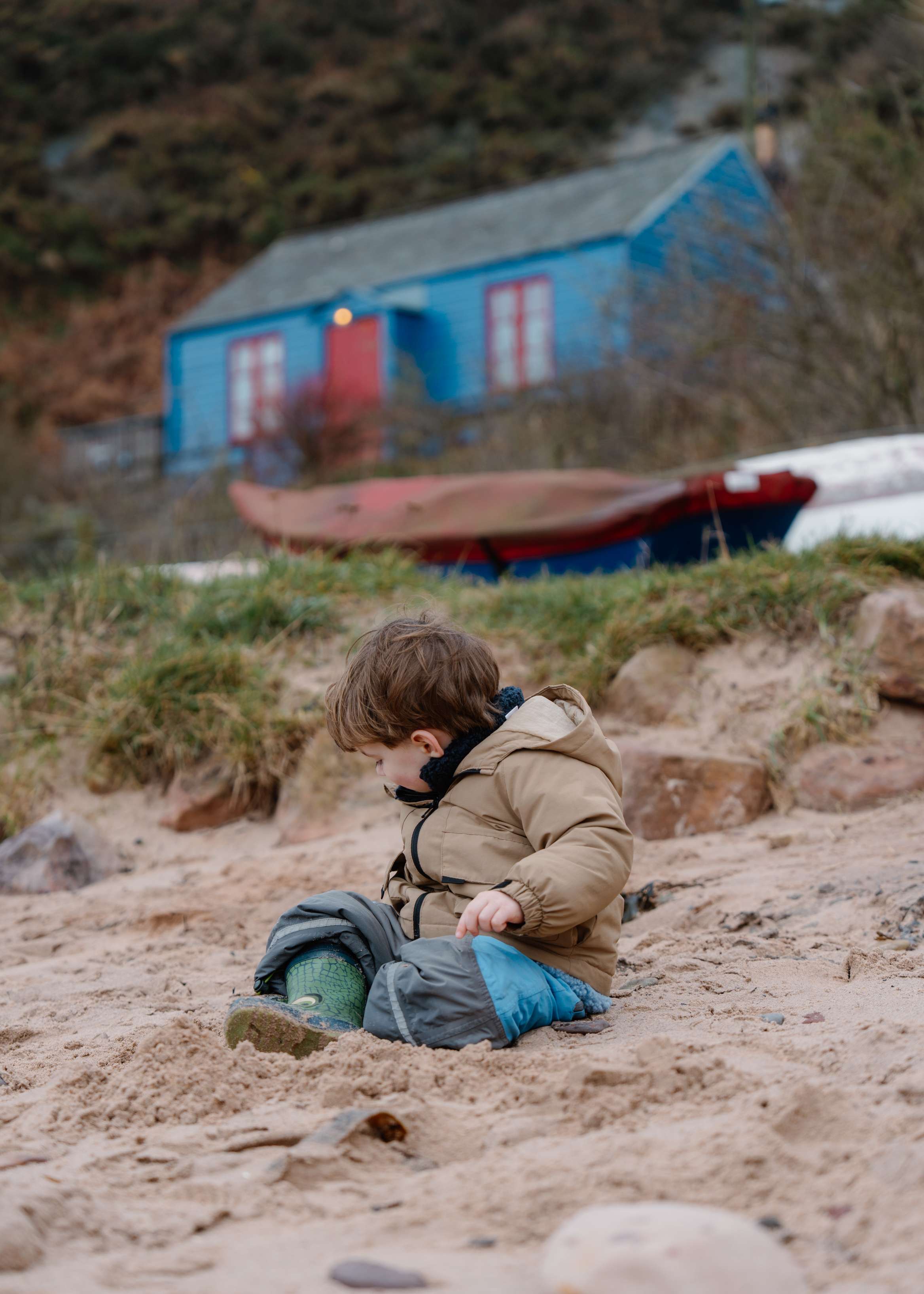
The pre-arrival information we’d received from cabin owners Ben Tindall and Jill Watson meant we knew what to expect: a walk to reach the cabin, a wheelbarrow to help with luggage and a secret tunnel to find by torchlight. Aedan threw himself into the adventure, splashing his way through inky puddles in his crocodile wellies as – the tunnel now safely located – we headed towards the sea, the crash of the still-invisible waves growing louder.
Then, just like that, the tunnel gave way to damp evening air as we emerged into the harbour. In front of us, a narrow footpath led us down towards a dimly lit bay and a small gate. Adorned on the gate in bold traditional signwriting were the words “Blue Cabin by the Sea”. We had arrived. It felt like a victory. Boots off. Kettle on. Stove crackling. And relax.
When you reach a destination late at night, waking up the next morning can sometimes be disorienting, your mind playing catch-up as you look around at your surroundings. Not here. As the January daylight seeped in through the curtains and the North Sea foamed against the foreshore, the cosy rooms around us already seemed like home. We were somewhere special. Time to explore in daylight both indoors and out.
The bracing sea air hit us as we stood on the cabin’s outdoor terrace. Gulls wheeled offshore. Around us was coastal greenery sloping down to an empty beach and beyond it the waves. The whole scene – sights, sounds, scents and all – could have been taken from any point in the last 200 years. It felt soul-lifting.
It’s thought that the bay here has been home to some form of harbour since prehistory. There were numerous attempts to construct early piers, although the rock-cut tunnel that links the harbour to the outside world wasn’t built until 1752. The current piers – arranged like a pair of arms sheltering the bay from the open sea – were designed in 1828 and helped the dock briefly become one of the most important herring ports on the east coast.
The harbour’s past, however, is not without heartbreak. It was hit disproportionately hard by the infamous East Coast Fishing Disaster of 1881, its tight-knit community tragically losing 11 lives and three of its four boats. Jill, a renowned figurative sculptor, has erected a poignant artwork commemorating the disaster at the very top of the track leading down to the tunnel.
As Jack, Aedan and I wandered from the cabin down onto the rock-fringed sands, the little harbour had the air of somewhere with an importance belying its size. Jill’s husband Ben, a highly regarded architect, purchased the harbour from the council in 1991 to save it from development and conserve its character. Impressively, it’s still managed in a way that prioritises fishing and all profits from guests at the Blue Cabin support its conservation.
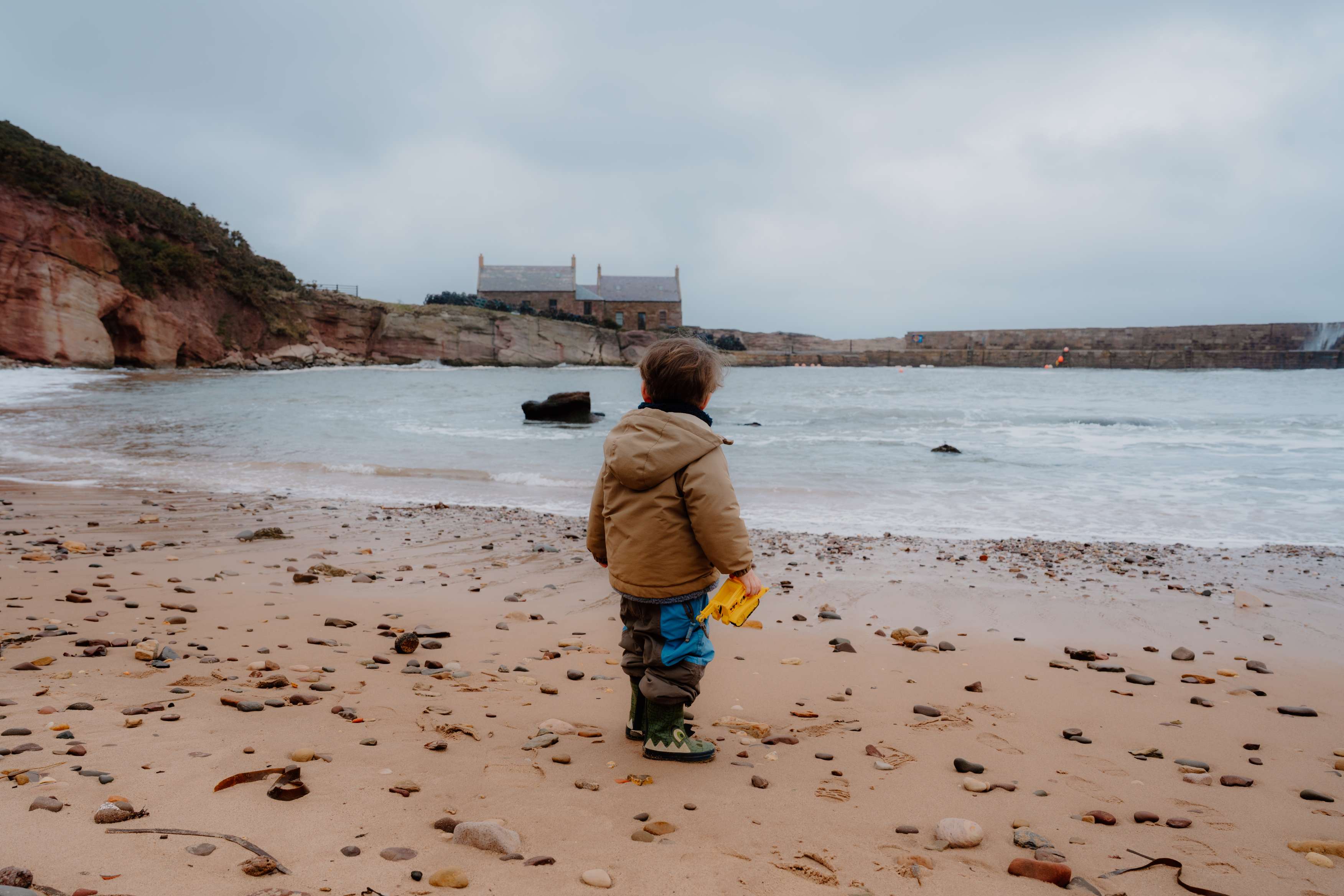
For Aedan, the modestly sized beach had the pull and potential of a vast coastal kingdom. He excitedly dug holes in the sand with his toy tractors, burying treasure and building castles. We peered handin- hand into rockpools and marvelled at the fact that we had an entire beach and harbour almost to ourselves. We combed the tideline for shells and seaweed, then later took them back to the cabin to use as stencils, before returning them to the sand.
The cabin was like a magnet, in fact, its charm and proximity meaning it routinely pulled us back from our beach wanderings. Paintings show it was built in the 1880s and found use as an out-of-theordinary holiday chalet circa-1920s, although today its gorgeous styling is the work of Ben and Jill.
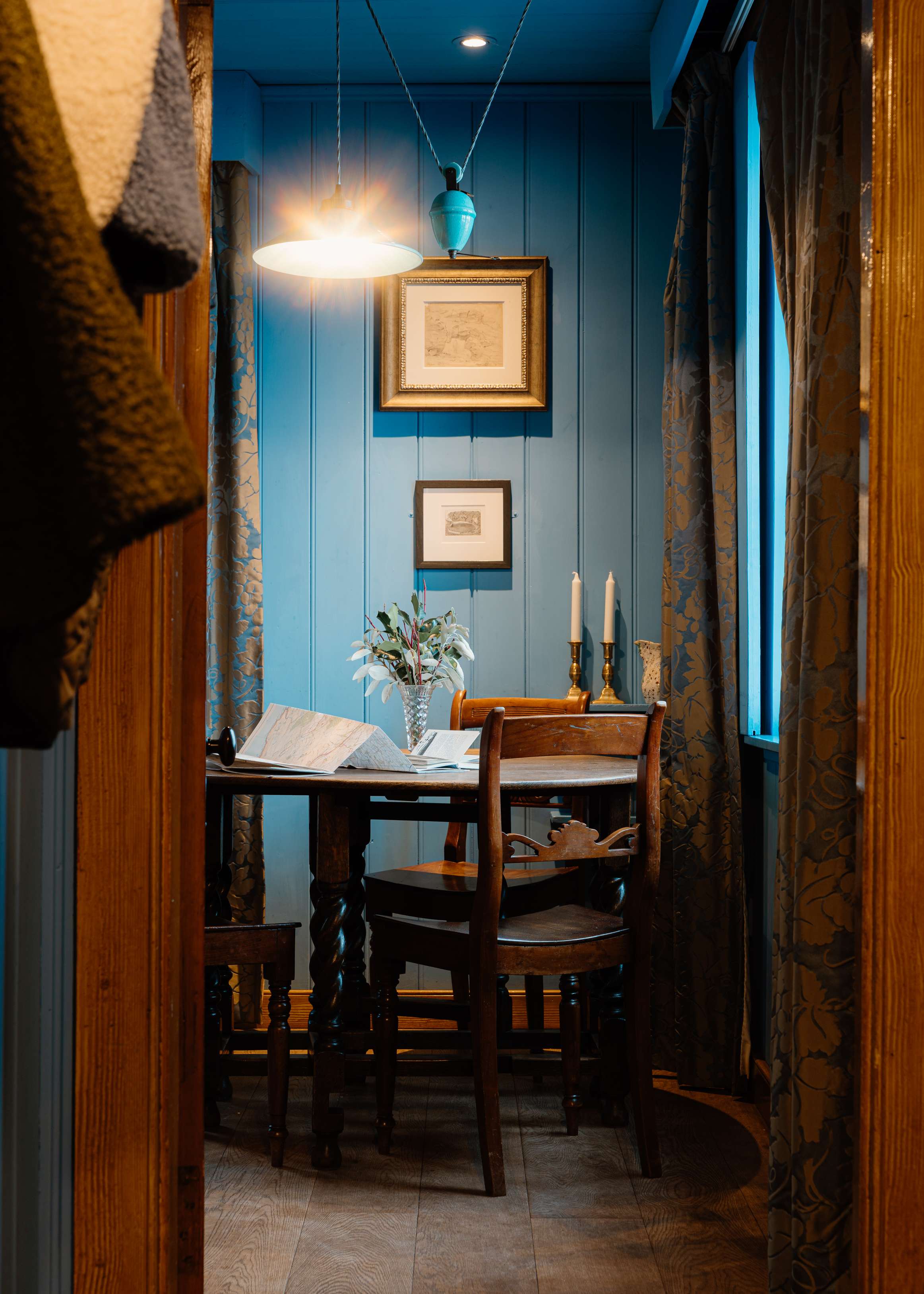
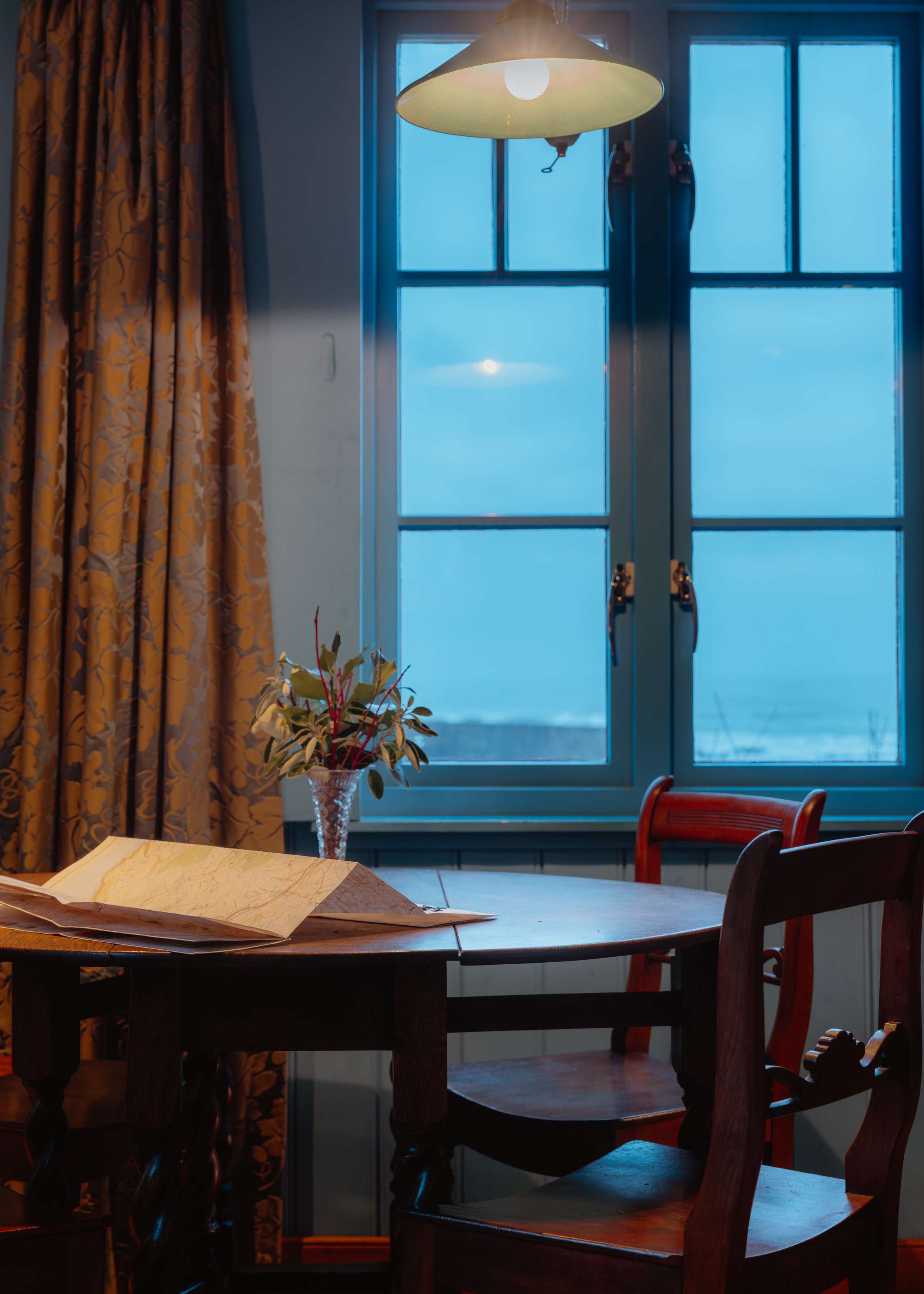
The cabin is aptly named. Its bright blue exterior comes from a richly hued paint also used on local fishing vessels. The same striking colour was very much in evidence inside the cabin, paired with an equally bold green. The cabin sleeps four and when the couple designed it, they imagined it “as belonging to a retired sea captain who’d travelled the world”.
This storybook romanticism was evident in every room, with artworks, books, trinkets and antiques turning it into a nautical mini-universe of its own. I was especially fond of the woodcut print of the Blue Cabin, handprinted on Skye by artist Kathleen Lindsley (highlandprintstudio.co.uk), a friend of Ben and Jill’s. Other standout design features included the maps that came down like roller blinds in the living room, a delicate shell-ringed mirror made by Ben hanging above the fire, a handsome pair of wooden-framed, straw-backed Orkney chairs and a comfy ship-style box bed – decorated with seaweed cutouts drawn by Jill and a joy to drift away in at night.
Aedan, meanwhile, was in his element in the specially designed bunk bed in the second bedroom. Reading him the cabin’s collection of children’s books on the top bunk – and listening to him craft his own adventure stories – is a memory that will stay with us.
His creativity ran wild, too, when it came to the winding rock-cut tunnel. Exploring it again in the daylight, we reimagined it as the stomach of a whale, its corrugated walls doubling as a cetacean ribcage. In all sorts of ways, Cove Harbour is a glorious place for letting your imagination set sail.
We learned, indeed, that writers, painters and other creatives have found themselves drawn here for generations. The radical young modernist artists known as The Glasgow Boys were inspired by the area at the end of the 19th century and in more recent times the bay's hushed character and picturesque location have seen it appear on screen in various TV and film productions.
In honesty, this all came as no surprise. There was something about the harbour’s salty-aired seclusion that had already worked its spell on us. Some holiday homes serve mainly as bases for the wider area – and it’s worth mentioning that there are ample diversions and local walks close by, from clifftop coastal paths and wooded valleys to the famed sandstone geology of Siccar Point, where James Hutton’s 18th-century observations changed our perception of science and deep time – but we were more than content to stay put.
Our stay became shaped by our surroundings: the clouds, the rocks, the beach, the waves, the birdlife, the comings and goings at sea, the cherished hours of not needing to be anywhere else anytime soon. We cooked when we needed to and ambled back down to the sands when the fancy took us. Nothing was rushed or overscheduled. It was a luxury in the truest sense of the word.
Before leaving, we met Ben and Jill in person. It was a reminder of something significant: if there’s anything that our six-year journey of publishing Hidden Scotland has taught us, it’s the people who truly make a place special. They were warm, welcoming and brimming with stories.
The harbour still depends on the generosity of donations – and profits from the Blue Cabin – to fund its ongoing repairs and renovations and we can confirm this much: when somewhere is this adept at capturing your heart, it needs preserving.
Hidden Scotland readers can enjoy an exclusive discount at The Blue Cabin by the Sea. Quote “Storybook” when enquiring to redeem the offer. bluecabinbythesea.co.uk
Promoted Post
Eagle Brae
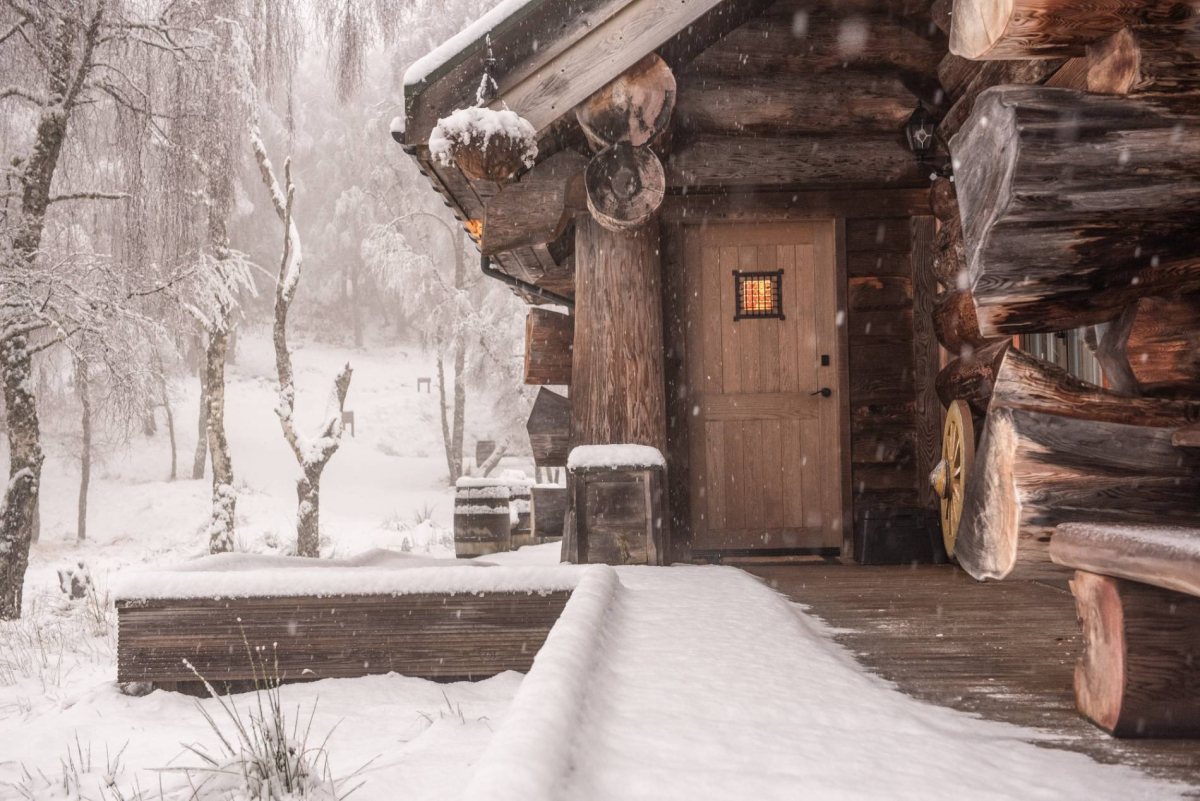
Escape to Eagle Brae, a secluded collection of Highland log cabins near Beauly. Handcrafted cedar, big skies, and deer on the hillside, with a fireside welcome that makes it easy to slow down.
-full-1748988291.jpg)
-full-1744927319.jpg)
-full-1746434816.jpg)
-full-1741009545.jpg)






 Sign in with Google
 Sign in with Email