
Discovering the nooks and crannies of Dumfries and Galloway
The southernmost region of Scotland is the country’s least populated and most underestimated. Spectacular walks, characterful high streets, surprising tales from history and a thriving producers’ scene all find their place against a backdrop that features one of Britain’s loveliest coastlines and its largest Dark Sky Park.

Written by Ben Lerwill
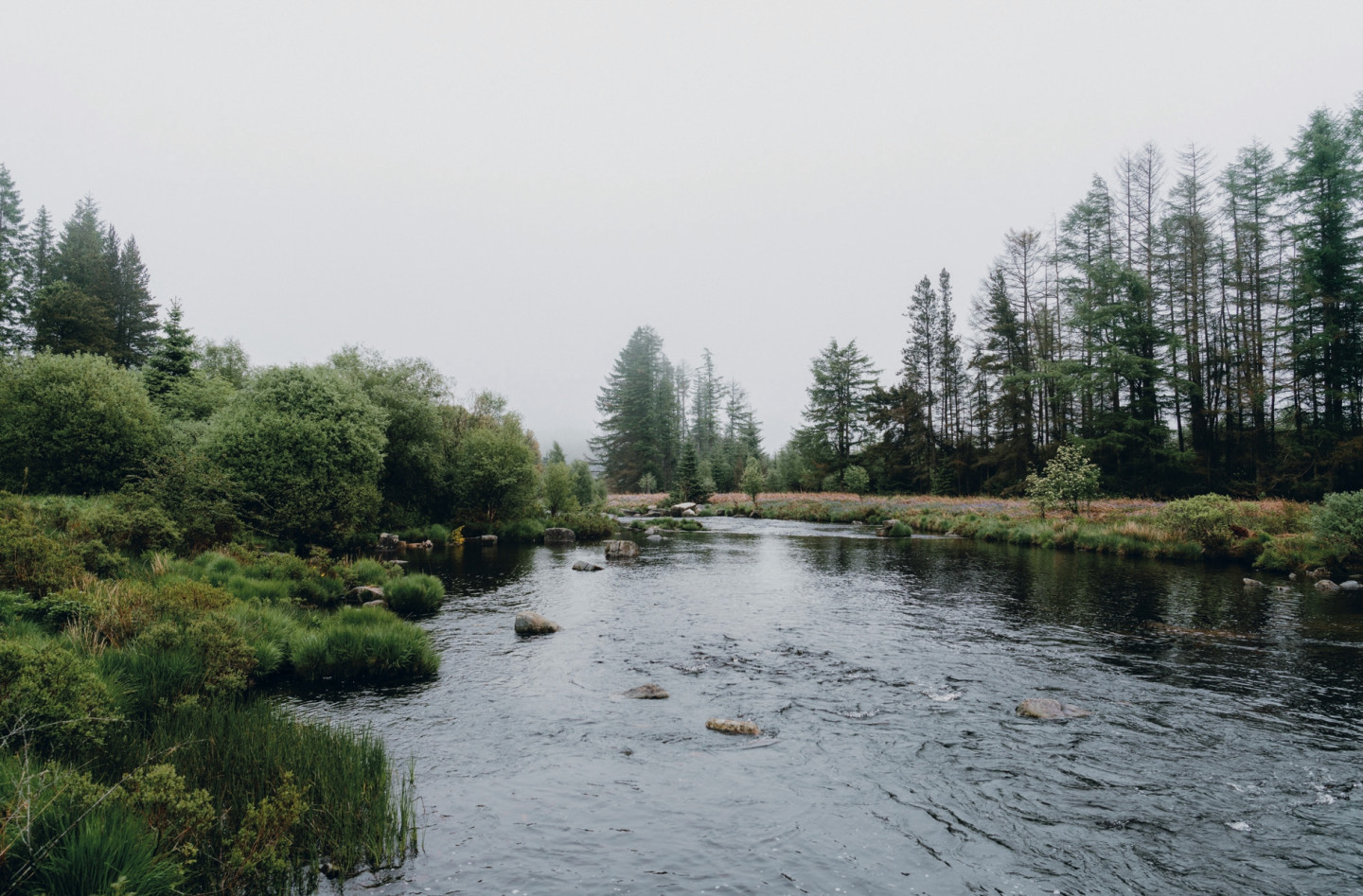
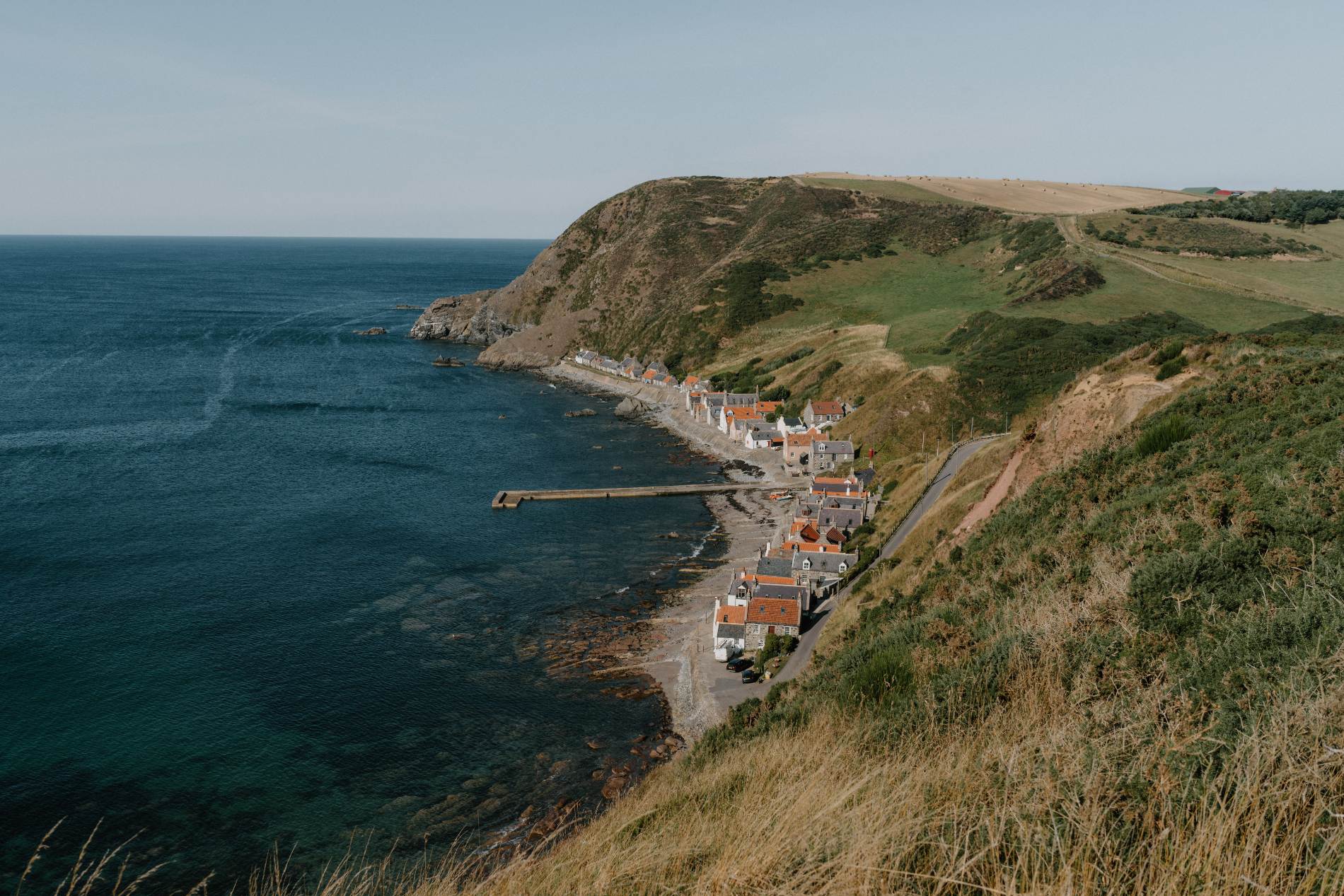
Dumfries and Galloway is unspoiled and remote, quiet and authentic. It’s often known as ‘Scotland’s forgotten corner’, which is a compliment rather than a snub, as for those who turn left at Gretna Green, leaving the throng heading north, it’s like being given the keys to the Secret Garden. It’s a land that might have been penned by a writer, where gorse glows gold atop rugged granite coves, trees are cast horizontal by the wind on clifftops that drop onto treacherous shifting sands, black cattle with wide white belts graze in gloriously unkempt meadows, and whitewashed fishing villages bask like paperchains beside cyan waters. Flowers are as vivid as the eye can imagine – explosions of pink fuschia and orange montbretia – and the hills are huge and remote with views over lochans, rivers and wooded valleys. Such light and colour; such big skies and openness.
From its border with Ayrshire, the region climbs over the Lowther and Moffat hills, and summits southern Scotland’s highest peak, Merrick, before tumbling into the Nith Estuary with its woodland and merse. It takes in former coal mining villages and moorland and spills onto one of Britain’s most dramatic coastlines – 200 miles of it. You can see the Lakeland fells to the south; to the west, from Scotland’s southernmost point of land, the outline of Ireland is visible; and in between, there’s the Isle of Man. This proximity gave rise to smuggling in the 1700s and 1800s, and on a moody day you can imagine smugglers huddled in the coves waiting for the right tide. Some reports suggest that the majority of goods smuggled into Scotland landed on this coast.
The hub of the region is Dumfries, the ‘Queen of the South’, famed for its connection with Robert Burns, who farmed, worked, wrote and drank in the town in his final years. And then there’s historical Annan, which has strong links with Robert the Bruce; ‘Food Town’ Castle Douglas; ‘Artists’ Town’ Kirkcudbright; ‘Scotland’s National Book Town’ Wigtown; the characterful port Stranraer; and Moffat, with a lively cultural scene amid hills that have been dubbed the ‘mini Highlands’. The towns feel lived-in and warmly welcoming, places you’ll be glad to while away time in cosy surrounds.
If beyond the towns Dumfries and Galloway feels quiet, it’s because this vast landscape (it’s almost 2,500 square miles) contains one of the country’s smallest unitary authorities: there are just 60 people per square mile. But there is a thriving community and an abundance of small businesses. The locals have a reputation for being friendly, as Fiona Lee, who runs art tours in Kirkcudbright, describes: “Dumfries and Galloway people, like the landscape, are gentle and welcoming. All kinds of people, from farmers and fishermen to artists and dot-com entrepreneurs, rub along together with little dispute, rather a robust sense of humour, and the odd dram as well.”
As one now-local puts it, the county is not to be underestimated: “I moved from Cornwall to Dumfries and Galloway. People always say how beautiful Cornwall is, but I honestly think Dumfries and Galloway has spots that are just as lovely (and much less expensive and busy!).” Cornwall it is not; Dumfries and Galloway it is. However you choose to experience it, once sampled it will have you coming back for more.
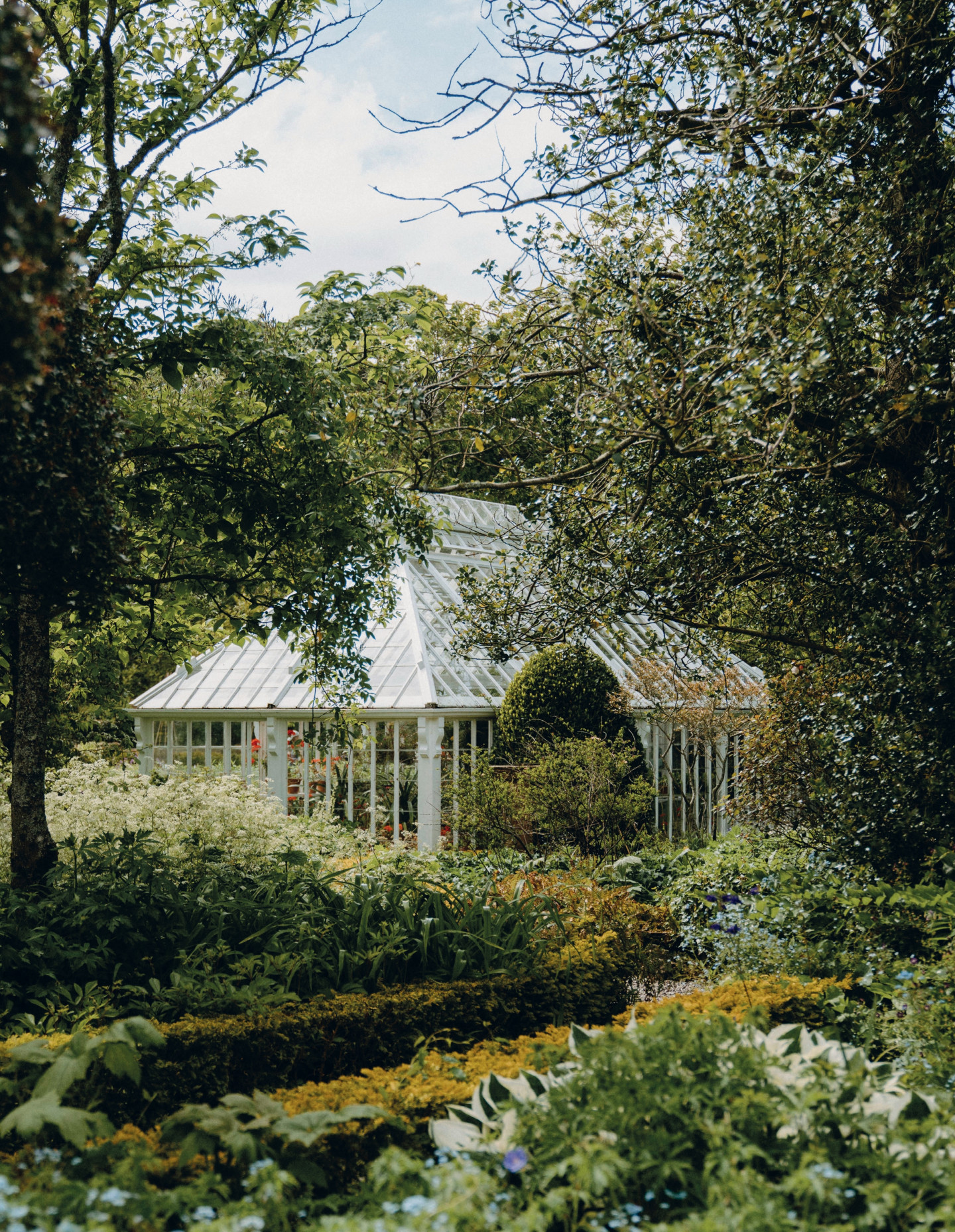
“it’s like being given the keys to the Secret Garden”
History
There’s more to Dumfries and Galloway’s past than runaway lovers getting hitched at Gretna Green. The fields and hills and castles and seas tell tales of drama and intrigue – of Prehistoric nomads, Viking settlers, early missionaries and bloody battles. Nowhere escapes a connection with a notable historic figure. To name but a few – in the 13th century, William Wallace chased the English army out through the Nith Valley. Robert the Bruce was descended from the Lords of Annandale, and John Paul Jones, the founder of the US Navy, was born on the Solway Coast in 1747. Kirkpatrick Macmillan invented the bicycle here in 1839 and pioneering female engineer Dorothée Pullinger designed The Galloway – “a car built by ladies for those of their own sex” – in the 1920s near Kirkcudbright. Thomas Telford, who laid the foundations of the Industrial Revolution, was from Eskdale, and you can see his first major Scottish bridge across the Dee at Tongland.
They say that the name Dumfries derives from the Viking “Fort of the thicket”, which translates into the Gaelic Dùn Phris. It was in the 8th century that the Vikings landed, eventually going on to settle, and without them, Dumfries and Galloway may have remained part of Northumbria. Their tale recently came to light following what has been described as “one of the most important UK archaeological finds of the century”, when a metal detectorist uncovered Viking treasures in a field close to Kirkcudbright in 2014. The Romans had set foot here before them – there’s stunning evidence of a complex of Roman forts at Glenlochar – and the Picts, Saxons and Danes are known to have made their way through. Earlier still, Prehistoric peoples left their mark in cup-and-ring carvings, standing stones and chambered cairns.
One of the region’s most fascinating tales is that of the early missionary St Ninian, who reputedly landed in Galloway at the end of the 4th century and established Whithorn on the Machars peninsula as an early Christian centre. The town is home to the Latinus stone – the earliest inscribed Christian monument in Scotland – and a 12th-century cathedral. Flying under the radar today, the relics of St Ninian would have been the destination of choice for anyone in mediaeval Scotland, according to Julia Muir Watt, development manager at The Whithorn Trust. “During the Wars of Independence, St Ninian appears to have been revered on both sides – for instance, he offered a cure to a wounded English soldier,” she says. She describes Whithorn as understated and underestimated: “It does not appear in the list of tourism hotspots and its history is often forgotten. However, that means you can really have a sense of discovery by finding out about it.”
In more recent history, Dumfries and Galloway played an important role in war work, going out on a limb to do the unexpected. Judith Hewitt, Museum Manager at war museum The Devil’s Porridge, says: “People think Scottish history is all about clans, tartan and castles and we are proud to be part of showing that there is a lot more to Scotland than that! Peaceful Dumfries and Galloway used to be a hub of industry and activity, of people making a vital contribution to war work. I think it is surprising that this happened here and that the work was done by women.”
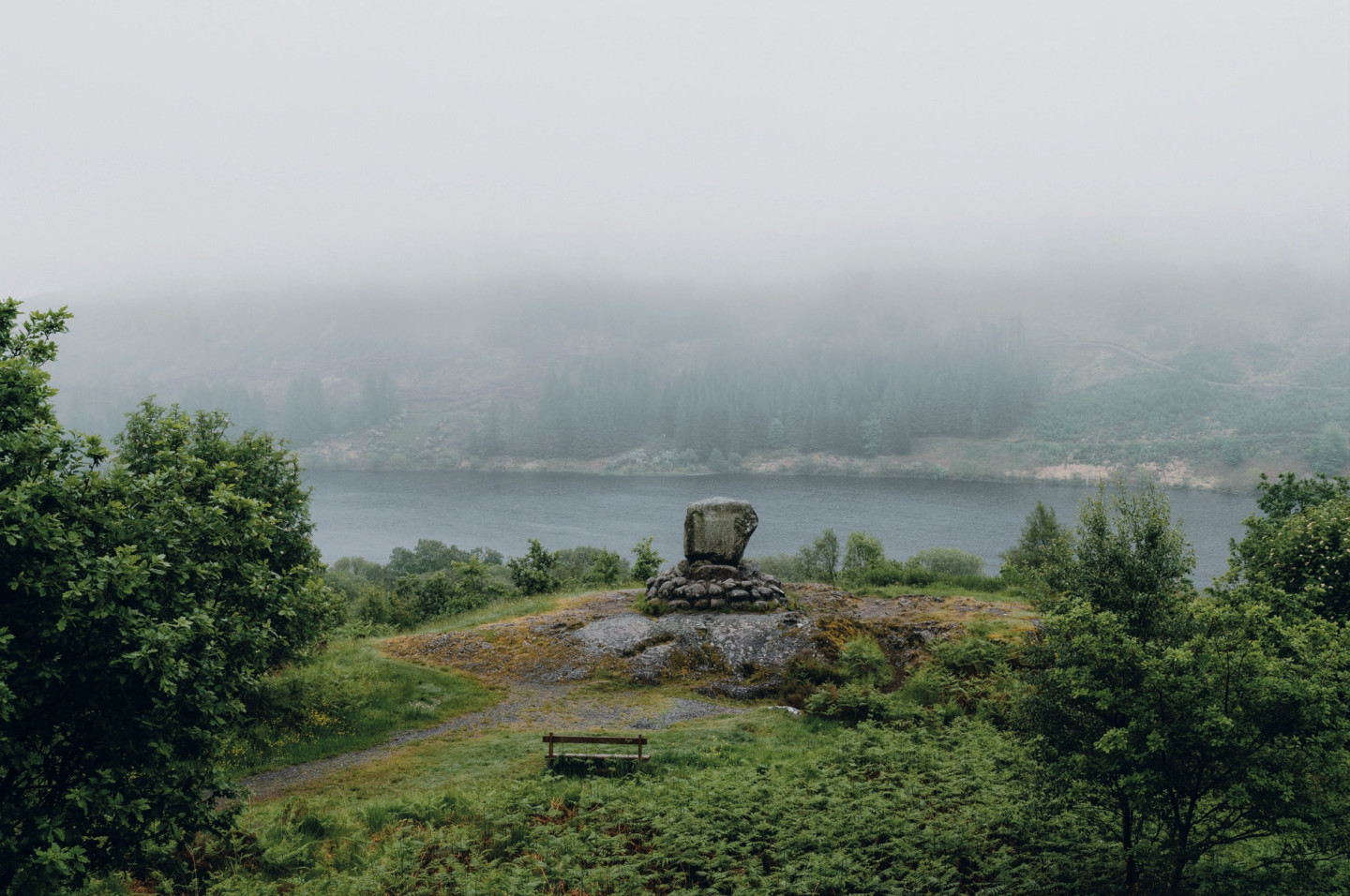
Bruce’s Stone & Loch Trool
HISTORY
see & do
The Devil’s Porridge
Eastriggs, Annan
Museum Manager Judith Hewitt reveals that a common misconception about the museum is that it is about porridge. “This would be fun,” she says, “but not what we’re about!” The term “devil’s porridge” is a nickname for cordite – an explosive propellant used in World War One in ammunition and shells. The term was coined by Sir Arthur Conan Doyle when he visited HM Factory Gretna (the largest munitions factory in the world during WW1) in 1916 and saw young women mixing a white, lumpy mixture that he thought looked like porridge. “But it was a devilish kind that exploded and killed your enemies!” says Judith. The awardwinning museum close to Gretna gives fascinating insights into World Wars One and Two, and the Cold War, focusing in particular on the role of young women. An exhibition about the work of Dorothée Pullinger is running until October.
Christianity in Whithorn
St Ninian is said to have built his Candida Casa in Whithorn in 397 AD. Now, the Priory Museum and visitor centre tell his story via a collection of ancient stones, remnants of the early church and some of its treasures. On the coastline you’ll find St Ninian’s Cave, which is said to have been his hideaway, and in Isle of Whithorn, 12th-century St Ninian’s Chapel. Later this year, The Whithorn Trust will be delving into the lives of the Medieval bishops who much revered St Ninian. “A 14th-century poem in Scots describes a feast day when the relics were carried on a circuit and devotees crowded round to touch the saint’s remains,” says Julia Muir Watt. For the Trust’s exhibition, “scientists will use ancient DNA testing to establish the hair and eye colour of the 13th-century Whithorn bishops. The face of one, Bishop Walter (died 1235), will be physically reconstructed,” she explains.
Discovering Robert the Bruce
Dumfries and Galloway is the Scottish monarch’s homeland. He was descended from the Lords of Annandale, though his place of birth is uncertain, and he slew his rival The Red Comyn in Greyfriars Kirk in Dumfries in 1306. At Dumfries Museum and Camera Obscura you can see a replica of his skull. Over on the shores of Loch Trool, with one of the finest views over Galloway Forest Park, Bruce’s Stone marks his first victory over an English army – the Battle of Glentrool in 1307.
Dundrennan Abbey
Kirkcudbrightshire
These are Gothic ruins to rival Rievaulx Abbey in Yorkshire – haunting stone shapes rising among secluded woodland – and it was from there that the monks who worshipped at Dundrennan arrived. The latter, though most famous as being the site where Mary, Queen of Scots sought shelter on her last night on Scottish soil, is special in its own right. As the major abbey of the Cistercian order in Scotland, it features beautiful carvings on its remaining stonework and has an unusual three-storey design. Look out for rare fairy foxgloves growing on the abbey walls in early summer – legend has it that the deep pink plant only grows where Roman soldiers once trod.
Sweetheart Abbey
New Abbey
Lady Devorguilla was a powerful princess of Galloway in the 1200s, but she had a heart – or two. The story goes that when her beloved husband John Balliol died in 1268, she had his heart embalmed and carried it with her to her final resting place in this abbey, built in 1273 to commemorate him. She named it New Abbey, but it was later renamed by monks as Dulce Cor, or Sweetheart, in recognition of the story. The red sandstone structure is largely intact and features a stone effigy of Princess Devorguilla.
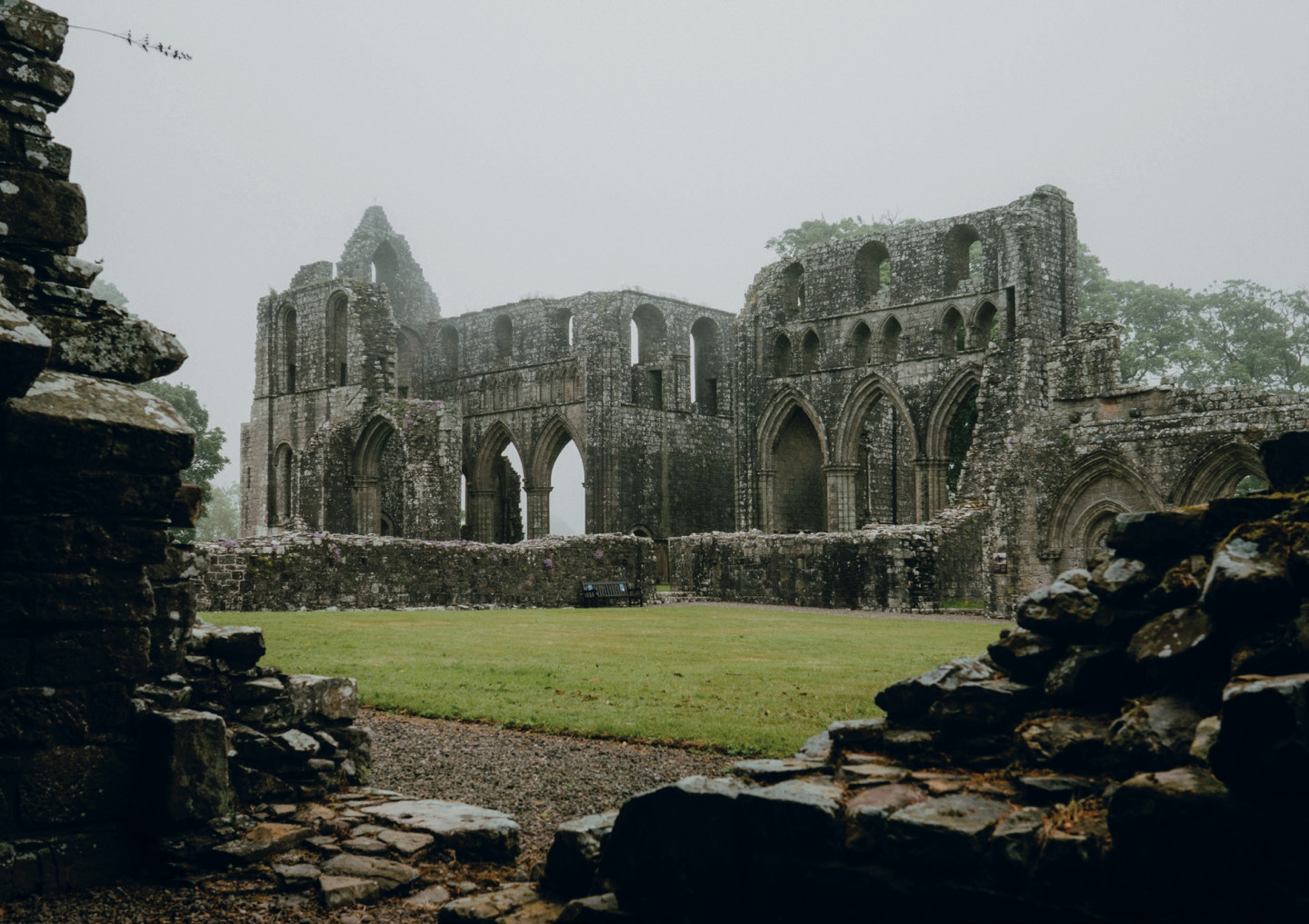
Dundrennan Abbey
Threave Castle (Castle Douglas)
Rising from the River Dee stands a forbidding tower that becomes more forbidding still as you arrive by boat. It has three-metre-thick walls and state-of-the-art timber battlements that kept out James II’s forces during the siege of 1455 – until the garrison reportedly gave in to a bribe from the king. It’s said that the island on which the castle sits was home to the ancient rulers of Galloway, but the tower was built in 1369 by Sir Archibald Douglas, aka Archibald the Grim – so-named by the English due to his terrifying appearance in battle. Like his father Sir James, who was Robert the Bruce’s close ally during the Wars of Independence, Archibald fought the English, but by the time of his death in 1400 had pacified them. The castle was later used as a prison for French prisoners during the Napoleonic wars.
Drumlanrig Castle and Estate
Nithsdale
Drumlanrig Castle recently rose to prominence when it featured as a location in the television series Outlander. The 17th-century structure is considered to be one of Scotland’s finest stately homes. It sits in the rural expanse that characterises Nithsdale, and incorporates 90,000 acres of wild parkland where you can spot otters, red squirrels and birds of prey. Inside, fine antiques jostle for space with Rembrandt’s Old Lady Reading, as well as works by Thomas Gainsborough, Paul Sandby and the Dutch masters.
Museum of Lead Mining
Wanlockhead
Wanlockhead, the highest village in Scotland, is reached by a steep climb (often into the clouds). At the lead mining museum here, you can go on the only underground mine tour in Scotland, exploring the 18th-century lead mine, visiting miners’ cottages and the miners’ library – one of three subscription libraries in Scotland set up by miners themselves – then trying your hand at gold panning.
The Merlin Trail
Moffat
This seven-day trail features 30 different sites based on 6th- and 7thcentury accounts of one of the last great druids, Merlin. Robin Crichton, who developed the trail, says: “Behind the legend is a true story of a man of learning who lived in what is now Southern Scotland.” Merlin’s existence is generally accepted by historians, but the details of events in his life incorporate fact and fiction, so the visitor is invited to play detective. “Whatever your conclusions, you will be enchanted by an intriguing mystery in a magical landscape,” Orcharton Tower, Castle Douglas says Robin. The route’s stages can be completed individually and have information panels. If you want to delve deeper, there is a permanent Merlin exhibition at Moffat Museum.
Thomas Carlyle’s Birthplace
Ecclefechan
This understated white stone cottage is where one of Britain’s most prolific 19th-century writers and social commentators was born. It contains objects from Thomas Carlyle’s childhood – among them his cradle – as well as his writing desk and an 80th birthday tribute signed by Victorian figures. The house is interesting: built by Carlyle’s father and uncle and known as the Arched House, it’s a good example of Scottish 18th-century vernacular architecture and has remained virtually untouched since 1881.
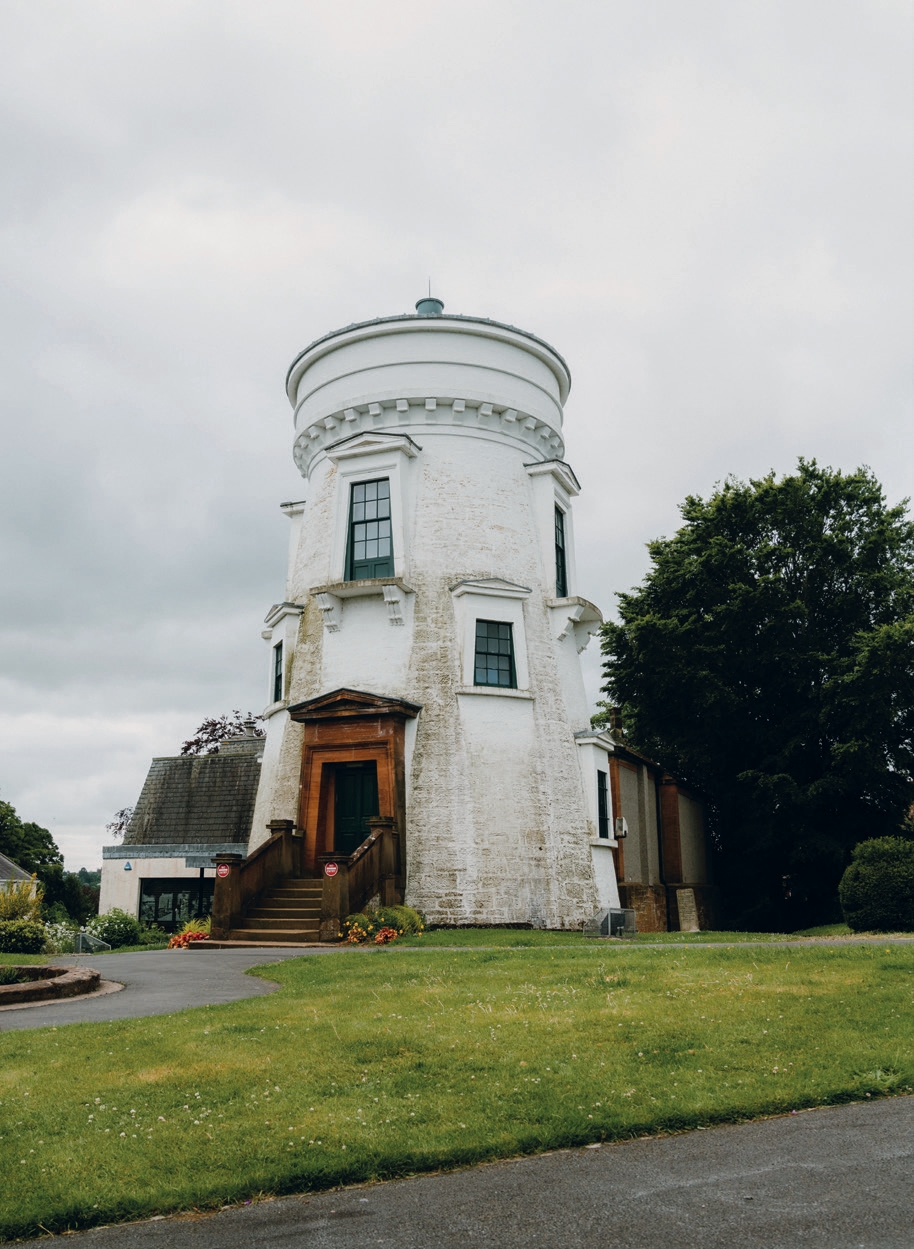
Dumfries Museum
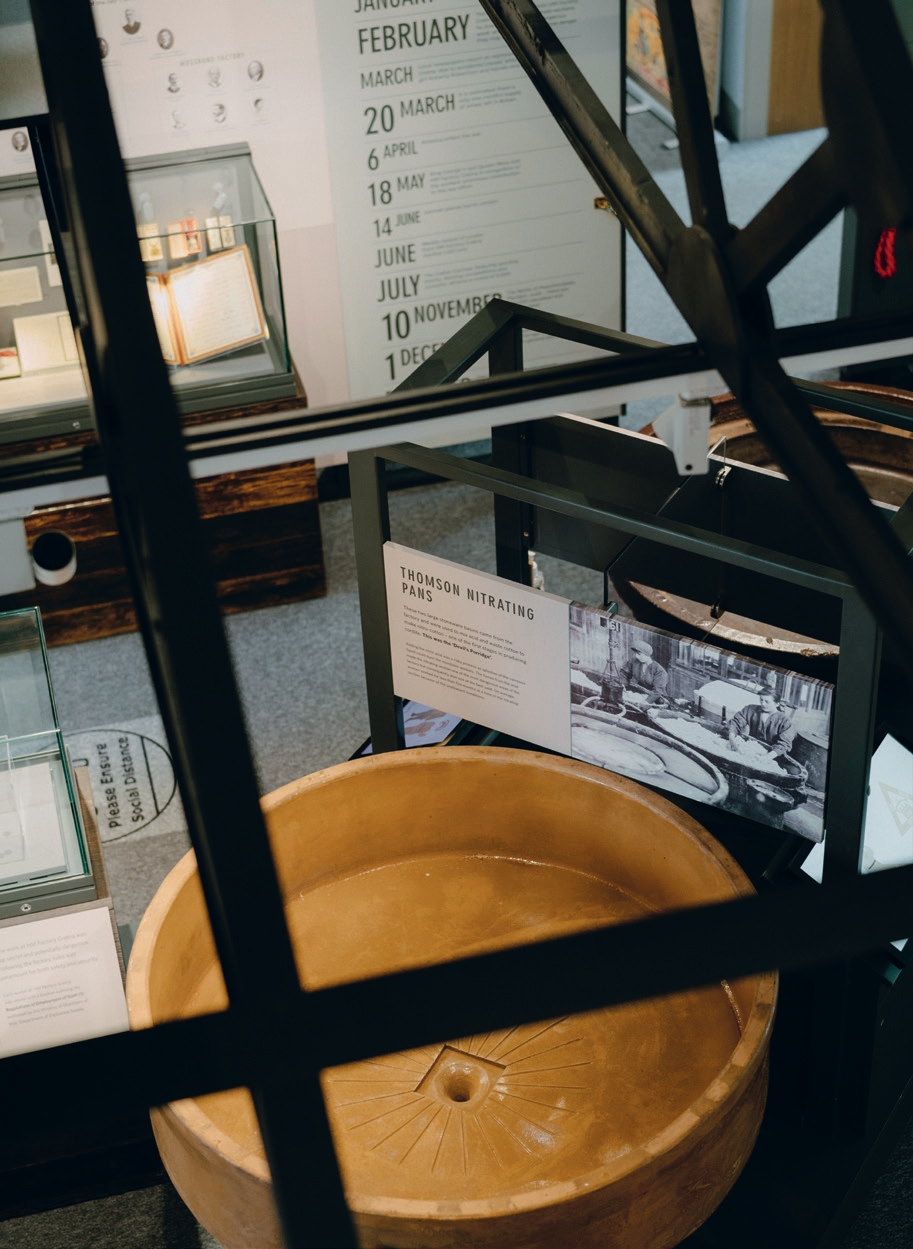
The Devil’s Porridge
History : look out for
Twelve Apostles Stone Circle
At 88 metres wide, this is the largest stone circle in Scotland. Only 11 stones remain but they’re magnificent, rising to two metres high in the rural landscape between Holywood and Newbridge.
Drumtroddan Cupand-Ring-Marked Rocks
These Neolithic or Early Bronze Age swirls were carved into bedrock some time between 3,500 and 1,000 BC. Much mystery surrounds rock art, but it is thought it may have marked territories.
Cairn Holy Chambered Cairns
Built more than 5,000 years ago and said to be the final resting place of the mythical Scottish king Galdus. Visit for lonely strolls and marvellous views over Wigtown bay.
The Devil Stane
Legend has it that this giant peach-shaped boulder on the Arbigland shore was spat out by the devil after he bit a chunk out of Criffel, one of the region’s summits.
The Moffat Ram
This mighty bronze statue, all curly horns and thick coat, peers across Moffat from its vantage point on a fountain. It was commissioned in 1875 to commemorate the town’s association with sheep farming but look closely and you’ll see it has “nae lugs” – as noted by a local farmer at the unveiling of the statue.
Garlieston Mulberry Harbour
In the months before D-Day, this port tried out prototypes of Mulberry Harbours, temporary artificial harbours used to protect supply ships off the coast of Normandy. Remains can still be seen on the shore.
Burnswark Hill
This landmark flat-topped hill, which rises 1,000 feet from the Solway plain, is thought to be where the first major battle of the Roman invasion of Scotland took place. There are superb views from the top.
-full-1748984984.jpg)
The Moffat Ram
Art & Culture
Dumfries and Galloway is reputed to have more craftspeople per square mile than anywhere else in the UK. The light on the Solway has inspired artists for centuries, the region is home to Scotland’s National Book Town, and some argue that Nithsdale is the heart of Burns country – the poet entered his mature creative period here. The Dumfries and Galloway Arts Festival is Scotland’s largest rural multi-artform festival and the annual Spring Fling across the region is recognised as one of Britain’s premier open studios events.
Dumfries, with its fine historic architecture and genteel Nith-side parks, is the cultural centre. The “Queen of the South” – so-dubbed by local poet David Dunbar in the 19th century – is where J.M. Barrie dreamed up Neverland while living in Dumfries. The town also has extensive connections to Robert Burns, as you can read further below. And it is the site of Scotland’s oldest working theatre, the Theatre Royal, which opened in 1792.
To the northwest of Dumfries, Moniaive is a work of art in itself. This tiny village in Nithsdale, which looks like Hobbiton with its round green hills and leafy copses, has hosted hundreds of arts events in the past, winning awards for its vibrant arts scene. Many artists live here too – among them a sizeable community of folk musicians, so you’ll find live sessions aplenty.
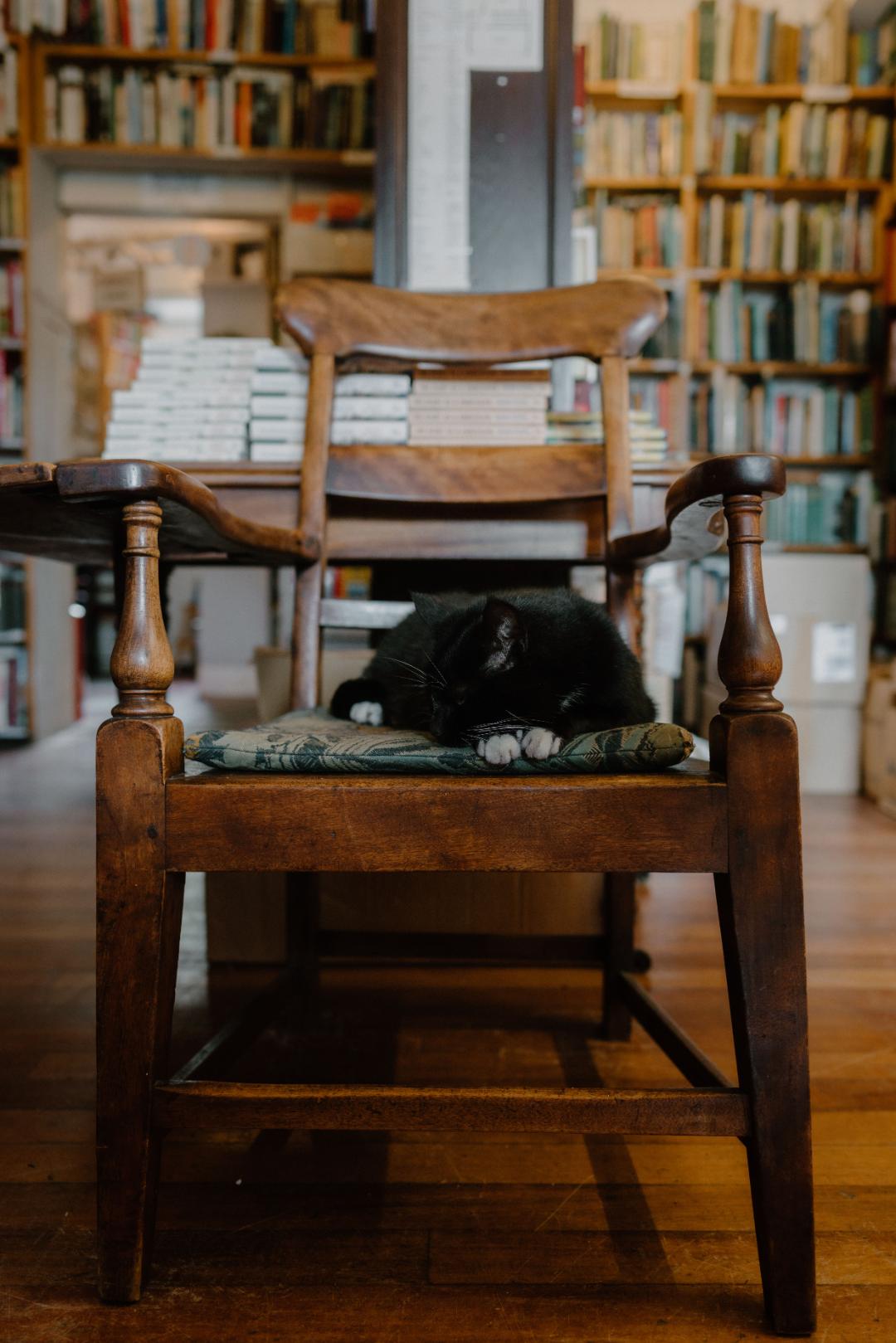
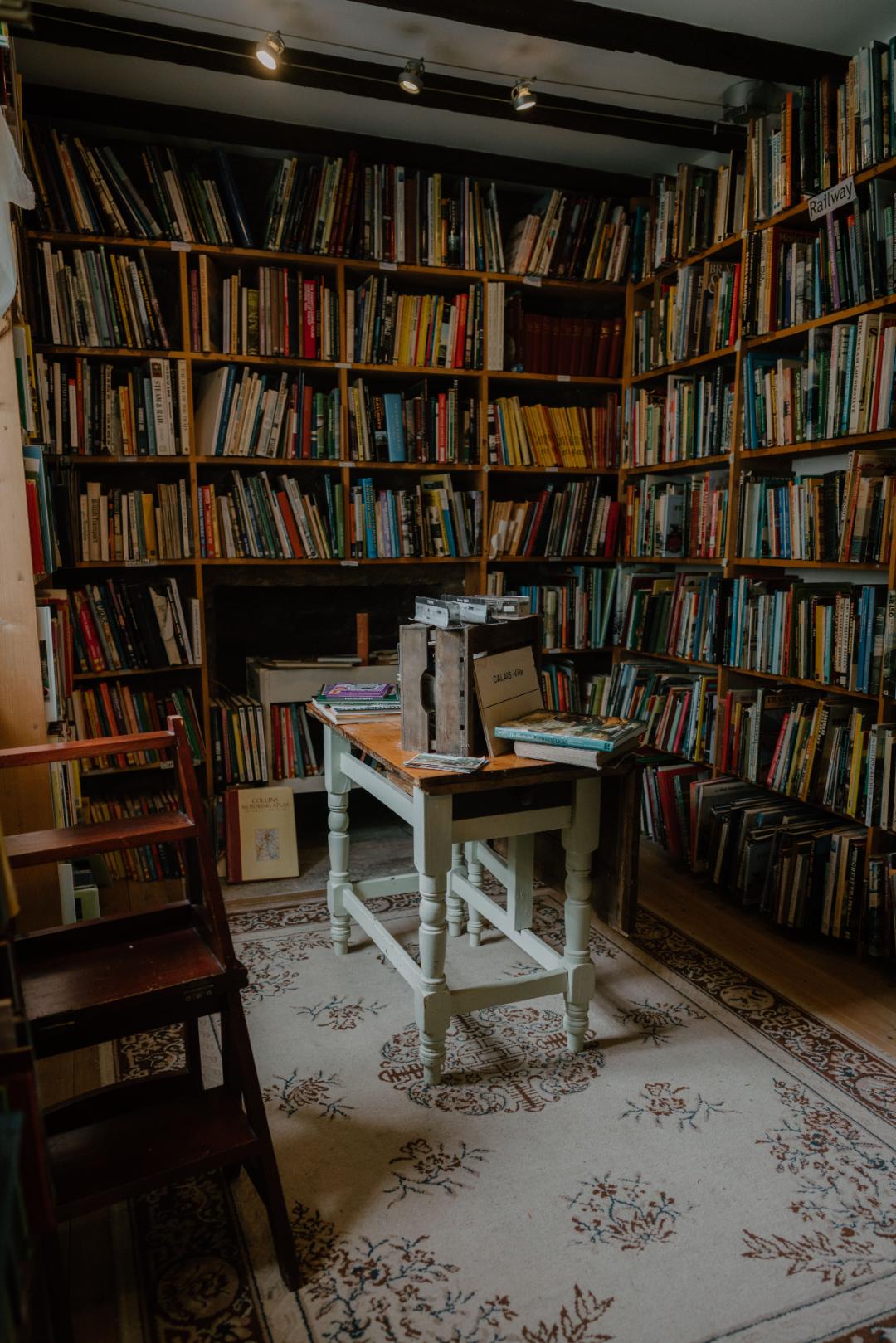
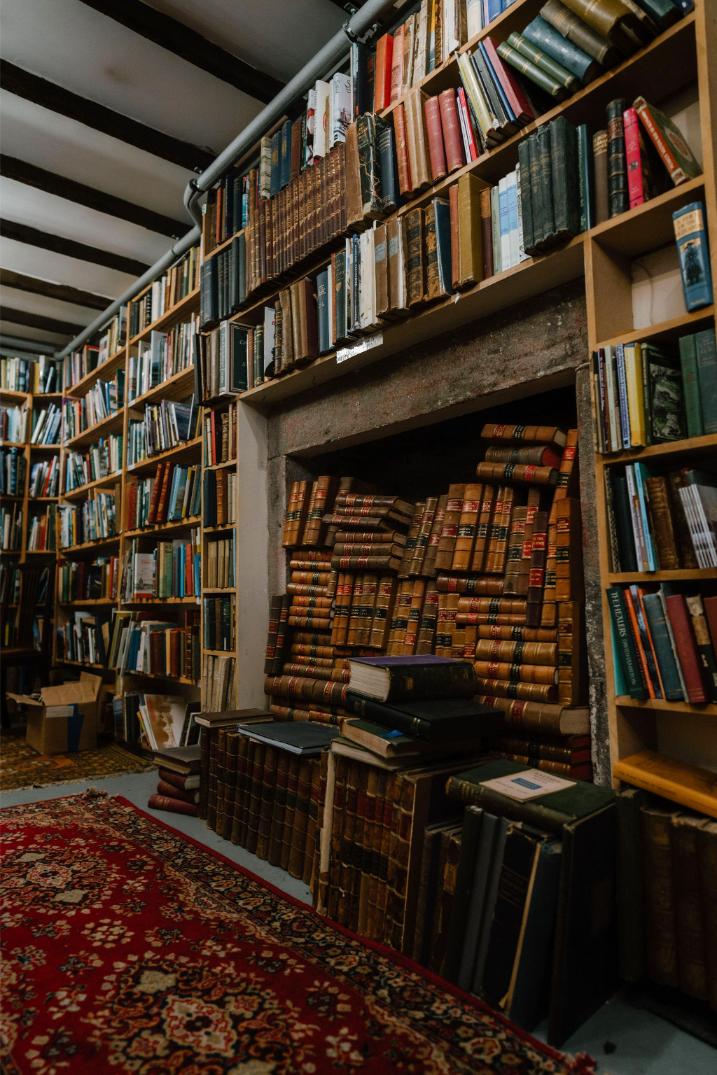
Over on the Machars Peninsula, where empty moorland slopes down to mesmerising clifftops and beaches with rock pools and views to the Rhins, Wigtown is the National Book Town. As well as being charming in that way that Dumfries and Galloway towns are, it is a dream for book worms. Behind the colourful facades you’ll find shelves upon shelves of stories waiting to be explored. There are more than 20 independent bookshops here, among them Scotland’s largest second-hand bookshop, and every autumn, the town hosts Wigtown Book Festival.
Kirkcudbright is the official ‘Artists’ Town’. Set on what is known as the Scottish Riviera on the southern coast, with the Galloway hills unfurling around it, this honeycomb of colourful Georgian and Victorian facades ripples out from a busy natural harbour where fishing boats bring in scallops. It attracted painters including EA Hornel, Charles Oppenheimer and illustrator Jessie M King in the late 19th and early 20th centuries, and is now home to quality galleries, interesting boutiques, and an award-winning Arts & Crafts Trail in the summer.
“Artists have long come to Kirkcudbright searching for beauty and a particular lifestyle,” says Fiona Lee, who runs art tours of the town. “The land and seascapes, that special Galloway light and our lush green pastures. The town itself with its wide streets and pretty coloured houses cast a spell on every visitor. Artist Jessie M King spoke of ‘the romance of this old world town set in her historic stones’, and she would be happy to know that little has changed in the 70 odd years since her death.”
For Kirkcudbright-based landscape artist Stewart Morrison, the surroundings are a constant source of inspiration: “I’m at home anywhere by the sea,” he says, “be it the muddy banks of the Dee estuary at Kirkcudbright or the deserted golden sands of the beaches in the west of our region. Even though I have spent over 50 years exploring Dumfries and Galloway, I have still only seen a fraction of what there is to see.”
-full-1748984984.jpg)
Harbour Cottage, Kirkbudbright
ART & CULTURE
see & do
The must-see in Dumfries is The Crichton, an 85-acre historic parkland estate that was originally set up as a mental institution and is now a remote campus for various universities, with lovely organised trails, an arboretum and rock garden. Another for your list is Moat Brae, Scotland’s National Centre for Children’s Literature and Storytelling, where J.M. Barrie dreamed up Peter Pan in the 1870s. It invites you into enchanted lands of the imagination via treasure trails, playrooms and a pirate ship playground. Next, stop for a pint at The Globe Inn, Robert Burns’ favourite Dumfries haunt, before popping to the quiet side street where the sandstone house in which he spent his final years lies – his name is scratched on an upstairs windowpane. Then venture to the Robert Burns Centre, an 18th-century watermill, to discover some of the National Bard’s manuscripts and belongings. After dark, the museum turns into a cinema that showcases contemporary films. Also worth a look in Dumfries is Gracefield Arts Centre, which is home to some 600 paintings and drawings by Scottish artists.
Ellisland Museum and Farm
Dumfries
In 1788, Robert Burns resolved to lead a “retired, domestic life” – and so built whitewashed Ellisland Farm on the banks of the River Nith northwest of Dumfries for his bride Jean Armour. But his ideas of retirement didn’t quite go to plan. As well as working as a farmer, exciseman and militiaman, the Bard penned around a quarter of his songs and poems here, among them Auld Lang Syne. Some say he experienced his most creative years at Ellisland, finding inspiration in the countryside. The farm, left virtually untouched, contains artefacts, memorabilia and manuscripts.
Crawick Multiverse
Sanquhar
In the heart of former mining country on the River Nith, this sculpted landscape by designer Charles Jencks is dedicated to the themes of space, astronomy and cosmology. So it is that you wander between landforms that represent the sun, galaxies, black holes and comets in huge spherical mounds, standing stones and slategrey pools. There are 360-degree panoramas across the wide landscape.
Kirkcudbright Art Tours
Kirkcudbright’s L-shaped High Street is a sort of who’s who in Scottish art. Charles Oppenheimer lived at number 14, writer Dorothy Sayers at 14a, and elsewhere, a cluster of artistic beach huts from the town’s annual Art & Crafts Trail is a colourful fixture on the harbour. The best way to explore is on a tour with art expert Fiona Lee. One artist of note for her is John Halliday. “He was the child of the ‘art colony’ in the 1940s,” Fiona explains. “Painted as a teenager by Cecile Walton in 1948, he is perhaps now the grandfather some 70 years later. Throughout his distinguished career, the subtle tones of the Galloway landscapes forever influenced his work. He returned finally to Kirkcudbright ‘where my eyes feel most comfortable’ and lives in a house only two doors down from the one in which he was born.”
Broughton House
Kirkcudbright
This elevated townhouse on the River Dee is the former home of E.A. Hornel, one of the Glasgow Boys painters. It’s a work of art, containing a Parthenon frieze, glass ceiling and paintings by Hornel of local children at nearby Brighouse Bay and of his travels in the Far East. His airy studio at the back of the house contains unfinished pieces, and the library’s shelves are stacked with one of the world’s largest collections of works by and about Robert Burns. The garden is an even greater masterpiece: inspired by Japan, it combines Eastern and Western horticulture in a kaleidoscope of wisteria and Japanese cherries.
Wigtown Book Festival
In the 1990s, Wigtown was unrecognisable. Buildings stood empty and unemployment rates were among the highest in Scotland. In 1999, the new Scottish Parliament crowned the town ‘Scotland’s National Book Town’ to reinvigorate the economy. Wigtown Book Festival honours this heritage. As well as a 10-day literary festival every autumn (23 September-3 October 2021), it hosts author talks, exhibitions and a poetry prize. It also owns The Open Book – a holiday apartment with a bookshop, giving guests the chance to “live the dream of having a bookshop by the sea”. They can change displays, price books and use the blackboard to entice visitors.
ART & CULTURE
community
Pleat Art + Fashion
Suneeta Rathore set up this arty boutique in 2009 after moving to Dumfries and Galloway from London. As well as sourcing items from around the world, she mixes fashion with her own paintings and embroidery. “I find the quirky, unconventional and unusual is truly embraced in this bustling, happy community,” she says.
The Whitehouse Gallery
The cream of the crop of Kirkcudbright galleries, specialising in affordable, contemporary art by leading artists and up-and-coming talents. Look out for landscape artist Joshua Miles (Insta: Joshua_miles_ artist), whose reduction linocuts aim to capture the movement of light creating atmosphere. He says: “I was drawn to live in Kirkcudbright, like so many artists before me, for the beautiful light and the landscapes that have enough inspiration for more than one lifetime.”
The Bookshop
The Bookshop is not only Wigtown’s largest second-hand bookshop, but Scotland’s too. “It’s in the middle of the medieval town and is a sprawling Georgian building, packed from floor to ceiling with books about almost everything,” says owner Shaun Bythell.
Working Print Studio
In a lovely wooden studio in the grounds of 850-year-old Buittle Castle (the former seat of the Balliol Dynasty), Kim Lowe runs courses in letterpress printing, linocutting and watercolour white-line (Orkney) print. The castle is open for tours and has a tearoom and Medieval sunken garden.
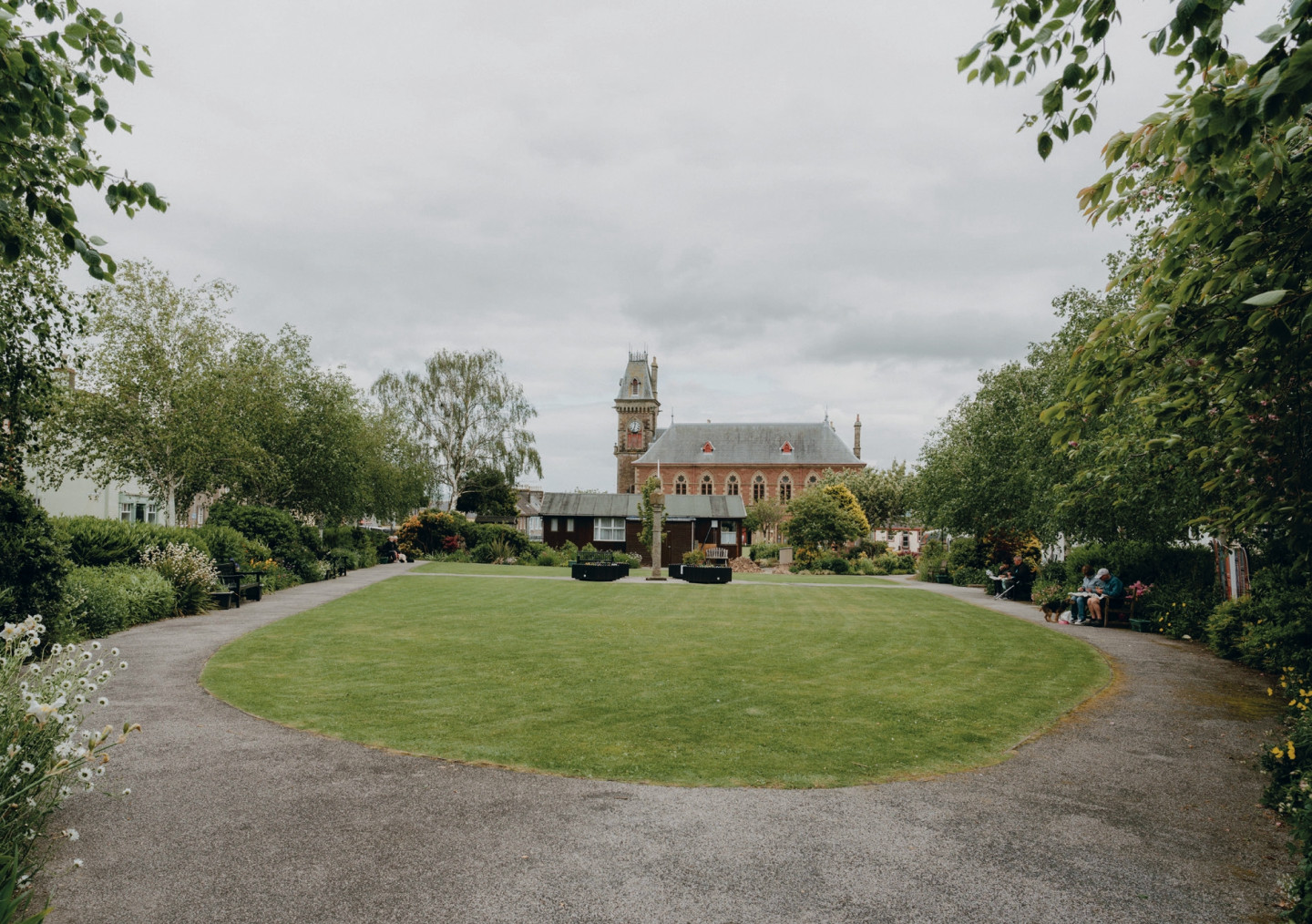
Wigtown
Lily Knowles Florist
Adele Marshall of Lily Knowles Florist knows a thing or two about flower arranging. “My passion for flowers started as a hobby at the local flower club,” she says. “Over the years this has led me to running and owning my own florists. I like to support local events, often by designing a window display to reflect what is taking place in the town, and I also support the local Lifeboat as much as I can.”
Ochre Gallery and Studio
All the beauty of Dumfries and Galloway in one studio! “Ochre, whilst being a gallery, is also home to my studio where I draw and paint (mainly using oil paints), aiming to capture the natural gentle charm of the Stewartry area around Gatehouse of Fleet where I live and Kirkcudbright where I work,” says Richard Brinley. To find Ochre, you need to look for the yellow shutters and door in the Old High Street, which is a chequerboard of some of Kirkcudbright’s finest architecture.
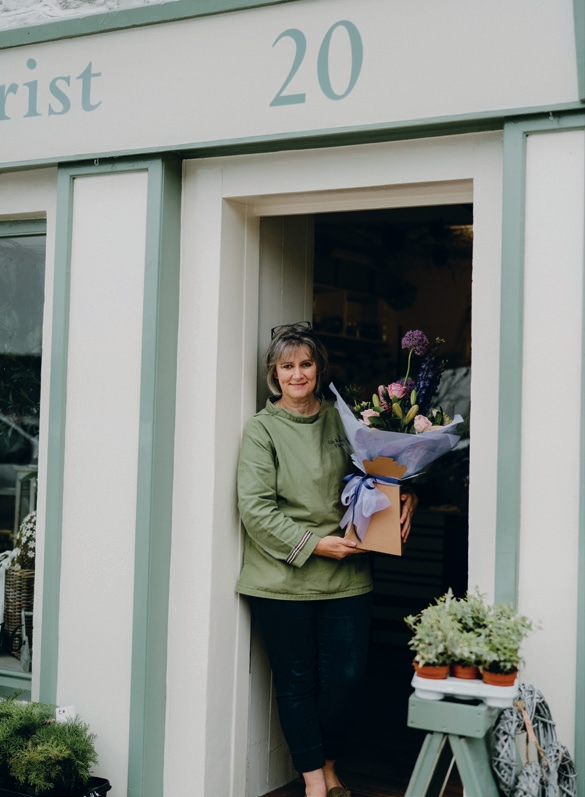
Lily Knowles Florist
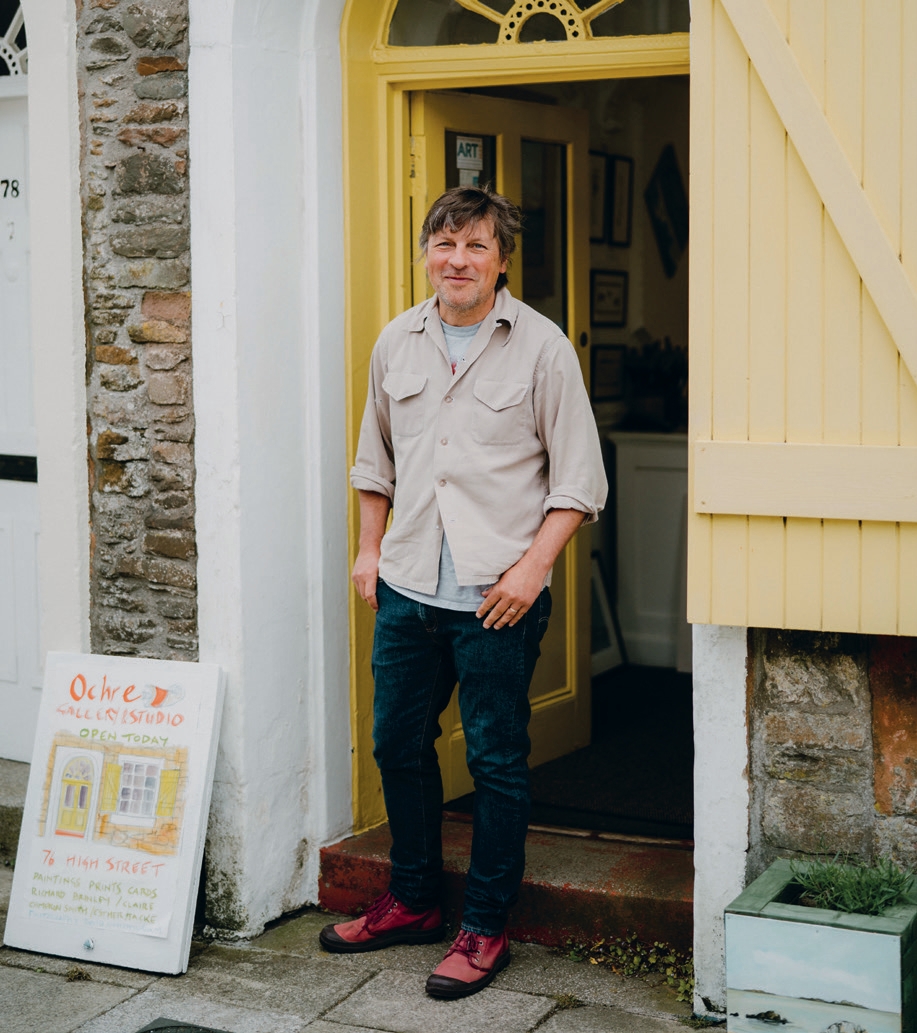
Richard Brinley of Ochre Gallery & Studio
Walking, Nature & Wildlife
The Mull of Galloway, Scotland’s southernmost point on land, rears up from its surroundings. It’s reached by a narrow neck of wave-sculpted land where waters collide, and even on a calm day you can hear the racing and swirling and swooshing, and watch as seabirds dive into the kingfisherblue melee. Then there are the smugglers’ paths along the headlands of the Solway coast, where you can peer into horseshoe-shaped coves and gaze over shimmering estuarine beaches. Climb southern Scotland’s highest mountain Merrick and watch the shadows of clouds sailing over the velvety folds of the Southern Uplands. Maybe bask in an exotic garden and take in the colours that are such a contrast to the wildflowers and ancient woodlands elsewhere in the region. Here you can just be. Be among nature. Be in the scenery, all of it – from coastline to moorland, fishing villages to high passes.
“There is a quiet calm in the Galloway Hills, something I haven’t encountered in many other places,” says local Morag Paterson, an awardwinning photographer. She talks of expansive views accompanied by the soundtrack of skylark song, intimate glens and cleuchs (steep valleys). Of open moorlands, peat bogs teeming with mosses, chattering burns and deep pools that seem too black to be true. “I feel welcome amongst the softly rounded hilltops, eroded by time, upland lochs reflecting the sky, and water lapping at pristine mountain beaches,” she says. “As far as photography goes, I rarely stray from my house. A famous photographer once said to me, ‘don’t waste your time on those Borders (sic) hills; even I couldn’t take a good photograph there’. I like to think we are still proving him wrong.”
There are ten regional scenic areas, including the Moffat and Langholm hills and the rocky Rhins coast around Stranraer where seabirds nestle. There are also the national scenic areas of the Nith Estuary, East Stewartry Coast and Fleet Valley. There is excellent walking everywhere, but one of the finest hikes in the region is Sandyhills to Kippford along the Solway coast, which is often called the “Scottish Riviera”. It takes in sandy beaches strewn with shells, castle ruins, the site of an Iron Age fort and the grave of smuggler Joseph Nelson, whose body washed up in 1761. The seven-mile walk spills out in Kippford, a very pretty garland of white cottages on the Urr Estuary that from the end of the 1700s was an important port. These days it’s a tranquil spot to enjoy a bite of fish and chips or a pint. Other days you might opt for an easy beach stroll – Brighouse Bay near Kirkcudbright is the most delightful stretch of golden sand.
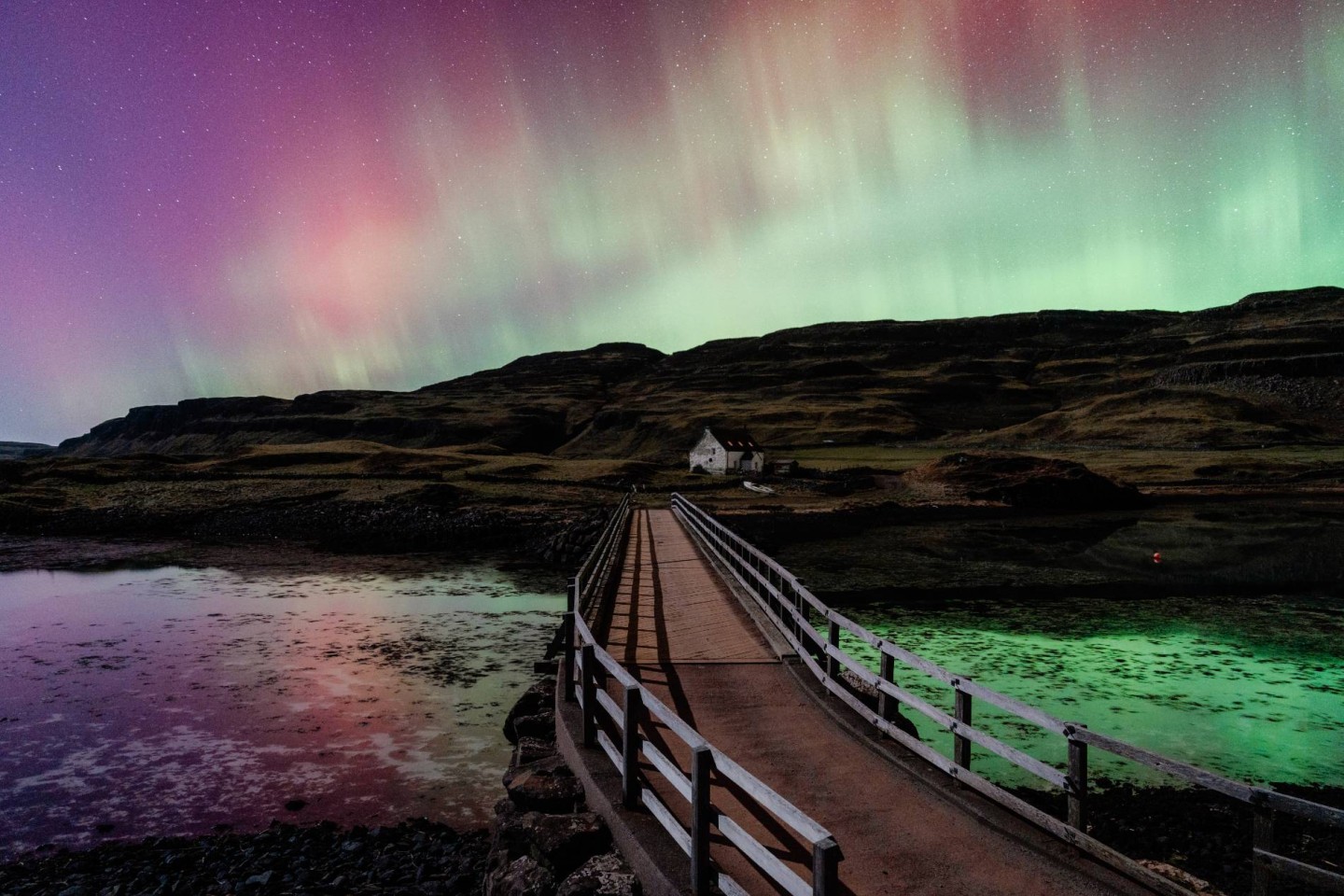
At the core of the region, in the Galloway Forest, is the UK and Europe’s first Dark Sky Park. Dark Sky Ranger Elizabeth Tindal, who runs stargazing experiences, explains that because very few people live in the 300 square miles of the park, nights are lit only by the moon and stars: “If you look at a satellite image of Britain at night, the area around Wigtown and the Dark Sky Park looks like it doesn’t exist because there are so few lights compared with everywhere else. It is saying something when most of the light pollution in the Dark Sky Park comes from the moon.”
The park lies in Scotland’s first biosphere – the Galloway and Southern Ayrshire UNESCO Biosphere, which meanders across burns, lochs, hills, bogs and rivers where species including red deer, wild goats and pine martens roam. Estimates suggest that Dumfries and Galloway is also home to 20 per cent of Scotland’s red squirrel population. More recently, there have been golden eagles, thanks to the South of Scotland Golden Eagle Project, which started translocating eaglets from eyries in the Highlands in 2018. Earlier this year, Moffat was named Scotland’s first ‘Eagle Town’ thanks to the role it has played in addressing low numbers of the birds in the area. Along the coast, the Solway Firth is one of the most important estuaries in Britain, with 40,000 wildfowl and 83,000 waders visiting in winter.
-full-1748985877.jpg)
Galloway Forest Park
Wildlife, Walking & Nature
see & do
WWT Caerlaverock Wetland Centre
Caerlaverock
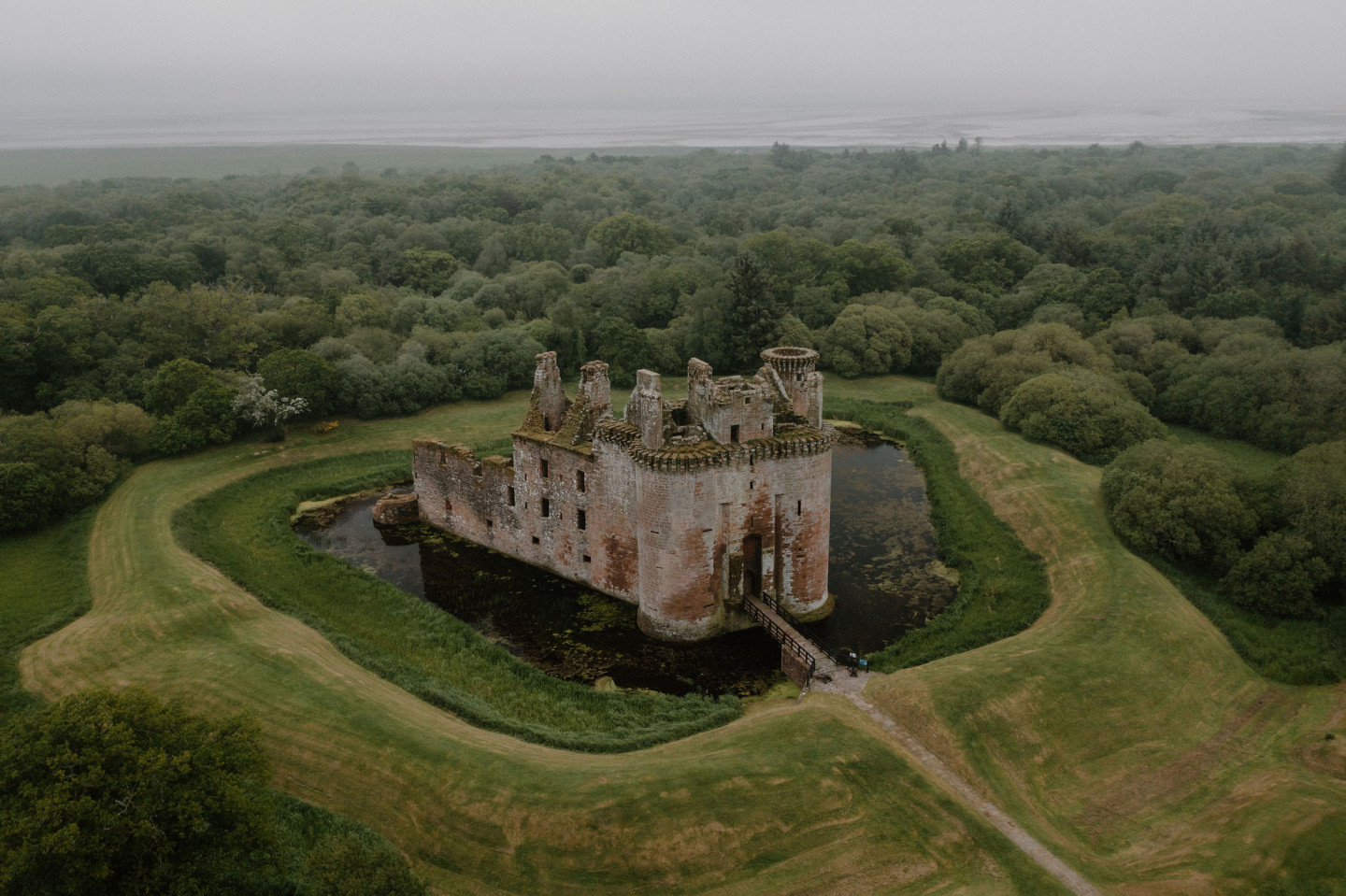
Every winter, 40,000 barnacle geese from the Svalbard archipelago in Norway fly south to Dumfries and Galloway to enjoy milder climes. The ‘barnies’, as they are known, arrive in October after completing their 2,000-mile journey in 61 hours. They have an ornate pattern that led to the story in medieval folklore that they developed from barnacles on driftwood. At WWT Caerlaverock, you can also spot whooper swans, tufted ducks, mallards and widgeons. The expansive wetlands are close to Caerlaverock Castle, one of Scotland’s finest medieval castles.
Wood of Cree Nature Reserve
Newton Stewart
This RSPB site is situated in the largest ancient wood in southern Scotland. A tangle of wizened oak trees known as Scotland’s rainforest, it expands onto open moorland, wet floodplains, fen, grassland and scrub. With all these habitats, it is home to a range of species, from black grouse and cuckoos to eight types of bat and purple hairstreak butterflies. In winter, tits, woodpeckers and tree creepers are easy to spot.
7Stanes
Mythology and mountain biking – not a combination that readily springs to mind, but at these seven mountain biking centres across the south of Scotland, that is just what you’ll find. ‘Stane’ comes from the Scots word for stone, and at each of the locations is a unique stone sculpture based on a local myth or legend. Dalbeattie’s heart cleft stone commemorates Kirkcudbright as the former heart of the granite industry in Scotland; in Forest of Ae, a giant ‘talking head’ dominates the pop-up layers of misty valleys; or at Mabie things get ghostly in the Misty Glade, where a white marble stane is engraved with a lace pattern. Apart from that, you’ll find award-winning mountain biking trails suitable for all levels.
Grey Mare’s Tail and Loch Skeen
Moffat
Where the Moffat hills sink to form a velvety V, the Grey Mare’s Tail tumbles, a 60-metre-long skein of silver silk. It’s the fifth-highest waterfall in the UK, made even more impressive by its dramatic landscape created by glacial erosion. Climb to Loch Skeen, which basks in a craggy basin created by Lochcraig Head, Mid Craig and White Coomb. You might spot feral goats, peregrine falcons, or Britain’s rarest freshwater fish, the vendace. In the 17th century the spot was a lookout point for Covenanters keeping an eye out for government troops. The circular walk from Grey Mare’s Tail car park takes around 2.5 hours and includes 278 metres’ steep climbing.
The Annan Merse shore walk
Annan
Here on the Solway Firth, billowy grassland spills onto silvery sand flats that shimmer and stretch as far as the eye can see. The fivemile circular starts at the heart of Annan, a devastatingly pretty 14thcentury port on the River Annan with an interesting high street and a fascinating past. The bridge, a lowarched golden stone structure, was built in 1826 by Robert Stevenson, and the Scottish writer Thomas Carlyle went to school here. From the Town Hall, the walk passes beneath the bridge to Whinnyrig, then descends onto the Annan Merse where you negotiate “dubs” (salt water pools) before culminating on the sandstone pier at Waterfoot.
Walking on the Rhins of Galloway
This hammerhead-shaped peninsula on the western edge of Dumfries and Galloway is peaceful, narrow and almost completely surrounded by water. Its west coast is craggy, while the east is gentler; it tops out at Corsewall Lighthouse and the Mull of Galloway is the southernmost point. The 24-mile Mull of Galloway trail, which follows the Southern Rhins coastline, is one of the most spectacular in the region. More accessible is the “mini” coast-tocoast – a 90-minute jaunt from New England Bay to Port Logan on the Irish Sea coast. There’s also a nice sixmile circular along the rugged coast from Portpatrick to Killantringan Lighthouse. A little further north is Knock Bay, a wild cove with a gorgeous sweep of sand. From the peninsula you can see as far as the Isle of Man, the Mountains of Mourne in Ireland, and even the Mull of Kintyre. You might spot grey seals, gannets and porpoise, and the Mull of Galloway foghorn is the only operational one on mainland Scotland.
Criffel
Kirkcudbrightshire
Merrick is the biggest mountain in the region, but Criffel is the more striking. It’s an isolated bulge, prominent in the landscape of Kirkcudbrightshire, and at only 570 metres high, it’s a breeze to reach the summit’s views (some say the best in the area) that stretch across the Solway coast to the Lake District. There’s a nice circular walk from New Abbey that takes around six hours, or less for more experienced walkers.
Logan Botanic Garden
Port Logan
Here you’ll find blooms from Australia, New Zealand, South America and Southern Africa tangled in a zesty riot that thrills the senses. Thanks to warmth from the Gulf Stream, “Scotland’s most exotic garden” allows plants such as eucalyptus, palm trees and gunnera to thrive. Dating from 1869 and a regional garden of the Royal Botanic Garden Edinburgh, it also features a walled garden and conservatory houses, and picturesque benches aplenty. Logan is part of the Silent Space initiative, which encourages visitors to take a seat and listen to nature. When you’re done exploring, grab a bite of local food such as Ecclefechan Tart at the award-winning Potting Shed Bistro.
-full-1748986075.jpg)
Grey Mare's Tail
Wildlife, Walking & Nature
community
Wild Eskdale
Langholm
A 4x4 drives you into wild scenery, such as Langholm moor, where you might spot golden eagles, wild goats and sparrow hawks. There are full- and half-day, as well as private experiences.
Galloway Activity Centre
Castle Douglas
On the banks of Loch Ken in the Biosphere, you can choose from activities including sailing, stand up paddle boarding, mountain biking and climbing.
Freelance Ranger Elizabeth Tindal
Galloway Forest
Join Biosphere Dark Sky Ranger Elizabeth Tindal for a stargazing experience in the Dark Sky Park. Elizabeth also offers creative outdoor activities for families, such as shelter building and campfire cooking. She has a wealth of experience to share and welcomes any questions. “One of the best conversations I had while stargazing was with a 10-year-old boy,” she says. “He kept starting with ‘I know this is a stupid question, but…. What is outside the universe? Do aliens exist?’ These questions were not stupid; questions in general are not stupid.” You’ll be sure to find out the answers on your experience.
Leeming and Paterson photography
Dalry
Photography workshops and classes (autumn and winter only) in the Galloway hills with award-winning professional landscape photographic artists Ted Leeming and Morag Paterson.
Galloway Kite Trail
Kirkcudbrightshire
A 24-mile anti-clockwise tour around Loch Ken on which you can spot the red kites that were reintroduced here in 2001.
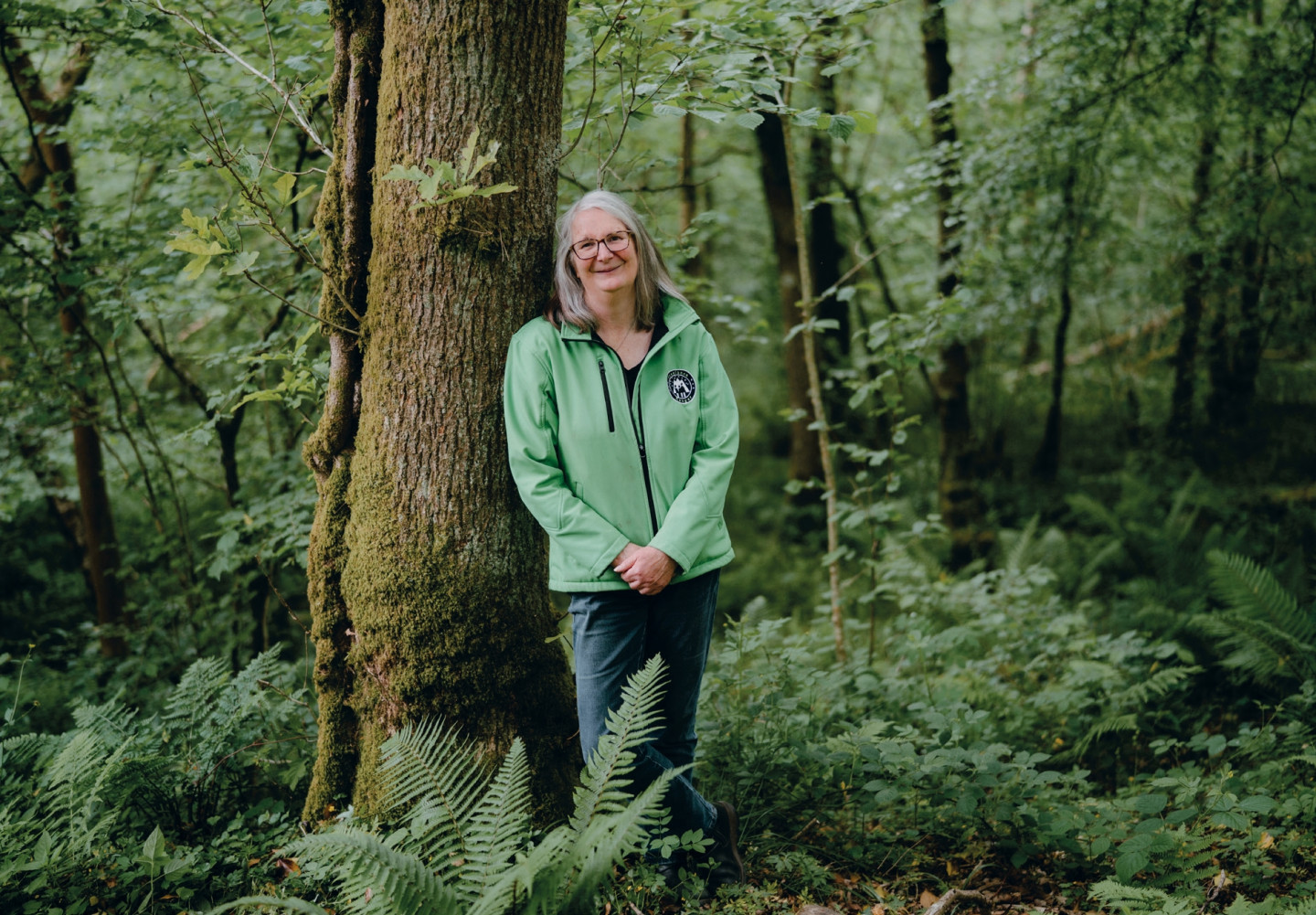
Freelance Ranger Elizabeth Tindal
Food & Drink
High streets in Dumfries and Galloway have what many elsewhere have lost: individuality. Theirs is a character that comes from independent businesses and local producers. There’s a lived-in feel, and most of the towns have an independent butcher’s and greengrocer’s, not to mention a small bakery. There’s a packed calendar of producers’ markets, with gin, dairy products, venison, chutneys and cakes. The region even has its own ‘Food Town’ – Castle Douglas, a pretty market town with over 50 independent businesses, including a high-street brewery. Food isn’t just a necessity here – it’s a way of life.
For baker Annette Need, who grew up on a farm on the Colvend coast, Dumfries and Galloway is an inspiration to its small food and drink producers. “Dumfries and Galloway is a special place,” she says. “The hills, forests and coastlines are the backdrop for many small businesses as well as farming. Our family farm provides the basis for all my recipes and ideas.”
She’s not alone. The region has borne a cornucopia of local specialities. You might try Moffat toffee, Cream O’ Galloway ice cream or tartan-patterned chocolate from Moniaive Chocolatiers. One of the best ways to sample it all is at one of the aforementioned producers’ markets – there’s a good one in Colvend. As Annette says: “The produce markets are a great way of sampling local food and drink, perhaps finding something you cannot get anywhere else. My personal favourite is butternut squash and apricot chutney made by a Dalbeattie jam and chutney maker. Perfect with local cheese.”
There is also locally caught fish, such as scallops in Kirkcudbright, while Stranraer, an old-fashioned seaside town, celebrates seafood with its annual Oyster Festival. You’ll find tasty smoked meats from smokehouses in the west of the region, and we’ll bet you’ve heard of Galloway beef? Galloway cattle originated here in the 17th century and their meat is renowned today for being lean and flavoursome. In 2019, Dumfries baker Kerr Little of The Little Bakery – a former World Scotch Pie champion – joined forces with the Galloway Cattle Society to create the ‘Galloway pie’. This gooey concoction of Galloway beef bathing in gravy and encased in a scotch pie shell with a puff pastry top is surely just one more good reason to head for Dumfries and Galloway.
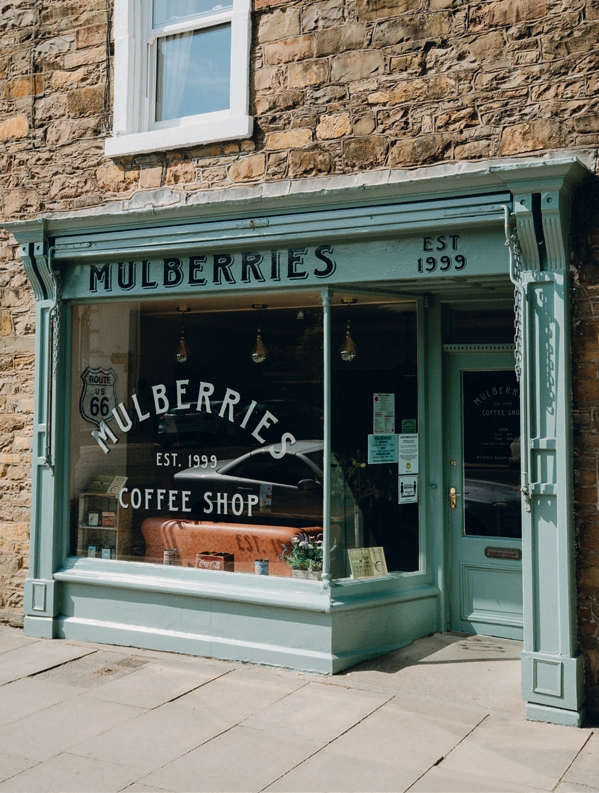
Mulberries Coffee Shop
Ninefold Distillery
Lockerbie
In a converted stone cattle byre on Dormont Home Farm, the formerly active farm on Dormont Estate, owned by distiller Kit Carruther’s family, this is the South of Scotland’s only rum distillery. “Rum is made here entirely from scratch by fermenting and double distilling North African sugar cane molasses,” explains Kit. “It takes around two weeks to make my rum, and I bottle and label on site too. I make an unaged white rum and a spiced rum, and I have a warehouse at the farm where I am barrel-ageing rum.” The brand logo – a six-winged angel – is the Carruthers family crest, and ‘ninefold’ refers to the angel being at the ninth level in the celestial hierarchy. Discover more on a guided tour.
Ninefold Distillery
Lockerbie
In a converted stone cattle byre on Dormont Home Farm, the formerly active farm on Dormont Estate, owned by distiller Kit Carruther’s family, this is the South of Scotland’s only rum distillery. “Rum is made here entirely from scratch by fermenting and double distilling North African sugar cane molasses,” explains Kit. “It takes around two weeks to make my rum, and I bottle and label on site too. I make an unaged white rum and a spiced rum, and I have a warehouse at the farm where I am barrel-ageing rum.” The brand logo – a six-winged angel – is the Carruthers family crest, and ‘ninefold’ refers to the angel being at the ninth level in the celestial hierarchy. Discover more on a guided tour.
Loch Arthur Creamery and Farm Shop
Beeswing
As you drive along the A711 from Dumfries to Dalbeattie, keep an eye out on the left for this farm shop beside a loch. In the café and shop you’ll find the farm’s organic produce, as well as locally produced fare, including a range of delicious artisan cheeses and mouthwatering cakes. It’s all produced and managed by members of the Loch Arthur rural working community, which houses some 75 people, including men and women with learning difficulties.
Galloway Wild Foods
Southwest Scotland is an openair larder of gourmet delights, says Galloway Wild Foods founder Mark Williams. This is thanks to the warming influence of the Gulf Stream, which allows plant species to flourish. On one of Mark’s foraging courses, which venture across tidal estuaries, rocky shores and upland moor and into coniferous forest, you might collect samphire, wild radish, sweet cicely or chanterelles, to name but a few.
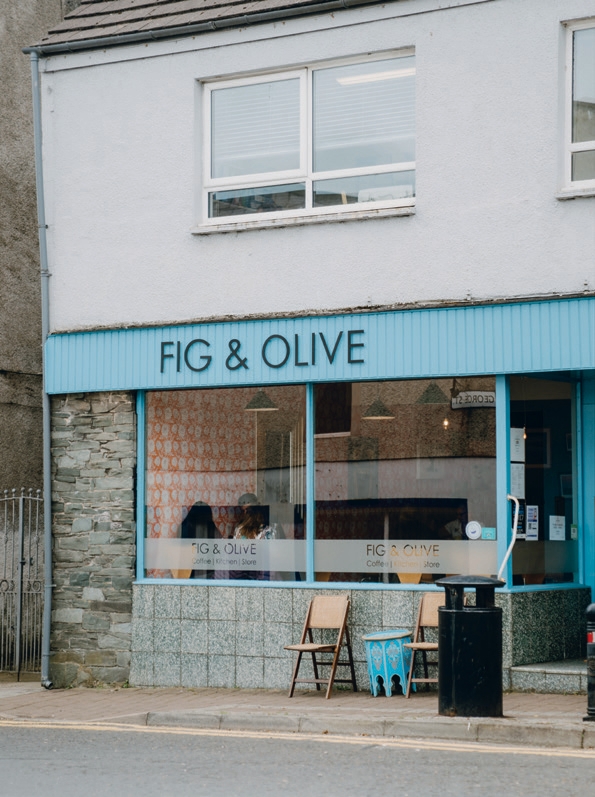
Fig & Olive
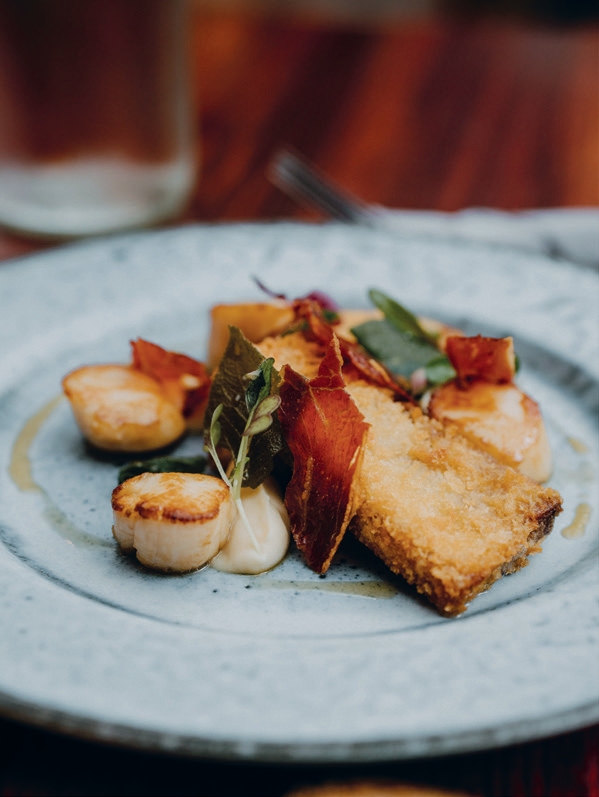
Selkirk Arms Hotel
Selkirk Arms Hotel
Kirkcudbright
Where those in the know go for Kirkcudbright scallops, all dished up amid the Georgian finery of the High Street and walls hung with local art.
Auld Alliance
Kirkcudbright
Galloway ingredients concocted into traditional Scottish cuisine with a French twist and served up in a stylish attic overlooking St Cuthbert Street.
The Steamboat Inn
Kirkbean
Award-winning pub-style grub enjoyed with views across the Solway Firth and Cumbria.
Galloway Lodge Preserves
Gatehouse of Fleet
Established in the 1970s, Galloway Lodge is now one of Scotland’s most popular producers of jams, marmalades and chutneys. In its coffee shop you can enjoy tasty local fare.
Fig and Olive Café
Stranraer
Australian chef Maria whips local ingredients into antipodean dishes inspired by family recipes at this Stranraer café just off the harbour.
Ruin & Redemption
Liquors
Dumfries Foraged fruit, herbs and flowers make their way into gins such as the Scarlet Woman (raspberry gin) or Blaze and Glory (strawberry and pepper).
Annette’s Baking in a Box
Colvend
Cakes lathered in whipped cream, chocolate ganache and fresh berries, creamy quiches and tray bakes you could guzzle in a jiffy are among the treats Annette Need bakes on her Colvend farm. Available at Colvend Producers Market and to order.
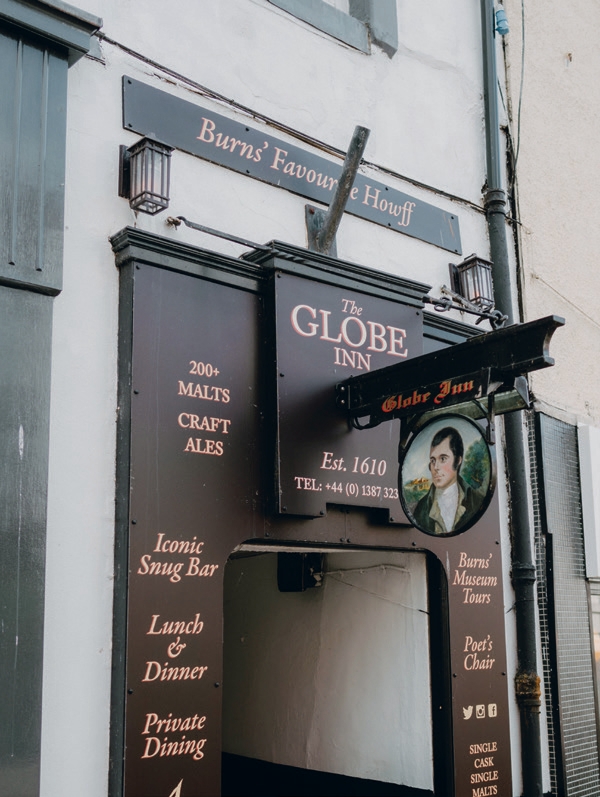
The Globe Inn
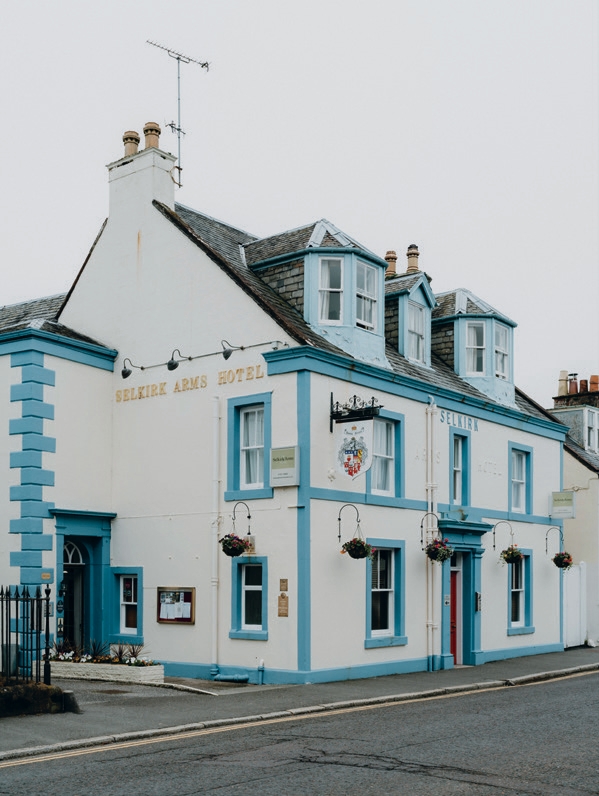
Selkirk Arms Hotel
Promoted Post
The Scullery
Tucked away in the heart of the Yarrow Valley, The Scullery is a one-bedroom boutique hideaway, eloquently designed for comfort, calm, and connection. Whether you’re escaping the city or craving a countryside reset, this is your space to slow down and just be.
-listable-carousel-1769292770.jpg)
-full-1741009545.jpg)






 Sign in with Google
 Sign in with Email