Shetland’s Unst – Underhoull, the Skidbladner and Hermaness
A day by car, from Belmont ferry terminal and back.
Written by Laurie Goodlad
Unst, known as the ‘island above all others’, is Shetland’s – and the UK’s – most northerly place, claiming the most northerly house, church, shop, pub, beach, bus stop … the list goes on!
Unst is a two-ferry hop from the Mainland, travelling through the island of Yell before catching the ferry onward to Unst. The island is home to about 600 people and is a popular destination for those holidaying in Shetland – both locals and visitors.
Unst is rich in wildlife, geology and archaeology. It’s best to set out early in the morning and leave the island late at night to make the most of your trip, as it takes two hours each way to get there. Better still, spend a night or two, or even a week, in Unst to make the most of everything the island offers.
Unst is well worth the trip, and the only regret you’ll ever have is not spending more time there. There are cafes, museums, a distillery, and plenty of beautiful walks and beaches for those who love the outdoors.
Getting to Unst is easy; travel to Toft in the north of Mainland Shetland before catching the ferry to Yell (a 15-minute crossing). Drive 17 miles through Yell and catch the ferry from Gutcher to Belmont (Unst). This second crossing takes about five minutes. Booking is recommended but not required.
Unst is an island that you will fall in love with. One day in Unst is not nearly enough to do it justice, and you may wish that you’d based yourself in the island for a few days or a week. Unst is an island that you never grow tired of.
Noosthamar is a self-catering property based in a beautifully converted and modernised traditional ‘but-an’-ben’ croft house overlooking the sandy shores of Burrafirth.
Gardiesfauld Hostel & Camping Park is a fantastic hostel and campsite at Uyeasound. The site is quiet, picturesque and served well with plug-ins for caravans and motorhomes, shower and kitchen facilities and pitches for tents. The reasonably priced hostel has brilliant amenities and is clean and well-maintained. The campsite overlooks a small sandy beach towards the pier, where you can often watch otters. Booking is essential as this site is very popular with visitors and locals alike. These are the only plug-in facilities for caravans and motorhomes on the island.
The Peerie Neuk – opening in 2022, The Peerie Neuk is a tiny, eco-friendly home in Haroldswick, offering simplicity, style and charm. Following the tiny house movement, the small shepherd’s hut uses low environmental impact materials to create a small, functional space that’s suited to withstand the Scottish climate and allow you to get closer to nature.
Belmont House – the historic Belmont House has recently reopened as a B&B, offering guests the chance to spend the night in this classic Georgian house.
Unst is a small island with limited eating out options. If you are planning to stay for a few days, be prepared to have to do some cooking. However, there are plenty of shops on the island, so all you need can be bought locally.
Victoria’s Vintage Tea Rooms – Victoria’s Tea Room is a beautiful cafe in Haroldswick, with uninterrupted views out to sea. With a mouth-watering selection of cakes and savoury lunch options, Victoria’s is worth the stop. You are advised to book in advance during the summer season as the cafe does get busy.
The Final Checkout Cafe is located in the Final Checkout shop, north of Baltasound. The small cafe is situated inside the shop and sells affordable, simple lunch options, including soup, sandwiches, toasties and baked potatoes. Booking is not necessary.
The Old Haa Museum may not be where you would expect to find great food, but the museum’s tearoom has the best cakes you’ll find for miles around. A team of dedicated volunteers runs the museum and cafe, and the cakes are all homemade and generously portioned with an excellent selection to choose from. The museum is just a short walk from the campsite and is a great place to spend time – particularly if timed to coincide with that mid-afternoon energy slump that only tea and sugar can fix!
Skibhoul Bakery – Shetland has several bakeries supplying fresh bread to the islands. Skibhoul Bakery is found at the Skibhoul Shop and has provided baked goods since 1885. Be sure to pick up their bread and fantastic oatcakes when you’re in Unst – these make the perfect picnic!
Shops – you may want to pick up a picnic from one of the local shops in Unst. Several shops serving the islands, including Skibhoul Stores and Henderson Stores – known locally as Ethel’s – are in Baltasound. The Final Checkout is outside Baltasound, on the road to Haroldswick. Fuel can be purchased from Skibhoul and The Final Checkout.
Top tip: If you’re planning to visit Unst on a Sunday, check the What’s On guide in the weekly Shetland Times newspaper or check roadside signs advertising Sunday Teas in any local public halls. Sunday Teas are quintessentially Shetland. Basically, a team of volunteers will open the hall for an afternoon selling tea, coffee, cakes, bakes, sandwiches, soup. For a nominal fee, visitors can tuck into an all you can eat buffet-style spread with the best local home-baking and hospitality.
The following are a couple of options for a 1-day itinerary for the island of Unst.
It is possible to do all these in a day, visiting the Viking sites in the morning and hiking to Hermaness in the afternoon, or vice versa.
The route
Before you go
Book the ferry from Toft to Ulsta, out and back
Book a car both ways on the Toft to Ulsta ferry, a 20-minute crossing, at ferry.shetland.gov.uk or on 01595 745804: from Lerwick this is a day of 13 and a half to 16 hours, depending on your time at Hermaness, for May to August, so check the times.
Book the ferry from Gutcher to Belmont, out and back
Book the car on the Gutcher to Belmont ferry too, a 10-minute crossing each way, on sailings that meet your Yell Sound ones, allowing 25 minutes for the 18 miles through Yell from Ulsta to Gutcher.
The day
Unst
1 hr 17 min at the wheelAbout 37 miles
Lund
It’s often argued – although neighbouring Fetlar would dispute this – that the Vikings’ first landfall in the UK was in Unst. The island is peppered with the numerous remains of Viking and later Norse habitation, dating back to the 9th century. The island’s Scandinavian roots are strong, with place names, boat building design and the local language carrying traces of this Norse heritage. Shetland was under Scandinavian rule until 1469, when the marriage of Princess Margaret of Denmark and King James III saw the islands fall under Scottish control as they were given away as part of the wedding dowry. The remains of at least 60 Viking longhouses have been discovered on the island – the highest density found anywhere, Scandinavia included. For this itinerary, we’re starting on the west side of Unst. From the ferry, follow the A968 for about two miles before turning left towards the ‘Westing’. A mile or so along, the road forks – choose either fork, but for this itinerary, we’re going left towards Lund. Lund Standing Stone – along the road, you can’t miss the giant standing stone on the right. This 12-foot high monolith dates to the Neolithic or Bronze Age and dominates the gentle landscape surrounding it. This is Shetland’s largest and most impressive standing stone and is sure to make you stop and marvel at its gravity-defying wonder. St Olaf’s Kirk – from the standing stone, continue to the end of the road. Please note that this is croft land, and you may have to stop and open and close gates. Alternatively, park up without obstructing the road and walk down the track towards the beach and graveyard. The graveyard at the ruined St Olaf’s church holds the remains of Viking graves from the 9th to 11th centuries. Within the graveyard is the final resting place of a Hanseatic merchant, Segebad Detken, laid to rest in the churchyard in 1573. This is also an excellent place to look for seals and walk along the beautiful sandy beach.
About 5 min by car
Underhoull
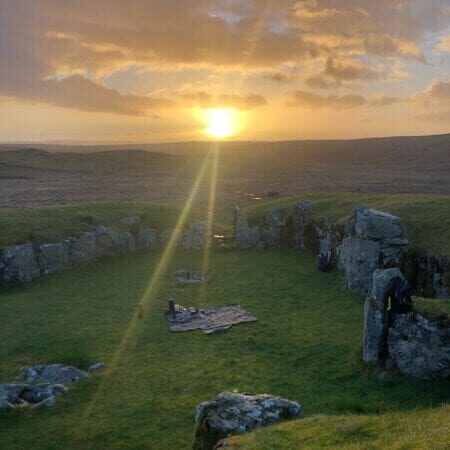
Underhoull Viking longhouse & Iron Age broch site – From Lund, go back out the road and take the fork in the road to the right that leads towards the ‘Westing’. A mile or so along the road, you’ll come to the Underhoull longhouse and Iron Age broch that sits at the top of the hill on the left-hand side of the road. Park in a passing place, allowing space for other cars to pass, and have a walk through history. Like much of Shetland’s archaeology, we find different periods of occupation sitting cheek by jowl, with later inhabitants using what was there already and repurposing former structures. The most apparent structure – and most impressive – is the Iron Age broch, dating back some 2,000 years and predating the Viking occupation. Although the broch stands in ruin, it has impressive ramparts and commanding sea views. From the broch, the ruins of a longhouse lie about halfway down the hill, at the midway point between the broch and the sea. A former Viking boat noost lies at the water’s edge, and, to the left, another excavated longhouse makes up the full complement of Viking and Norse sites in the close vicinity. Before heading back to the main road, take a drive to the end of the road at the Westing - if you look out to the island, you may spot a small stone booth – the remains of a 19th-century fishing station.
About 11 min by car
Sandwick Beach (the Eastings)
Sandwick Beach combines arguably the best beach in Unst with one of the best Viking sites. From Uyeasound, follow the road towards Muness. After about a mile, at the top of the hill out of Uyeasound, you’ll come across the Uyea Breack Standing Stone (known as the Clivocast standing stone), standing proud with views across to the island of Fetlar to the south. A short distance after the stone, take the junction to the left, marked ‘Hannigarth’, and park at the end of the road to walk to the beach. Sandwick Beach is a short walk down the fields towards the beautiful white sands that sweep around the wide bay. This was an important Viking site, and evidence of this occupation can be viewed at the head of the beach, where the remains of an excavated Viking longhouse lie. Look out for the curved doorway in the byre, an interesting architectural feature that allowed the cows to get in and out without having a wide door! If you feel like walking a little further, follow the coast to the graveyard at Framgord, where distinctive rectangular slabs or hogback stones mark Viking graves. An even longer walk around the coast leads to the abandoned settlement of Colvadale, where the remains of the 19th-century community remain in the roofless ruins of their former crofts.
About 21 min by car
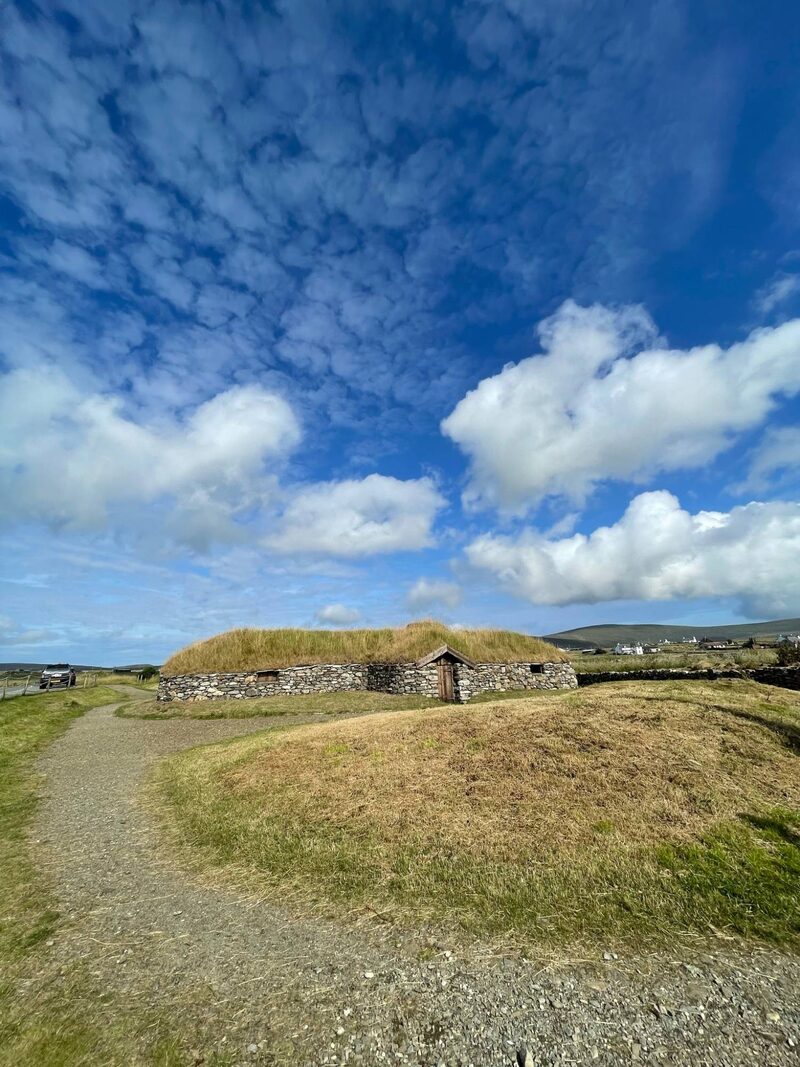
The Skidbladner
An attraction
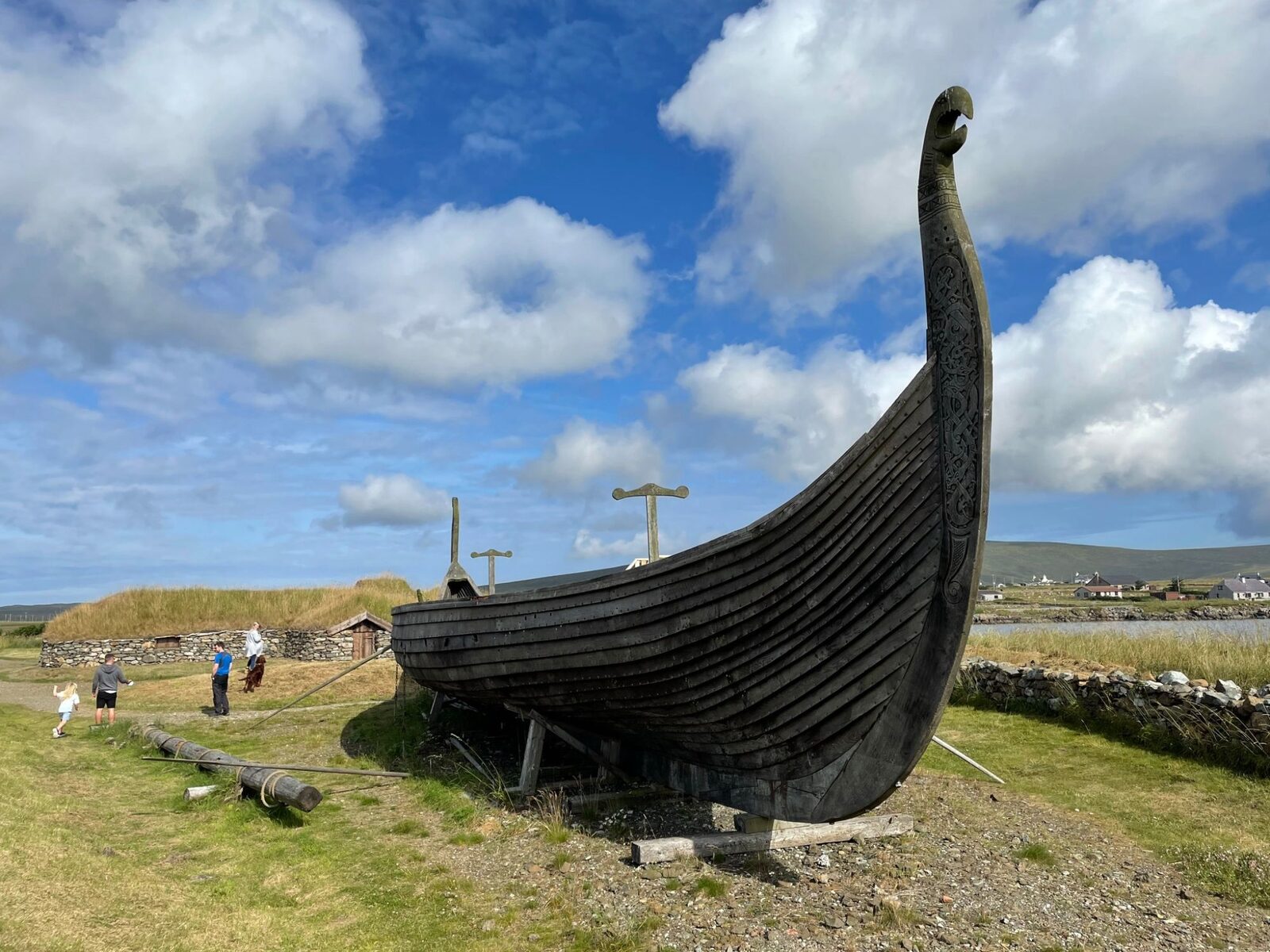
To discover more about the Viking and Norse period that lasted until the 15th century in Shetland, visit the reconstructed longhouse and longship at Haroldswick before stopping at Victoria’s Vintage Tearoom for lunch. Top tip: You’re best to book lunch as the cafe gets busy, particularly in the summer season.
About 6 min by car
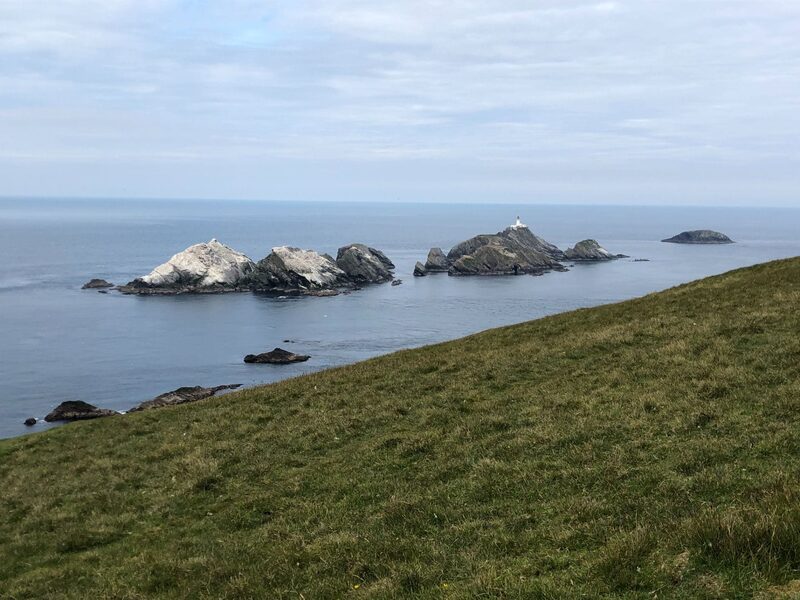
Hermaness National Nature Reserve
An attraction
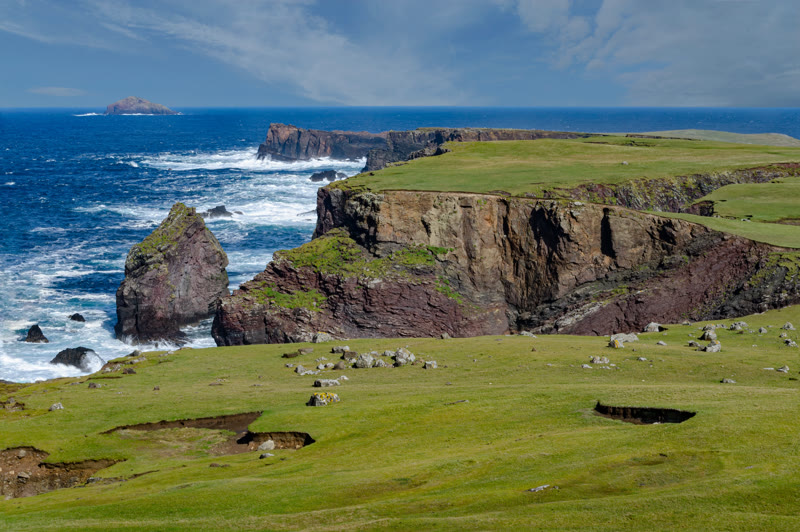
Walk details: 5.5 miles (9 km); moderately challenging in places, although a boardwalk gives easy access to the cliffs. For those who love wildlife, landscapes and wild places that feel as though they’re perched on the edge of the world, Hermaness National Nature Reserve is worth exploring. The walk treks over vast, open moorland to the coastal fringes of Britain’s most northerly point, Muckle Flugga lighthouse, precariously perched on an outlying rock. Shetland’s Atlantic coast is spectacular and rising to 170 metres, the cliffs, stacks and skerries off Hermaness will take your breath away. It’s also a place rich in wildlife; this is a land where birds rule, and for the keen birder, there are over 100,000 breeding seabirds to watch. Be sure to scan the western horizon as you walk in case there are any passing cetaceans nearby. Dramatic and sheer, other-worldly and awe-inspiring; just a few words that spring to mind when I think of this walk. Puffins and fulmars proudly dominate the crags, stacks and cliffs, while nesting great skuas (1,000 breeding pairs) command the moorland, their dark silhouettes camouflaged by the heathery hills. Perhaps the most astonishing sight of all is the vast colony of gannets – 25,000 breeding pairs – who live in a raucous cacophony of noise on the outlying rocks. According to folklore, Hermaness was home to a giant called Herman, and together with Saxa, a giant from the neighbouring headland of Saxa Vord, they fell in love with a mermaid who lured them into the sea. Challenging them to swim to the North Pole, the mermaid promised her affections to the winner. Unfortunately for Herman and Saxa, neither could swim, and both were drowned, leaving this wild and remote area to the birds. The walk to Hermaness is aided by a boardwalk that weaves through the moorland before opening up to the sea. A landscape of wonder appears as you leave the moors behind, revealing uninterrupted views across the vast nothingness of the North Atlantic in all her glory. Standing on the edge of the cliffs, knowing that there is nothing between you and North America is quite something.
If it rains
Rain and mist decide the afternoon: the cliffs at Hermaness are unfenced and show nothing in low cloud, so in poor weather spend it under a roof at Haroldswick instead. The Unst Heritage Centre and the Unst Boat Haven, a minute apart, open every day from 1 May to mid-October, 11am to 4pm, at £5 each for adults at the time of writing, with under-16s free. Saxa Vord Distillery, 3 minutes away, runs tours on Wednesday and Friday at 2.15pm and on Saturday at noon: book online or on 01957 711217. The Viking sites, Sandwick Beach and the Skidbladner are all out in the open.
Worth a detour
- Unst Heritage Centre
Unst Heritage Centre and Boat Haven document the island’s history, particularly its lace industry and maritime heritage.
- Bobby’s Bus Shelter and the E49 memorial
Bobby’s Bus Shelter is a bit of an institution and not easy to miss as it sits on the road out of Baltasound and is highly decorated and colourful. Beside the iconic bus stop is the poignant memorial to the E49 submarine lost in 1917 after hitting a German mine, killing all 31 crew.
- Muness Castle
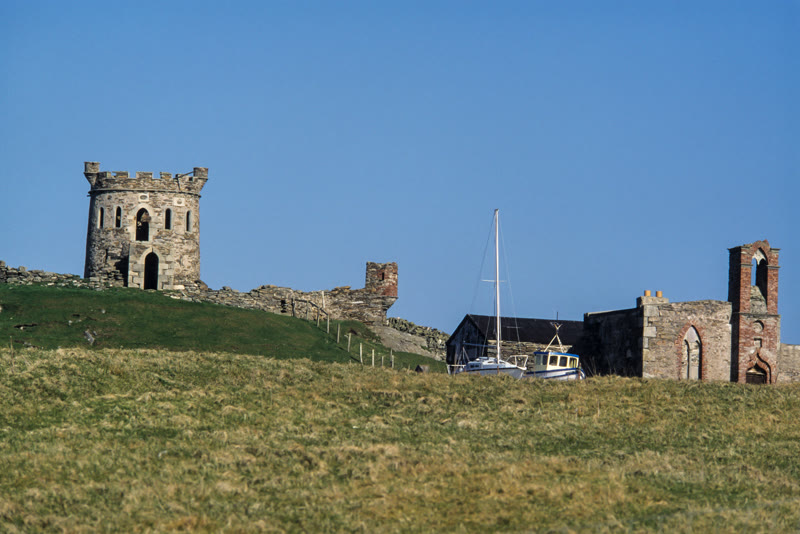
Muness Castle is Britain’s most northerly castle. Shetland is not known for its castles, but, along with Scalloway, Muness represents the tower house, a style of building popular in Scotland. Muness Castle is two miles from Uyeasound and stands as a roofless ruin. The castle, dating to around 1598, was built by Laurence Bruce of Cultmalindie, an uncle to Earl Patrick Stewart, who built Shetland’s only other notable castle, Scalloway Castle, in 1600. The castle is open all year round, and visitors are free to explore it.
- Saxa Vord Distillery
Pre-book a distillery tour and sample a taste of Shetland with the island’s famous gin.
- Keen of Hamar
At first glance, the Keen of Hamar Nature Reserve may look like a stony waste ground but look closer to be rewarded with a delicate carpet of tiny and often very rare plants, including Edmondstone’s chickweed, a plant endemic to Unst. Top tip – the excavated Hamar longhouse is not far from here, on the south side of the Keen!
- Skaw and Norwick Beaches
Beaches – Skaw and Norwick beaches are both worth the drive. Norwick is picture-perfect and makes a beautiful photo, and Skaw beach is the UK’s most northerly. Why not go in for a dip? Visit the most northerly beach and see the most northerly house in the UK at Skaw. Skaw Beach is isolated and remote, and the road leading from Norwick to Skaw is rutted and rough – incidentally, this unclassified road is also the most northerly in the UK. Take a walk around Lamba Ness and view some of the Second World War remains that made up part of a radar station. Lamba Ness is now SaxaVord Spaceport, a licensed site for launching satellites into space.
More days by Laurie