
A day in Yell
Yell, the largest of Shetland’s North Isles: quiet beaches, Windhouse and the Old Haa Museum.
Words by Laurie Goodlad
Yell is the largest of Shetland’s trio of North Isles and, at 17 miles long and seven miles wide, there are plenty of places to discover. Many visitors bypass Yell in favour of the most northerly island, Unst, but Yell has much to offer.
Yell is much more than the road to Unst, and leaving the main road and winding through the scenic back roads affords some stunning vistas and fantastic coastal walks. The island also has good wildlife watching and glistening beaches.
Getting to Yell is easy; it’s just a short hop across Yell Sound on the modern inter-island ferry. The crossing takes about 15 minutes. Passengers can stand on the upper deck and enjoy views across the sound, passing the uninhabited islands of Bigga and Samphrey on the way. The ferry to Yell departs from Toft on the Shetland Mainland and there’s a ferry almost hourly. Booking is recommended but not required.
Self-catering options
You may wish to base yourself in Yell for a few days or a week to explore the vast coastline and numerous places of interest on the island.
Varda self-catering is a self-catering property based in a converted kirk [church] at the end of the beautiful Herra road. The property has been lovingly restored and offers a homely, comfortable stay.
Burravoe Campsite is a delightful campsite at Burravoe Pier. The site is quiet, picturesque and served well with plug-ins for caravans and motorhomes, shower and kitchen facilities and pitches for tents. Reasonably priced, the campsite overlooks the busy pier and marina. If you’re lucky, you might spot an otter from your caravan or motorhome too. Booking is not required and alternative plug-ins can be found at the Cullivoe Hall in the north of Yell if the site is full.
Peerie Bugarth is a traditional self-catering cottage that has been renovated to a high, modern standard while still retaining the traditional feel of these rural houses so typical of the Highlands and Islands. The house is in Mid Yell, close to all the amenities of the island’s main village.
Scarpoe’s Kitchen is another property in the Herra. This is a small, stone-built house that sleeps two. It has been renovated to an extremely high standard and has a mezzanine bedroom overlooking the main house.
Eating Options
For an island the size of Yell, visitors are slightly limited by choice and it’s worth checking opening hours and times beforehand – but what is on the island is excellent.
The Hillshop & Isle Eat Cafe – Isle Eat in Mid Yell offers simple breakfasts, light snacks and lunches, and chef Brian adds his own flair to everything that comes from the kitchen.
LJs Diner & Pizzeria, also based in Mid Yell, has an extensive menu with all the expected favourites found in an American diner. The cafe is in the old Mid Yell school canteen, which gives it a diner feel of its own. If you enjoy ice cream, they have an excellent selection in their ice cream counter.
The Old Haa Museum may not be where you would expect to find great food, but the museum’s tearoom is a good stop for cake. The museum and cafe are run by a team of dedicated volunteers and the cakes are all homemade and generously portioned with a good selection to choose from. The Museum is just a short walk from the campsite and is a great place to spend time – particularly if timed to coincide with that mid-afternoon energy slump that only tea and sugar can fix.
Kitchen Bakery – Shetland has several bakeries supplying fresh bread to the islands. Da Kitchen Bakery is a Yell-based baker supplying local shops. Look out for their produce in the local shops and be sure to buy local.
Shops – you may want to pick up a picnic from one of the local shops in Yell. Incidentally, Aywick Shop is an experience in itself and a good hour or so should be set aside to explore this Aladdin’s Cave selling everything from spark plugs to hosiery. Other shops in Yell are the Hillshop in Mid Yell, the Ulsta Shop as you come off the ferry and Henderson’s shop in Cullivoe.
Top tip: If you’re planning to visit Yell on a Sunday, be sure to check the What’s On guide in the weekly Shetland Times newspaper or check roadside signs advertising Sunday Teas in any one of the local public halls. Sunday Teas are quintessentially Shetland. Basically, a team of volunteers will open the hall for an afternoon selling tea, coffee, cakes, bakes, sandwiches, soup. For a nominal fee, visitors can tuck into an all you can eat buffet-style spread with the best local home-baking and hospitality. Sunday Teas happen throughout Shetland and Yell has eight public halls.
The best of Yell’s beaches
Yell has a number of fantastic sandy beaches and, as the island is often overlooked, you may well have the beach to yourself, winter and summer.
There’s no getting around it, the route between West Sandwick and Gossabrough does involve a degree of retracing your steps but, nonetheless, it’s worth visiting both.
West Sandwick Beach
For this itinerary, we are starting at West Sandwick Beach, on the island’s west coast, on the assumption that the visitor has just come off the ferry at Ulsta. From Ulsta, follow the A968 for six miles towards West Sandwick. Take the turn into West Sandwick and look for the signs for ‘West Sandwick Cemetery (New)’ and take that turn before following the signs for the ‘Beach’.
West Sandwick has been given a Beach Award by the Keep Scotland Beautiful charity. The awards “are the benchmark for quality, celebrating clean, well managed and sustainable beaches.” The beach’s pristine white sand sits beneath the dunes, just a short stroll from the car park, and enjoys uninterrupted views across Yell Sound towards Northmavine.
From here, move on to the Gossabrough Beach. There are two options to get there, you can either travel south via Ulsta before heading north towards Gossabrough (A968 and B9081). This route is a 25-minute drive over 14 miles. The alternative is to head northeast towards Mid Yell on the A968 before joining the B9081 heading south towards Gossabrough.
We suggest going via Ulsta, passing Burravoe, where you can stop at the Old Haa Museum for a look at the displays and gardens and enjoy a warming cup of tea and slice of show-stopping cake before heading to the beach.
Gossabrough Beach
Gossabrough is on the east coast of Yell, with beautiful, peaceful views across Colgrave Sound towards the island of Fetlar. As the name suggests, Gossabrough is home to one of Shetland’s numerous Iron Age brochs. Now in ruin, the 2,000-year-old broch – now no more than a mound on the hill – is a reminder that people have been living on the islands for thousands of years, and, looking around the area, evidence of people is everywhere. From the abandoned 19th-century buildings across the water at Queyon to the remains of a boat noost offering protection to boats from the worst of the winter weather, it is clear that this is an area of almost continual habitation.
Top tip: After you’ve been to Gossabrough visit the White Wife statue just a few miles north at Otterswick. This is a short walk along the shore until you reach the upright statue, known as the White Wife. This is a ship’s figurehead from the Bohus that was wrecked off the coast here. The poignant figurehead that now acts as a memorial shows a woman clasping a bible to her chest and gazing out to sea.
From here, head north to rejoin the A968 at Mid Yell before heading towards Cullivoe, the northernmost point of the island.
But, before reaching Mid Yell, look out for the Aywick Shop – you can’t pass Mary’s shop without stopping for a look. You never know what you’ll come out with …
Sands of Breckon
From Mid Yell, follow the A968 for 13 miles until you reach Breckon. The beach is well signposted with brown tourist signs. Once you reach the end of the road, cars can be parked responsibly at the turning point before following the marked path to the beach.
Tucked away in the northernmost part of Yell, the Sands of Breckon is a quiet beach. The beach is a wide expanse of white sand, seldom busy, with a rich archaeological past that is still visible today. Hunt for beautiful shells as you walk because Breckon’s sands are teeming with intricate little pastel coloured shells, tossed onto the sand and discarded by the sea beyond.
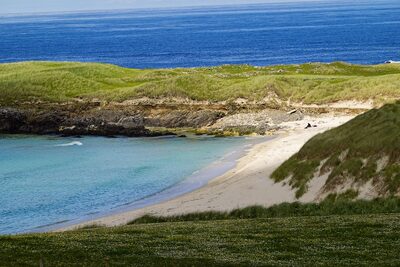
Breckon has also been given a Beach Award by the Keep Scotland Beautiful charity.
The island’s history
Yell is an island that’s full of history, with evidence dating back to the Neolithic period, some 5,000 years ago and, like most of Shetland, archaeological evidence is all around. As the islands have not been extensively farmed, many prehistoric sites are still standing in situ – albeit, mostly in a ruinous state.
The beauty of exploring Yell’s archaeology is that most of it is free to access, remote and secluded, away from the visitor centres and infrastructure that often accompany sites of antiquity.
Below are a few places that are worth exploring:
The Old Haa Museum
The Old Haa Museum is sited in a former haa house (two-storey laird’s house) dating back to the 17th century and houses the island’s museum and archive. It’s a fascinating museum, stuffed with local history, inspiring displays, an archive, exhibition space, shop and, importantly, a cafe selling locally made cakes and bakes.
The museum has a special display honouring Yell-born naturalist Bobby Tulloch (1929-1996). He was RSPB Shetland’s representative for many years, and in 1994 he was awarded an MBE for his work on behalf of wildlife. The museum’s gardens are beautifully presented within a walled garden, largely protected from the harsh Shetland climate and lovingly tended by the volunteers who run the museum.
Burravoe is five miles from the ferry terminal at Ulsta. When leaving the ferry, take the first road on your right (B9081) just after the shop. Follow the road for a few miles until you reach Burravoe.
Gloup Memorial
Shetland has traditionally depended on the sea and the rich fishing grounds around the islands have provided food and income for generations of Shetlanders over the years. This hasn’t come without human cost though, and the Gloup Memorial is a poignant reminder of more challenging times when men fished from small open boats called sixerns in offshore waters. This fishery, known as da haaf fishing, was dangerous, hard and crews were made up of whole families.
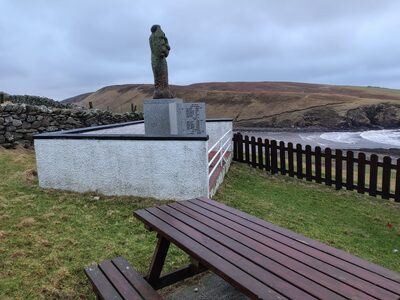
In 1881 a storm lashed the fleet that had set out to sea, leaving most of the boats wrecked. The memorial commemorates the lives of 58 fishermen who were lost to that devastating storm that left 34 widows and 85 orphans behind. In this small community, this is an unimaginable loss.
The White Wife
Travelling off the main road, along the east road between Burravoe and Mid Yell, is an excellent way to see more of the coastal fringes of Yell. At Otterswick, park and take the short walk out to the figurehead known as the White Wife. This ship’s fixture, which would have adorned the bow of a boat, came from the Bohus, a German training vessel wrecked off the coast in 1924.
Windhouse
Windhouse is really no more than a roofless ruin that visitors are warned not to enter for their own safety (as the building is crumbling), but, it’s a great place to walk around and do a spot of ghost hunting. Not only is Windhouse Shetland’s most haunted house, but it has also been suggested that this is the most haunted house in the UK.
The ruined house sits on the crest of the hill on the approach into Mid Yell. Its foreboding silhouette commands views in all directions and dominates the skyline. This house sits on the site of an ancient settlement – perhaps explaining why it has the reputation of being Shetland’s most haunted place. The house itself is built on the site of a 2,000-year-old Iron Age broch, and excavations have revealed a burial site within the house’s gardens. Steeped in mystery and legend, Windhouse attracts both historian and ghost-hunter, keen to unpick the magic of this iconic house.
The list of ghosts alone is impressive. They include the Lady in Silk, a tall, cloaked man, a child, a black dog, a taxman and, most chillingly, a beast that patrols the grounds and will kill. Whatever the truth, this once-majestic building, with the armorial crest of the Neven family above the door, was a grand home, and it is an eerie and thought-provoking place to pass.
You’ll find Windhouse along the A968 just south of the junction to Mid Yell.
Walks
For lovers of hiking and history, Yell has several sites of interest that involve slightly longer and more challenging walks.
Burraness Broch
This is a moderate three-mile walk along the coastline. Burraness is one of around 120 known broch sites in Shetland, most now standing in ruin, with only parts of the original structure still visible. The Burraness broch stands guard with commanding views out to sea. The walls on the seaward side still rise several metres in height, and ramparts are visible on the approaches to the broch.
The walk starts at North Sandwick, by the junction just before the Gutcher ferry terminal, and follows the coast out to the broch and back. *Please note that there is no designated parking area here so please park responsibly and draw-in by the stile without obstructing drives, livestock gates or obstructing the small turning point.
Catalina Crash Site, Arisdale
This is a slightly more challenging walk over five miles of open moorland, inland to the crash site of a Second World War Catalina seaplane. The walk is signposted “Catalina Memorial” and is roughly halfway along the B9081 between Ulsta and Burravoe and will take about three hours in total. Surprisingly, much of the plane survives. A poignant memorial commemorates the seven crew who lost their lives when the aircraft suffered engine failure on the approaches to RAF Sullom Voe.
Neapaback
The walk to Neapaback begins at the Burravoe Campsite, and is perfect if you are visiting with a caravan, motorhome or tent as the walk begins in the campsite car park. The 10-minute walk north along the coastline affords some spectacular coastal views and the chance to see some of Shetland’s seabirds up close and personal. During the breeding season, look for guillemots, razorbills, kittiwakes, fulmars, shags and puffins.
Top tip – From the campsite, another good walk is around the Heoga Ness peninsula. This is a fantastic area to see otters too.
Other places worth a visit in Yell
Aywick Shop – selling everything you could ever imagine.
Explore the Herra – The Herra sits in an often forgotten corner of West Yell, flanked by the long voe of Whalefirth. It’s a beautiful and unexpected community at the end of a long road, through open moorland. Explore the beach and surrounding coastline and, if you’re feeling fit, why not hike out to the imposing Stacks of Stuis?
Book a wildlife tour and look for otters – Yell is a fantastic place to track and see the elusive Eurasian otter, and there’s no better way to do this than by joining a local guide specialising in wildlife tours. Shetland Nature runs tours that let visitors spot wildlife in its natural habitat safely and with the utmost respect for the environment.
Explore the island’s craft scene – Yell has a wealth of creative talent and one of the best places to see this is in Sellafirth where you can visit the Shetland Gallery and pop next door to the Shetland Tweed Company.
Did you know that Bayanne House is based in Yell? Bayanne is best known as facilitating Shetland’s genealogical website, a site that allows people to freely trace their family heritage in the isles. Bayanne also has a craft shop and visitors are welcome to pop into their Sellafirth croft.
 Out now
Twice a year, to your door
One hundred and sixty pages of Scotland, every photograph commissioned, every word written by someone who went. Members get both issues posted and everything on screen.

 The Last Stop Before Nowhere
 A Weekend Exploring the Isle of Mull
 What's On in Scotland: Autumn and Winter