
From Issue Three of Hidden Scotland Magazine
Scotland’s Jurassic Island
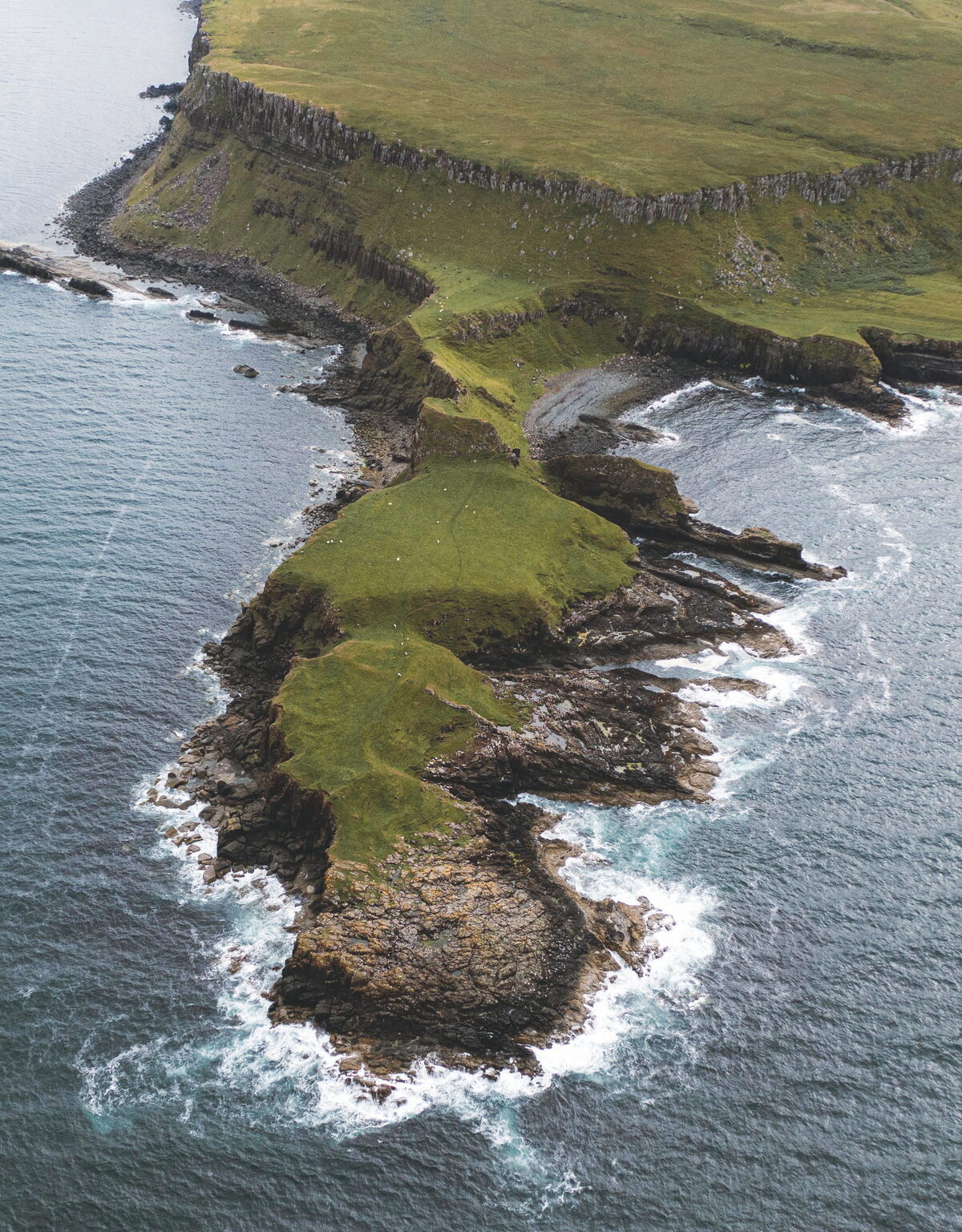
Dinosaur footprints beneath Duntulm Castle on Skye.
Words by Steve Brusatte · Photographs by Chris Houston

Printed in Issue Three of Hidden Scotland Magazine, Winter 2021.
In the shadows of the ruins of Duntulm Castle, once home to Clan MacDonald on the northern tip of the Isle of Skye, are the marks of a beast.
The tide gently laps over them each day. Other times they are covered by seaweed or sand. Occasionally, a storm engulfs them in frothy surf, and leaves them buried in boulders. There are over 100 of these scars, each the size of a car tyre. They are handprints and footprints, sealed in stone. Not from a dragon of medieval lore, but a true colossus, which once walked the Scottish coasts, 170 million years ago during the Jurassic Period.
Dinosaurs. When you think of these ancient giants, and where to find their bones and footprints and other fossils today, your mind probably goes to the television stereotype. An outpost of some unnamed desert, hot and dusty and dry, miles from civilisation, where an intrepid explorer patiently dusts sand away from a rock face, exposing a petrified skeleton. But in reality you can find dinosaur fossils anywhere where there are rocks that formed during the Mesozoic Era, the span of time from 250-66 million years ago when dinosaurs dominated. One such place is the Isle of Skye.
-full-1750069865.jpg)
For members
Keep reading with membership
The rest of Scotland’s Jurassic Island is for members. Printed in Issue 3, from page 60.
A year. Every issue and guidebook online, every article in full.
Join with DigitalA year. All of Digital, and two new issues posted to your door.
Join with PrintAlready a member? Sign in · Read the opening pages of Issue 3 free
 Elusive Creatures
 Chasing the Night
 Beaver, Is That You?