
-full-1750192539.jpg)
What Was Scotland’s Most Impenetrable Castle?
The castles built to resist a siege, from Tantallon's sheer curtain wall to Dunnottar's headland.
Words by Jack Cairney
-full-1750192539.jpg)
Stand on the clifftop at Tantallon Castle and the same thought comes each time: if you had to hole up anywhere in medieval Scotland, this might be it. The curtain wall is sheer and thick, stonework that seems to grow from the cliff itself, facing inland while the sea at your back takes care of any chance of encirclement. Even now, with only ruin to go by, it’s difficult to picture any medieval force breaching it without help from within.
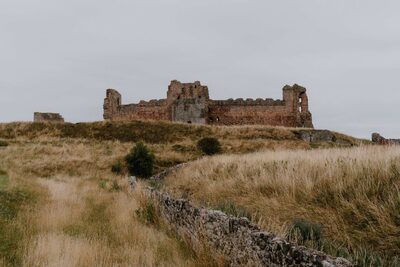
It was James V who famously ordered it destroyed (“Ding doon Tantallon!”), and even then it took cannon and bribery. Before artillery tipped the scales, it was practically impregnable. There’s no sneaky approach, no easy angle for ladders or siege towers, and the wall itself is a brute. You'd need patience, siege engines, and a lot of men willing to die getting nowhere fast. It’s not just the engineering, it’s the position: open to wind and weather, with the North Sea slamming into the cliffs below. Nothing about it invites an army to linger.
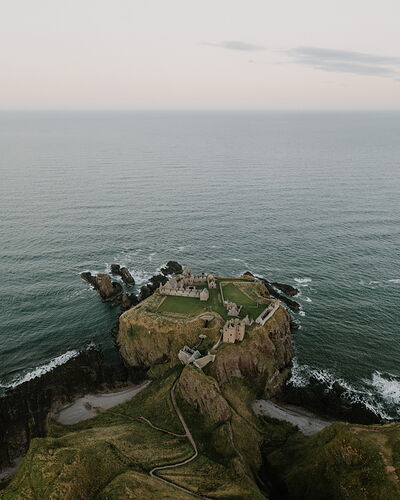
That said, Dunnottar Castle puts up a fair challenge. A fortress carved into a headland off the coast of Aberdeenshire, it looks like it belongs more to myth than military architecture. A single steep defile leads in, meaning any attacking force would have to funnel up under fire, while the sea surrounds it on three sides, cutting off any hope of a multi-pronged assault. What made it fearsome wasn’t just its walls but the fact that most armies simply wouldn’t get close enough to test them. Cromwell’s forces eventually took it too, but not without serious effort.
Stirling and Edinburgh were grander, yes, and strategically vital, but both were taken repeatedly, often by trickery or brute numbers. Their importance on the map outweighed their defensive reality. Dumbarton too, for all its height and drama, changed hands more than once. Cairnburgh Castle on the Treshnish Isles deserves a mention: remote, split across two islets, and about as logistically infuriating as you can get for anyone hoping to storm it from sea. But isolation is a double-edged sword. Holding out is only useful if help’s coming.
What makes Tantallon stand out, then, is its clarity of purpose. It wasn’t built to impress. It wasn’t tucked in a town, or layered with ceremonial buildings, or adapted to changing styles. It was built to endure a siege from one direction, and for a time, it did exactly that. No wonder later monarchs treated it as a threat even long after it had passed from its original lords.
The Daily
Arrives at 5am every day.
A free morning email to see what’s on this week, catch up on what’s happening in Scotland and find somewhere new to go.
So the choice is Tantallon, for the simple, stubborn way it was designed to resist.
 Out now
Twice a year, to your door
One hundred and sixty pages of Scotland, every photograph commissioned, every word written by someone who went. Members get both issues posted and everything on screen.
 The 900th Anniversary of Stirling
 Kilmartin Glen