
Site in focus: Jarlshof
Jarlshof, the site at Shetland’s southern tip with 5,000 years of almost unbroken settlement.
Words by Laurie Goodlad
Welcome to Jarlshof Prehistoric & Norse site. This fascinating site sits on the southernmost tip of Mainland Shetland, where the North Sea meets the Atlantic Ocean. This is one of the most important, and largest, multi-period sites in Europe, with an almost uninterrupted occupation from the first Neolithic farmers right up until the 1600s when the Stewart Earls ruled.
One of the most fascinating things about the site at Jarlshof is that there are 5,000 years of almost uninterrupted occupation here, giving us a clear picture of settlement in Shetland through the years.
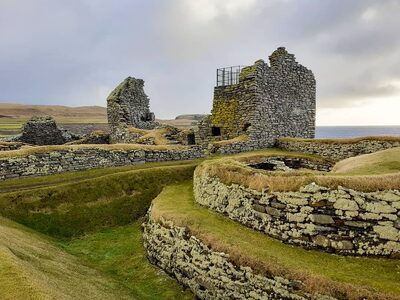
The site is well worth seeing for anyone visiting Shetland; laid out chronologically, visitors weave their way through the ages of Shetland’s human history. From the first farmers of the Neolithic, through the Bronze Age, Iron Age, Broch period and the arrival of the Vikings. Following a period of Norse rule, Shetland becomes part of Scotland, and we see an era dominated by the Scottish Lairds. Visitors conclude their walk through time with the now ruinous, but once grand, Laird’s house of 1600.
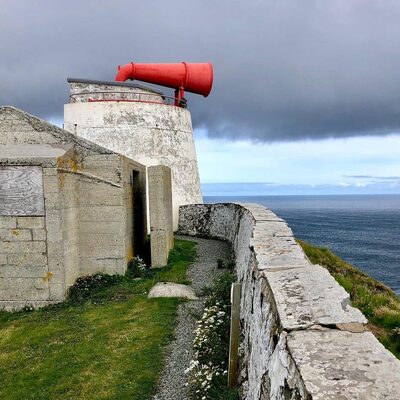
The name Jarlshof was coined by novelist, Sir Walter Scott, who visited here in 1814 with the Stevenson brothers who were building the lighthouse at Sumburgh Head (which is also well worth a visit). He later wrote the novel, The Pirate, inspired by this part of Shetland. In the book he called the house here on the site, Jarlshof, meaning ‘the Earl’s House’.
How was this site discovered?
Following a succession of severe storms over the winter of 1896/97 parts of the site were exposed by coastal erosion. Landowner, John Bruce of Sumburgh, held preliminary excavations and, recognising the importance of the site, handed it over to the state in 1925 who carried out systematic excavations for the next 50 years – only breaking for war. The excavations have significantly added to our knowledge of Shetland’s past societies; how they lived, worked and ate.
The varying depths of the site demonstrate how the layers were peeled back. Standing outside the Visitor Centre, views across the site show the different levels and layers of history. Archaeologists made important decisions as they unpeeled the site about how much to excavate and, importantly, how much to leave. This has allowed a clear and defined chronology which we can appreciate and unravel today. More lies likely buried beneath the layers, but to expose them, later phases of occupation would be lost. It’s important to remember that archaeology is always a destructive process.
Why Jarlshof?
Jarlshof was – and is – a fantastic location to settle; within easy reach of mainland Scotland and Orkney to the south, and two days’ sailing from Norway. The site sits in a shallow bay with a safe anchorage for beaching, drawing up boats and exploiting the shoreline for shellfish – the Mesolithic shell midden at Westvoe, just along the coast, is evidence of this. The whole area sits on a bed of fertile, sandy soil with freshwater springs nearby.
Paths have been laid around the site, and the walk is in chronological order. The turf on top of the walls and structures consolidate the area, preserving it into the future. Historic Environment Scotland maintains Jarlshof, and the site is open all year round (the Visitor Centre is only open throughout the summer season).
Jarlshof brings visitors tantalisingly close to how past societies lived on this salt-kissed peninsula of southern Shetland.
 Out now
Twice a year, to your door
One hundred and sixty pages of Scotland, every photograph commissioned, every word written by someone who went. Members get both issues posted and everything on screen.

 The 900th Anniversary of Stirling
 Kilmartin Glen