
Shetland’s relationship with Scotland
How Shetland passed from Scandinavia to Scotland in 1469, and why it still feels different.
Words by Laurie Goodlad
Shetland’s Scandinavian heritage, and its relationship with the Viking and Norse world, has shaped much of the islands’ past and present.
But what about the relationship between Shetland and Scotland? After all, Shetland is a part of Scotland and the wider UK.
This has not always been the case, and, until 1469, Shetland belonged to Scandinavia and was latterly ruled by the Danish monarch – King Christian I.
The differences between Shetland and Scotland remain quite striking today; for example, you’ll struggle to find much evidence of the ubiquitous haggis, kilts and bagpipes that are so synonymous with Scots culture.
To understand this unusual relationship, we must travel back to around 850 AD and the arrival of the Vikings to Shetland’s shores. Their influence and, importantly, the subsequent settlement on the islands led to a period known as the Norse period. This period shaped much of the islands’ language, culture and tradition.
This period of administration, spanning some 600 years, came to an end in 1469 when King Christian I of Denmark sanctioned the marriage of his daughter, Princess Margaret, to King James III of Scotland. What happened next would prove to be one of the most crucial turning points in the islands’ history.
It was not uncommon for royal families to intermarry in those days, and these royal intermarriages were usually politically driven. Often done for national interests, these bonds of union were rarely brought about through love but, instead, for political reasons; to promote or prevent aggression. These marriages, if advantageous, could bring peace between nations or an alliance of trust to reduce the threat or attack of another.
In the case of Princess Margaret and King James, it was hoped that a union would reconcile differences that had almost set the two countries at war. Scotland was in arrears to the Norwegian Crown (presided over by the Danish King Christian) and paid back the ‘Annual of Norway’ for several years. Scotland’s conditions for the marriage were a debt write-off, 100,000 crowns for the wedding and the islands of Orkney and Shetland.
King Christian was keen to retain Orkney and Shetland. He abolished the arrears, pledging 60,000 Rheingulden (gold florins from the Rhineland, a popular currency in Northern Europe at this time) as a wedding dowry instead.
Unfortunately, King Christian couldn’t afford to pay the dowry, and with the wedding set for 1469, he instead pawned Orkney and Shetland. Slightly insulting to Shetland – although understandable given Orkney’s farming credentials – the price set against each island was: Orkney 50,000 florins and Shetland, a mere 8,000 florins. Shetland was very much bolted on to the end of the deal, with Orkney as the greater asset, when Christian had failed to raise the cash any other way.
Christian didn’t give up on Orkney and Shetland and planned on redeeming the islands at a later date – even imposing a tax on Denmark to try and raise the money – but this never happened, and Shetland and Orkney have remained part of Scotland ever since.
Despite Shetland coming under Scottish administration in 1469, the final pieces of legislation were only settled in 1471. The islands continued to follow Norse Law and were connected to the Law Book of Magnus the Lawmender until 1611 when parliament abolished its use and ordered that the islands follow Scottish law.
An almost 150-year period followed where the islands were still entrenched in the old and familiar Scandinavian way of doing things. A similar story plays out in the language, too, where much of the roots of the dialect are found in Old Norse, spoken in Shetland until a few hundred years ago. Annexation to Scotland set change in motion as the traditional Norn language was gradually superseded by Scots English.
The transition into Scotland wasn’t easy for Shetland, and the people acutely felt the teething problems. On acquiring the lands of Orkney and Shetland, King James III was quick to begin giving out portions of them to friends and relatives. As a result, wealthy Scottish landowners migrated north in search of new lands and riches, bringing significant changes with them.
The time of the Stewart Earls is perhaps one of the most unpleasant periods in Shetland’s history, and it did little to endear native Shetlanders towards their new ruler, Scotland. The Stewart Earls – Patrick in particular – are today remembered as the most tyrannical figures in Shetland’s story. The Stewarts brought pain and suffering to those islanders they were supposed to serve.
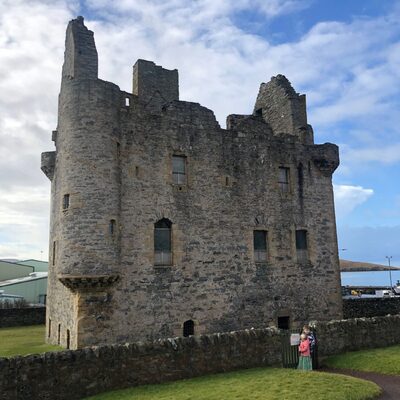
Earl Patrick Stewart is best known for building the Scalloway Castle in Shetland and the Earl’s Palace in Kirkwall.
Aspects of Scots popular culture have trickled north – Shetland supports Scottish football teams, takes delight in a can of Tennents or a bottle of Irn Bru, and children are brought up with a copy of The Broons and Oor Wullie in their stocking every Christmas. Yet the Norse roots are still very much celebrated today – particularly in the festival of Up Helly Aa.
The year 1969 marked the 500th anniversary of Shetland becoming part of Scotland.
To mark the occasion, the Shetland flag was specifically created to represent Shetland’s distinct cultural heritage. Designed by Roy Grønneberg and Bill Adams, the flag carries the Scandinavian – or Nordic – cross yet bears the same blue and white colours as the Scottish saltire.
The flag is a real celebration of Shetland’s rich past, commemorating 500 years of Scandinavian rule and 500 years of Scottish rule. Shetlanders are very proud of their flag. Visitors will see it flying freely across the islands and at sea as a symbol of Shetland’s distinct cultural identity and rich history.
The flag gained official recognition in 2005, in time for Shetland’s hosting of the Island Games, and is used by all local sports teams and islanders as a marker of national pride.
Shetland Flag Day, introduced in 2007, is held on the summer solstice (21st June).
As a visitor, what are the most obvious differences between Shetland and Scotland?
The greatest differences can be found in the culture and tradition of each place:
National dress: tartan and kilts in Scotland, Fair Isle knitwear in Shetland.
Music: bagpipes in Scotland, the fiddle in Shetland.
Food: haggis, neeps and tatties in Scotland, reestit mutton tattie soup in Shetland.
Language: Scots and Gaelic in Scotland, Shetland dialect (derived from Old Norse) in Shetland.
National animal: the Highland cow in Scotland, the Shetland pony in Shetland.
Celebrated poet: Robbie Burns in Scotland, Vagaland in Shetland.
Festival: Burns Night in Scotland, Up Helly Aa in Shetland.
 Out now
Twice a year, to your door
One hundred and sixty pages of Scotland, every photograph commissioned, every word written by someone who went. Members get both issues posted and everything on screen.

 The 900th Anniversary of Stirling
 Kilmartin Glen