
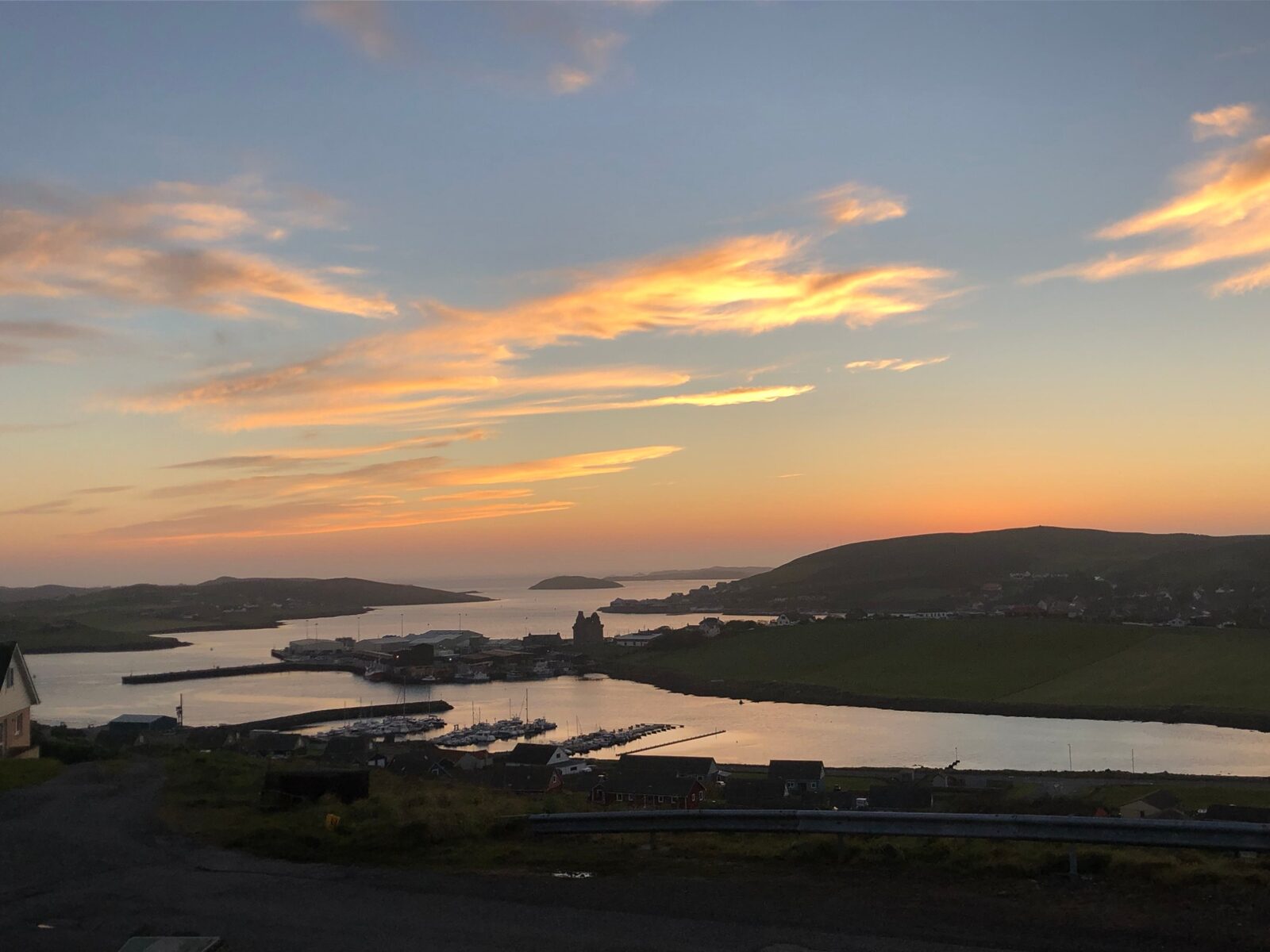
Scalloway Castle in 11 facts
Scalloway Castle and Black Patie, the earl who built it and was beheaded in 1615.
Words by Laurie Goodlad
The village of Scalloway is the former capital of Shetland and, in many ways, is a far more attractive place to create the administrative capital than Lerwick. Lerwick was not a natural choice for a town, and Scalloway was the main town until about 1838. Scalloway was an obvious choice; it sits at the foot of a fertile limestone valley, has a wide, natural harbour close to rich fishing grounds, and has a good supply of fresh drinking water. Lerwick did not share these qualities, and the land where the town now stands was only ever used for grazing animals from the neighbouring township of Sound (which has now been swallowed up by the town).
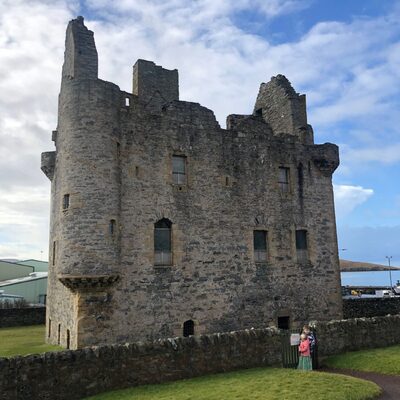
Today, the skyline of this picturesque village is dominated by the roofless ruins of the impressive Scalloway Castle.
Hopefully, these facts will give you a tantalising insight into the history of this thought-provoking building.
Scalloway Castle was completed in 1600
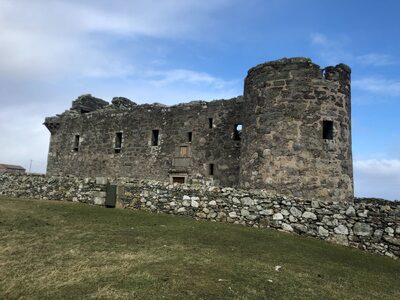
Scalloway Castle was completed around 1600 and built by tyrant Earl Patrick Stewart, Earl of Orkney & Lord of Zetland [Shetland]. Local legend tells us that the castle was completed using forced labour and was built from locally quarried limestone with sandstone finishings imported from Eday in Orkney. Patrick didn’t stop at Scalloway; he was also responsible for the Earl’s Palace in Kirkwall. These two buildings and Muness Castle in Unst all represent the Scottish tower house style, and nothing like it had been seen before – or since – in Shetland.
Human hair and blood was added to the mortar mix
Folklore tells us that to build the castle, Patrick mixed eggs, blood and human hair with the mortar; the truth of this is unclear, but for anyone growing up in Shetland, this is a story that is often regaled to children. The claim may be valid as organic material and shells were commonly used in making mortar at this time.
Earl Patrick Stewart is one of Shetland’s most infamous villains
Earl Patrick Stewart, known as ‘Black Patie’, was detested in Shetland. Despite spending much of his reign in Orkney, he retained residences in Shetland, including Scalloway Castle. This was a time of great suffering, punctuated by oppression and harsh, iron-fisted rule. Many of the stories of Black Patie are veiled with sinister speculations, and it isn’t easy to decipher what’s true and what’s a legend. Yet his name has gone down in history, and he’s often pegged as one of the most wicked villains in Shetland’s history. Patrick was no diplomat, and he was known to quarrel violently with anyone who opposed him – even those closest to him. He was a man with mounting debts who, in response to these, increased taxes on the people. The taxes were collected in wadmel (a rough, woven cloth), a low-grade butter used as oil, and fish oil used for lighting. As well as heavy taxes, his people were required to cut and supply peat to keep the castle fires burning, and any driftwood – a precious commodity in a treeless environment – was also taken by their ruler.
Scalloway was the administrative seat of power
The castle was the administrative seat of power in Shetland from 1600. It replaced the traditional Tings, or parliaments, held at the Law Ting Holm in Tingwall since the Norse settlers arrived and settled. Despite this, Shetland continued to follow Norse Law until an act of parliament in 1611 outlawed it.
Scalloway Castle was the site of Shetland’s witch hunts
During the 17th century, Scalloway Castle held the court proceedings, tried criminals, and dished out punishments to convicted criminals. The Database of Scottish Witches lists 28 people who were tried for witchcraft in Shetland (22 of whom were women and six were men). There are no details about the outcomes of the trials, and we cannot be certain of the accuracy of this database concerning Shetland’s witches. However, we know for certain from other records that seven of them were executed – a quarter of those who were tried. Barbara Tulloch and her daughter Ellen King were the last witches burned on Scalloway’s Gallow Hill around 1700. For a large part of the 17th century, many women were tried and executed for witchcraft. More often than not, they were merely ordinary women who were perhaps wise or familiar with alternative medicines. Like many more before them, Barbara and Ellen were burned on Gallow Hill after being strangled. It was a widely held belief that the devil may inhabit a witch’s body after death and cause them to rise again. They were burning the bodies to prevent this.
Scalloway Castle is one of only two substantial castles in Shetland
Scotland itself is the land of medieval castles, and with more than 1,500 dotted across the nation, they act as a reminder of a time forgotten, a time when wealthy classes ruled over the peasant classes. Scalloway Castle is one of only two substantial castles in Shetland, the other being Muness Castle on the island of Unst. As Shetland was part of Scandinavia until 1469, castle building was never part of the architectural landscape in the islands until Scots influence became more prevalent following the annexation into Scotland.
Families feud too
Scalloway Castle’s Earl Patrick Stewart was a nephew of Muness Castle’s owner Laurence Bruce of Cultmalindie (Perthshire). Laurence was appointed tax collector (or Sheriff) in Shetland around 1571, and he and his nephew Patrick were known to quarrel – resulting in the almost-sacking of Muness by Patrick’s men. It’s said that Patrick flew into a rage and, after sacking his house at Sumburgh, headed north towards Muness. Perhaps his mood lifted on the long journey north but, whatever the reason, a shot was never fired, and Patrick returned to Scalloway peacefully.
Scalloway Castle was designed by architect Andrew Crawford
Both Scalloway and Muness were designed by architect Andrew Crawford, who is buried in the Tingwall graveyard, just a few miles from Scalloway. Crawford was an incredibly skilled architect, and there are no other comparable buildings like these in Shetland. Stylistically they draw their inspiration from the Scottish tower houses of this period, and both castles would have been an impressive and dominating sight on the skyline.
Scalloway Castle is linked to Mary Queen of Scots
Earl Patrick Stewart’s father, Earl Robert Stewart, was an illegitimate son of King James V of Scotland and a half brother to Mary Queen of Scots. Robert and Mary grew up together in the palace and were both educated in France as Catholics. King James V died in 1542, and a six-day-old Mary, the only legitimate heir, succeeded him to the throne. Mary and Robert remained firm friends, and in 1564 Mary knighted Robert, making him Earl of Orkney (and later, in 1581, Lord of Shetland). Like Patrick, Robert wasn’t much liked in Shetland during his rule, and in 1593 he died and was succeeded by his son, Patrick.
Patrick eventually fell from grace and was beheaded in 1615
From the 1590s, not long after Patrick came to rule, word of his ill-treatment filtered back to Edinburgh, and the stories soon became too outrageous to ignore. In 1609, unable to ignore the dictatorial nature of Patrick’s rule any further, a party of men were sent north to capture him and bring him back to Edinburgh for trial. It was many years before he finally answered for his misdemeanours. Patrick was executed on 6th February 1615 and was beheaded by the Maiden. His son, Robert, was also tried for plotting a rebellion and was ordered to hang – he didn’t get the grace of a ‘nobleman’s execution’ by the Maiden.
-full-1749383090.jpg)
Smoking kills
Perhaps one story that sums up Black Patie is the tale – and I call it a tale as there are several versions, but this one’s my favourite – of how he came to be discovered by the King’s men. The story goes that, having been tipped off that the King’s men were on the hunt for him, Patrick hid in a turret in his castle at Scalloway. Patrick was a great pipe smoker, and while hiding, he lit up his pipe and took a long draw of the sweet tobacco. Unfortunately, for our poor villain of the story, the pipe smoke gave away his hiding place, and the King’s men were able to find him and cart him off to Edinburgh to face justice. There is no evidence that there is any truth in this tale.
 Out now
Twice a year, to your door
One hundred and sixty pages of Scotland, every photograph commissioned, every word written by someone who went. Members get both issues posted and everything on screen.

 The 900th Anniversary of Stirling
 Kilmartin Glen