
Knit Power
Contemporary craft pioneer and award-winning designer Donna Wilson manufactures her bright and beautiful knitted creations in her new factory in Dundee. Here, she is tapping into the city’s fabrics heritage to revive the traditional Scottish textile industry.
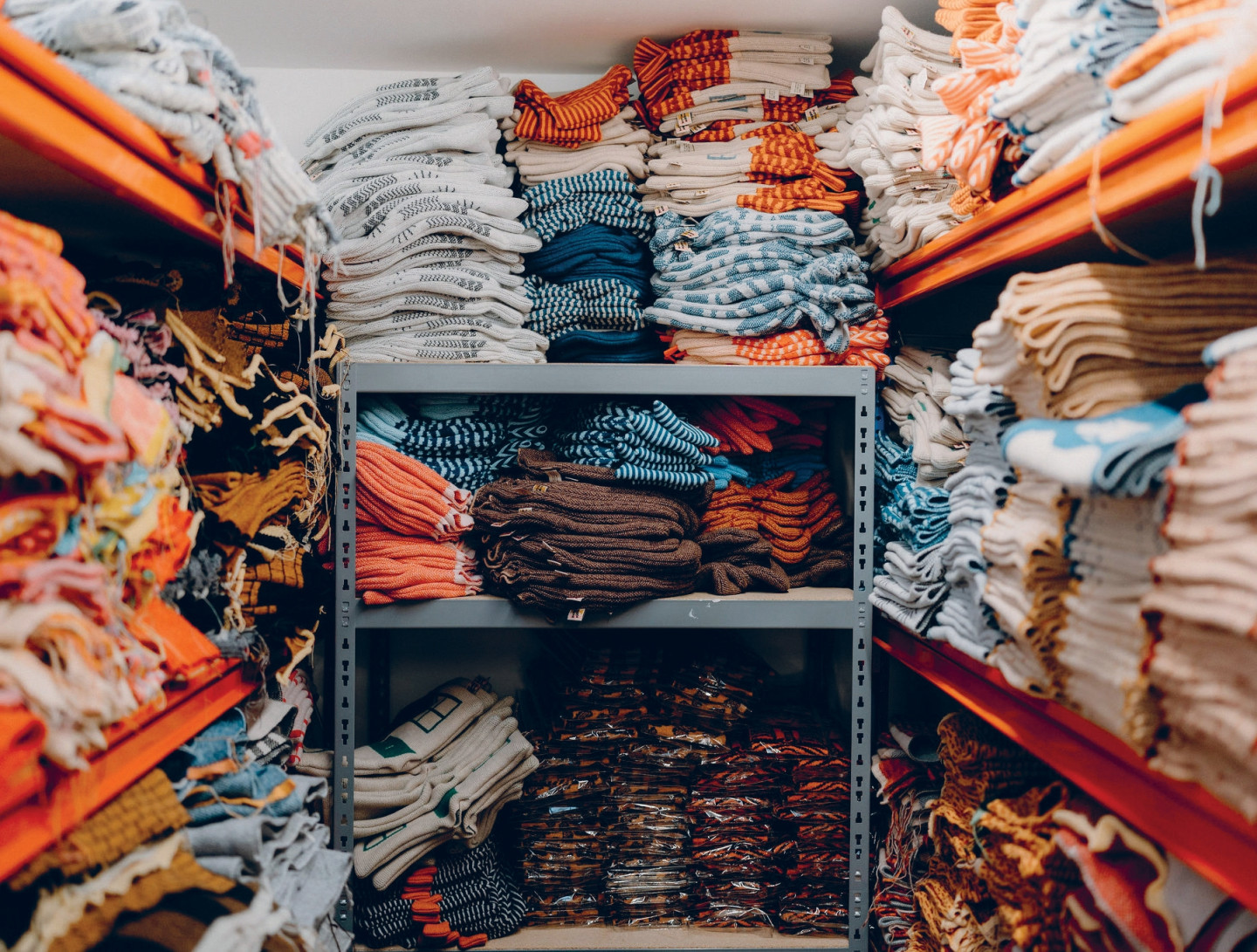
On a Dundee street, where the city’s arts institutions are scattered all around, knitting machines are whirring in a brand new factory. It’s a welcome sight in this once-thriving textile centre famed for its linen, sail-cloth and jute. A city whose mills and factories formerly employed over 50,000 people. Many of these industrial establishments closed in the 1920s as the Indian jute industry boomed, but Donna Wilson remembers one from her own childhood: a big knitwear factory called Spencer’s of Huntly that made fabric for Marks & Spencer. She remembers that when it became cheaper to make mass market items overseas and the factory closed, people lost not only their jobs but their skills. It is this that the award-winning knitwear designer wants to challenge. She wants to keep the tradition of knitwear and textile production in Scotland alive so that these skills are not lost forever. It is she who recently launched Knit Shop, Dundee’s newest knitwear factory, which is invested in preserving the traditions of the Scottish textile industry.
The story starts in an Aberdeenshire farmhouse, where as a child Donna occupied an old henhouse as a hideaway for making all sorts of crafts from branches, twigs and mud. Quickly developing a love for the natural landscape and making things using handcraft, she went on to secure a place at one of Scotland’s top art schools – Gray’s School of Art in Aberdeen. It was here that she became fascinated by wool – not only the beautiful colours that were available, but also the fact that it’s a natural material that can disappear into the earth. “I experimented a lot with wool felting techniques whilst at college, and I loved the fact that I could create my very own fabric by knitting. I had complete control over the pattern, texture and colour,” she explains.
She went on to study at the Royal College of Art in London and it was here, while completing an MA in Mixed Media Textiles, that she started to use recycled jumpers to make the “Donna Dolls” that would establish her future success. Her tutor suggested she show them to some local shops in London, and the bold designs with kooky style – think blue hair, stripy tunics and matchstick arms and legs – were an instant hit, their sales making Donna enough to pay her rent through college. “I was inspired by how you draw as a child – when it doesn’t really matter how many legs or arms or eyes you draw; it’s just creative and free,” she says. The designs developed into “creatures”, such as Cyril Squirrel Foxes or Charlie Monkeys, similarly quirky and all made by hand.
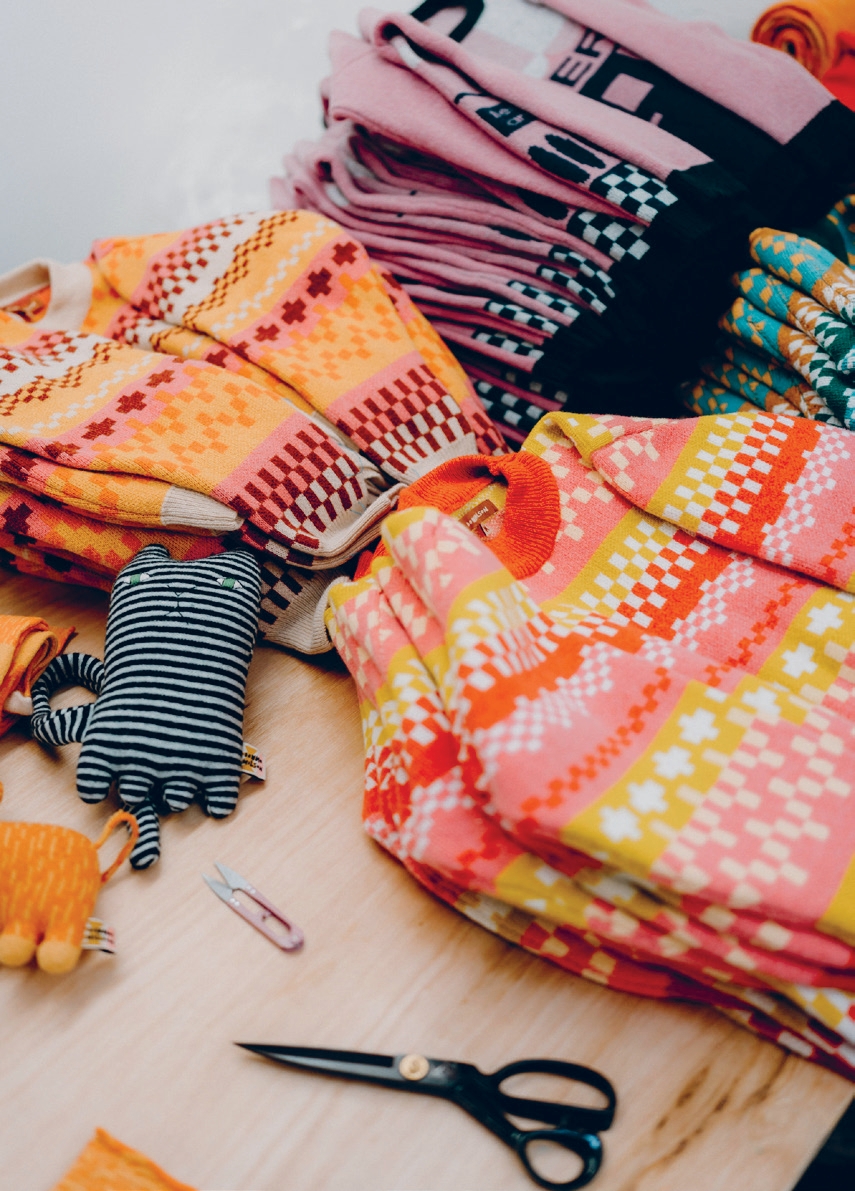
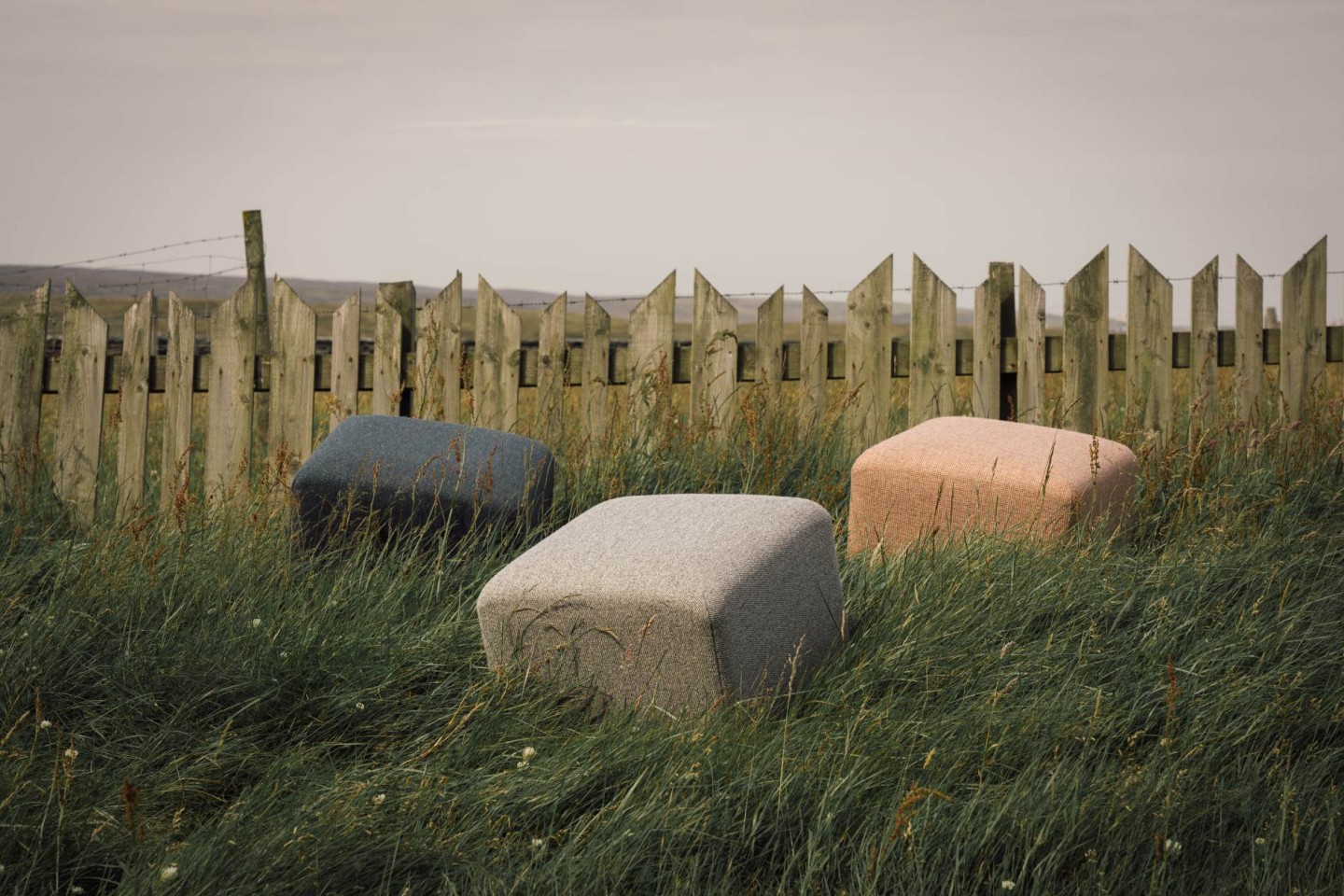
These days, alongside her odd objects, Donna is known for her range of contemporary furniture, homewares, textiles and clothing. She describes her work as “a woolly wonderland where pattern and colour collide, and the imagination is free to run wild”, and it’s hard to think of a better way of putting it. Her designs are distinct and charming, taking inspiration from Nordic and Scottish yoke design sweaters. There are colourful Fair Isle knits that take the traditionally popular design to a vivid dimension, hexagon-cut scarves in colour-block brights and gorgeously soft lambswool knits with abstract prints. “For me it’s about colour, pattern and quality,” she says. “In all my designs I try to create knitwear that has a nod to the past, to the traditional, but with a modern twist.”
Her work doesn’t come cheap, reflecting, like all good quality knitwear, the cost of producing locally and in an ethical way. “Now, more than ever, we need to take responsibility for the products we buy – where they are made, what materials they are made from, and how this affects our planet,” says Donna, who uses British-spun lambswool from Huddersfield and Yorkshire. “I think when you consider this, and choose to support small, responsible businesses, you can feel so much more joy in what you buy. British manufacturing may be more expensive, but it’s held to higher standards.” Soon, Donna Wilson customers will be able to purchase repair kits that teach them the basic mending skills to extend the lifespan of their treasured knits – another important step towards a sustainable fashion industry.
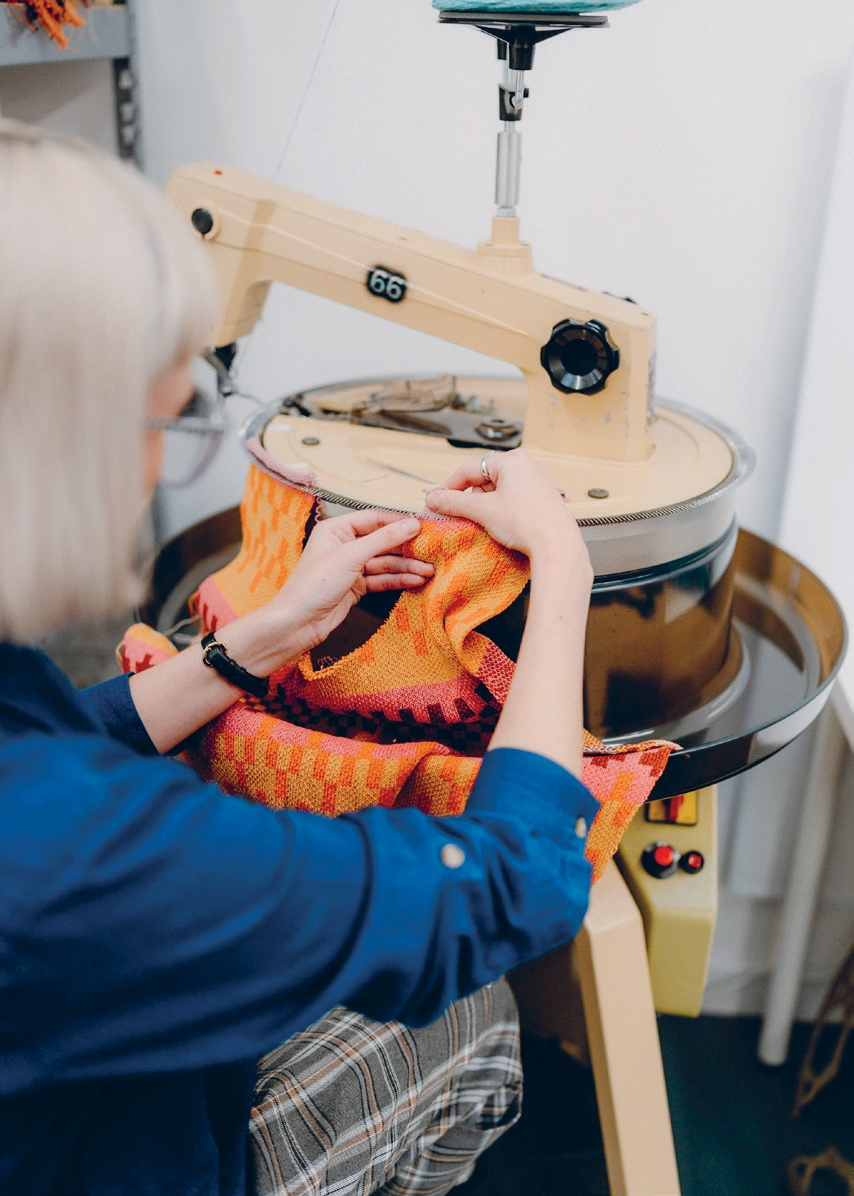
Above all, Donna aims to keep embracing new technologies and ways of working. She believes there’s a real need for the textiles industry to adapt to the changing manufacturing landscape. This encompasses offering a more bespoke production service, with lower minimums, so that other designers have somewhere they can make their products in small batches. This is where Knit Shop, launched in Dundee in 2021, comes in. “We have invested in new industrial Shima knitting machines that can produce a variety of knitted products at scale,” explains Donna, who manufactured the majority of her designs at the factory in 2021. Knit Shop employs primarily local staff and also partners with the region’s colleges and universities to support students in gaining practical industry experience. Many of the staff have recently graduated and have “new ideas and skills which can push us forward”, says Donna.
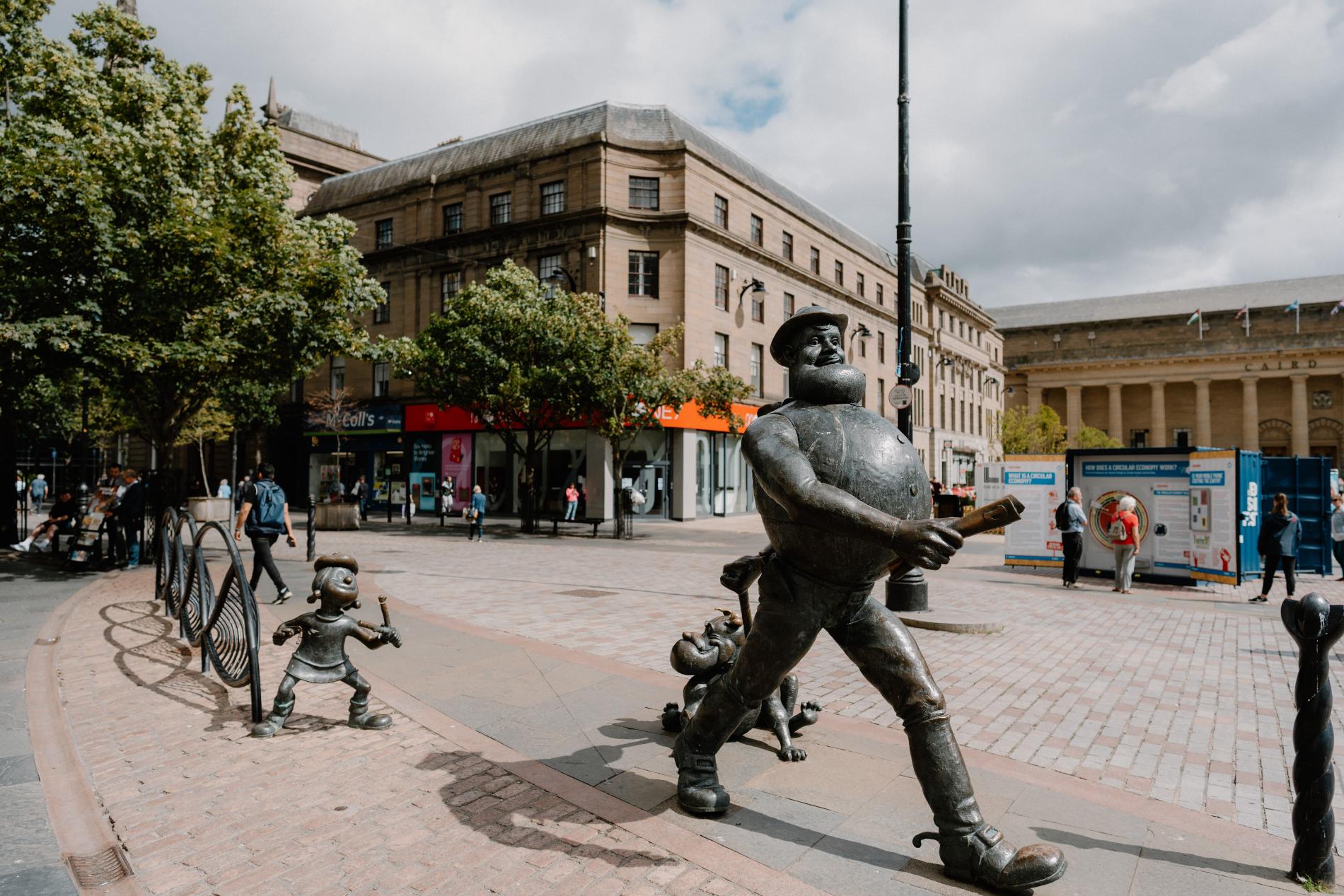
Just around the corner from Knit Shop, the refurbished mill Verdant Works uses interactive exhibits to tell the story of 19th- and 20th-century jute production during Dundee’s textiles heyday. It’s a lovely tangle of old and new, where heritage is heralded as the route to the future. Not much further on, on the banks of the River Tay, horizontal layers of precast concrete pile up to shape the V&A Dundee, which is part of a £1 billion plan to regenerate the city’s Waterfront area, including new hotels and walkways, a revamped train station and an urban beach. Dundee, too, is looking forward.
“There’s a real buzz of excitement in the air, led by the regeneration of the waterfront and the arrival of institutions like V&A Dundee,” says Donna. “It’s a city steeped in a rich industrial past and I’m proud to be part of its regeneration.” Donna and Knit Shop are currently working on a Fair Isle jumper for the museum that is inspired by one of the Scottish sweaters in its permanent collection. They also designed the Selkie Seal mascot for the V&A – an idiosyncratic number with big eyes and blue splodges, and the same irresistible charm as all Donna’s work. If this is what the Scottish textiles industry looks like as it readies for the future, it is looking bold and bright and totally unstoppable.
Find out more:
Donna Wilson
www.donnawilson.com
Knit Shop
www.knitshopscotland.com
words // Emily Rose Mawson - photography // Simon Hird
Promoted Post
The Scullery
Tucked away in the heart of the Yarrow Valley, The Scullery is a one-bedroom boutique hideaway, eloquently designed for comfort, calm, and connection. Whether you’re escaping the city or craving a countryside reset, this is your space to slow down and just be.
-listable-carousel-1769292770.jpg)
-full-1741009545.jpg)






 Sign in with Google
 Sign in with Email