
A day in Yell: five things to do
Windhouse, the Old Haa, two beaches and the White Wife on Shetland’s island of Yell.
Words by Laurie Goodlad
Yell is the largest of Shetland’s trio of North Isles. It’s easy to get to Yell; it’s just a short hop across Yell Sound on the modern inter-island ferry. The crossing takes about 15 minutes, and passengers can stand on the upper deck and enjoy views across the sound, passing the uninhabited islands of Bigga and Samphrey on the way. Yell is often overlooked as people favour neighbouring Unst for a day trip, but Yell has a lot to offer. At 17 miles long and seven miles wide, there are plenty of places to discover and enjoy.
Windhouse
Not only is Windhouse Shetland’s most haunted house, but it has also been suggested that this is the most haunted house in the UK. The ruined house sits on the crest of the hill on the approach into Mid Yell. Its foreboding silhouette dominates the skyline and is visible to any car that passes through Yell heading north towards Unst. Windhouse, commanding views in all directions, is the site of an ancient settlement – perhaps explaining why so many things go bump in the night. The house itself has its foundations in an Iron Age broch, and excavations have revealed a burial site within the house’s gardens. Steeped in mystery and legend, Windhouse attracts both historian and ghost-hunter, keen to unpick the magic of this iconic house. The list of ghosts alone is impressive – if not a little spine-tinglingly scary. They include the Lady in Silk, a tall, cloaked man, a child, a black dog, a taxman and, most chillingly, a beast that patrols the grounds and will kill. Whatever the truth, this building with the armorial crest of the Neven family above the door was once a grand home, and it’s an eerie and thought-provoking place to pass.
The Old Haa
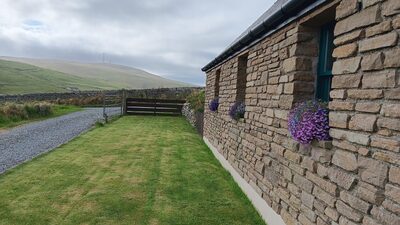
The Old Haa Museum is in Burravoe, just a few miles from the ferry, and its cakes are some of the best in Yell. The Old Haa is a fascinating museum, steeped in local history and lore, with engaging displays, a substantial archive, exhibition space, a small shop selling local crafts, and of course, the tearoom. The museum itself is a traditional Haa, or laird’s house, dating to 1672, that opened as a museum in 1984. Be sure to explore the extensive gardens that include sculptures showing all the geology of Yell.
Sands of Breckon & Gloup
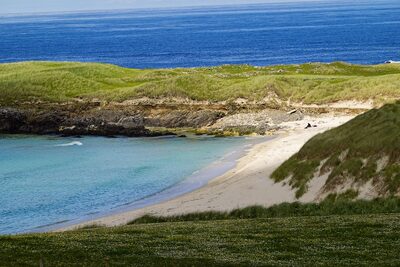
The Sands of Breckon are in the northernmost part of Yell. The beach is a wide expanse of white sand, seldom busy, with a rich archaeological past that is still visible today. This is an area of continuous occupation since prehistoric times, and archaeological evidence is apparent in the ruinous remains of prehistoric sites that are still evident in the beach area.
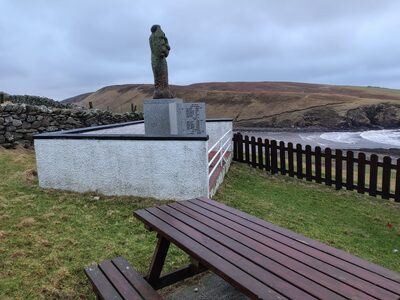
From here, Gloup Memorial is just a short drive away. The Gloup Memorial is a reminder of more challenging times when men fished from small open boats called sixerns in offshore waters, known as da haaf. The memorial commemorates the lives of 58 fishermen who were lost to a storm in 1881. They left 34 widows and 85 orphans behind; in this small community, an unimaginable loss.
West Sandwick
West Sandwick is another of Yell’s beaches, situated on the west coast of the island. West Sandwick is one of five beaches in Shetland to have been included in the national Beach Awards, part of the Keep Scotland Beautiful charity. These awards “are the benchmark for quality, celebrating clean, well managed and sustainable beaches.” Those selected “demonstrate excellent beach management and environmental best practice, and maintaining high standards.” The pristine white sand is tucked away underneath the dunes, just a short stroll from the car park. From here, a picnic on the sand affords uninterrupted views across Yell Sound to Northmavine, Mainland Shetland’s rugged northern frontier.
The White Wife
Travelling off the main road, along the east road between Burravoe and Mid Yell, is an excellent way to see more of the coastal fringes of Yell. At Otterswick, park and take the short walk out to the figurehead known as the White Wife. This ship’s fixture, which would have adorned the bow of a boat, came from the Bohus, a German training vessel wrecked off the coast in 1924.
Make time for a trip to the Aywick shop – an Aladdin’s cave, with everything from electrician’s wire to hair dye and hosiery. Go in for bread and milk and you may come out with a few things you didn’t need, such as a trout wand or a book on graveyards in Shetland.
 Out now
Twice a year, to your door
One hundred and sixty pages of Scotland, every photograph commissioned, every word written by someone who went. Members get both issues posted and everything on screen.

 The Last Stop Before Nowhere
 A Weekend Exploring the Isle of Mull
 What's On in Scotland: Autumn and Winter