
A day in Fetlar
Walks, Viking sites and red-necked phalaropes on Fetlar, the smallest of Shetland’s North Isles.
Words by Laurie Goodlad
Known as the Garden of Shetland, Fetlar is the smallest of Shetland’s trio of North Isles, and with summer fields awash with thick carpets of wildflowers and vast swathes of scented meadowsweet, it’s not hard to see why.
Fetlar is a two-ferry hop from the Mainland. Visitors take the ferry from Toft, in the north of Shetland, to Yell, before driving 17 miles through the island to reach the Gutcher terminal, where another ferry takes guests on a 25-minute journey to Hamars Ness in Fetlar. As there are only several ferries in and out of the island each day, it’s recommended that visitors spend a little more time in the islands, exploring, walking and enjoying the fantastic wildlife opportunities that this island offers.
With stunning landscapes, fertile valleys and diverse geology, Fetlar is a little slice of heaven.
Fetlar has a population of around 60 residents, and the island is served by a small shop and cafe, an Interpretive Centre and a public hall that houses the island’s caravan and motorhome site.
Despite offering visitors a remote and picturesque getaway, Fetlar has not been without its share of problems over the years. During the 19th century, the landlord (laird) evicted many tenant farmers from their homes and land to make way for large-scale sheep farming and the island never really recovered. The clearances undoubtedly left their scar on the community, mostly in the form of ruined houses and homesteads; homes once filled with happiness, warmth and laughter were reduced to gloomy ruins with empty hearths.
Today, Fetlar is a haven for walkers and wildlife lovers alike. The island is quieter than neighbouring Unst yet shares the same dramatic coastal walking and wildlife. Fetlar suits those searching for a more peaceful retreat.
Self-catering options
One day in Fetlar is not near long enough to make the most of all this island has to offer. Visitors to Fetlar are invited to slow down, and once you scratch the surface of this tantalising haven, you’ll wish you’d stayed longer.
The Lodge is a self-catering house on the shore at Houbie, in the shadow of the grand house of Leagarth.
Fetlar Hall Campervan and Caravan Site offer hard standing for motorhomes and caravans and fully-accessible showers and bar facilities at the weekend.
Aithbank Camping Böd offers budget glamping-style accommodation and overlooks the beautiful bay at Aith. This house was once home to Fetlar’s best-loved storyteller, Jeemsie Laurenson.
Gord is the only guest house in Fetlar, with four bedrooms and a home-cooked breakfast. They also offer dinner and packed lunches to guests.
Eating Options
Eating out is very limited in Fetlar. The main option is the small cafe at the shop, which is open a few hours a day and offers a simple menu of toasted sandwiches and filled rolls, hot and cold.
The Interpretive Centre also offers hot drinks and snacks. The centre is open seven days a week between May and September.
Shops – you may want to stock up before you go, ensuring you have plenty of food to sustain yourself during your stay. The Fetlar shop is open seven days a week from 1pm to 4pm during the summer season (mid-April to mid-September) and Tuesday to Saturday (11am to 2pm) for the remainder of the year. The island shop also acts as a post office.
Visit Lisa’s Leatherwork studio for a selection of leather goods, including knitting belts, bags and harnesses.
Top tip: Check the shop opening hours before your visit and consider stocking up on essentials in Yell before you leave. Please note that there is no fuel station on the island, so arrive with a full tank – although there is an EV charging point available at the Interpretive Centre.
Lace-up your boots and hike this way
Fetlar, like much of Shetland, benefits from an incredible coastline punctuated with stacks, geos and natural arches, hewn out by the sea surrounding it – and Fetlar is no exception.
The Snap walk
One of the most rewarding walks is from Funzie – pronounced Finnie – to The Snap, a coastal walk along Fetlar’s dramatic east coast from the boulder beach at Funzie to the impressive natural arch of The Snap. This walk can be extended into a circular route to the Wick of Aith and back to the Mires of Funzie, where tired legs can spend time trying to spot the elusive red-necked phalarope. The circular walk will take about 4 hours and covers 5 miles (8 km) along a pathless route around the coast.
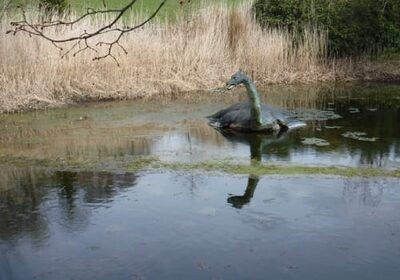
For a less challenging walk, the coastal route between Houbie and Tresta takes in the spectacular views of Lambhoga and the archaeology – including an Iron Age broch and Viking soapstone carvings hewn out into the cliff faces.
Houbie is the main settlement in Fetlar, where you can kick back and enjoy the Interpretive Centre’s displays once you’ve finished this walk. The shop, also in Houbie, is an excellent place to pick up an island picnic – or a refreshing bottle of beer to enjoy on the stunning sands of Tresta Beach. Also in Houbie, on the small sandy beach that fronts the community, is a 19th-century stepped pool system designed to encourage trout to breed in the burn.
Reaching Tresta Beach is like approaching paradise – a sweeping sandy beach backed by the kirk and Papil Water. Tresta Beach, flanked by Lambhoga’s steep sides, is a picture-perfect spot for a picnic, affording uninterrupted views across the Wick of Tresta.
This walk is 5 miles (8 km) and, from Tresta, follows the road back to Houbie. If you have two cars, reduce the distance by parking one at Houbie and one at Tresta – or thumb a lift back.
Other great walks
Everland to Gruting circular walk (which includes Arthur’s Folly, discussed below)
Lambhoga
Urie Ness
The island’s archaeology and built history
The following itinerary will take a full day to complete and involves a few short walks and a longer walk to Gruting.
Fetlar’s history spans millennia, going back some 5,000 years to the first settlers who arrived in Shetland – presumably island hopping from the north of Scotland, through Orkney, and on to Shetland.
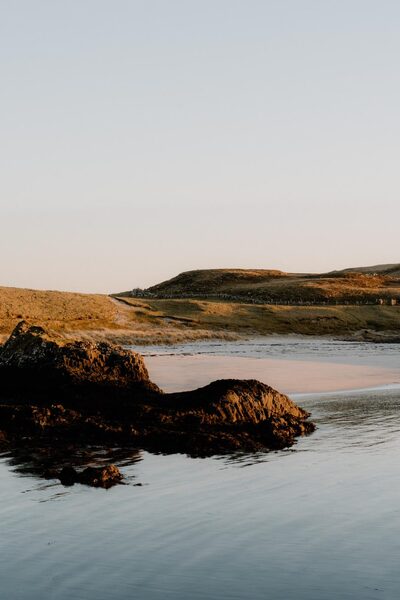
Haltadans Stone Circle
Some of the earliest remains are found in the Haltadans Stone Circle. Haltadans, believed to date to the Bronze Age, is a circle of 38 stones with two positioned upright in the centre of the ring. These aren’t on the type of grand scale that we find in places like Orkney. Haltadans is understated and can be tricky to find. The best way to find it is from the disused island airstrip and by following an OS map.
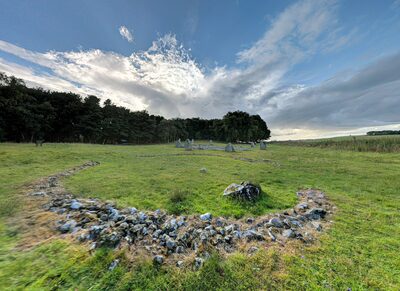
Fetlar is a land of folklore, myth and legend, trows and njuggles. This unassuming stone circle has several folklore stories associated with it. Most famously, folklore tells us that the ring represents a fiddler and his wife (the central stones) and that the surrounding rocks are trows (trolls) who, while dancing, were startled and turned to stone with the rising sun.
Trows, popular in Shetland folklore, were said to be a cheerful and mischievous race who loved fiddle music. The name Haltadans, according to etymologist Jakob Jakobsen refers to the belief that trows and fairies were often said to limp when they danced. The expression “to had (hold) a haltadans” or “to rush about noisily” was still an expression used in Fetlar and Yell (when he published his research in the late 19th century). Further evidence of this musical tradition is found on the OS map, which notes the Fiddler’s Crus cairn just a short distance northwest of the circle.
More about Haltadans Stone Circle
Houbie Broch
Moving chronologically through time, we come to the Iron Age, around 2,000 years ago, and find more evidence of Fetlar’s past in the ruined remains of the Houbie Broch. Following the coast between Houbie and Tresta, you’ll soon arrive at the remains of the broch.
Standing proud on the cliff’s edge sits the Broch of Houbie, a 2,000-year-old Iron Age structure cloaked in mystery and intrigue. These towers of the past, erected in the mid-Iron Age, are still an archaeological mystery, leaving archaeologists scratching their heads regarding their use. Like most of the other 120 broch sites in Shetland, the broch now stands in ruins, but the impressive ramparts are still visible on the approach to the broch from the landward side. From the broch, commanding views draw the eye out to sea and towards the towering headland of Lambhoga.
Fetlar has several brochs, and a quick look at an OS map marks them out on the coastline.
After Shetland’s Iron Age, we saw an influx from western Scandinavia with the arrival of the Vikings who settled, giving rise to a period of Norse rule that saw the islands governed from Scandinavia for around 600 years.
Evidence of this is also found close to the broch at Houbie, where steatite – or soapstone – workings can be found in the geos of Dammins and Clemmel Geo, where bowl-shaped carvings and initials engraved in the rock face document years of human history in this area.
Steatite, better known as soapstone, is a soft rock that’s easy to carve. It has been used since prehistoric times; Neolithic people used it to temper pottery, but the Viking and Norse settlers were the real champions of soapstone, using it for almost every conceivable purpose in the home and beyond. Steatite is synonymous with Norse occupation in Shetland, and its use can be traced throughout the North Atlantic.
Viking Boat Burial
The Vikings also left evidence of a traditional boat burial at Aith, excavated for TV’s Time Team in 2002. It is reputed to be the final resting place of a Viking man who washed ashore during a storm, with the crew all washed away. This one remaining sailor asked that, upon his death, he be buried with his boat and treasure. When he died, his wishes were honoured, and he was granted a Viking boat burial. The site, often referred to as the Giant’s Grave, contained a significant number of iron nails and a beautiful tortoise-shaped brooch, but no skeletal remains were uncovered. Not much remains to be seen of the grave other than a quarried mound and several scattered stones. Still, the coastal setting is beautiful, and it’s a fantastic place to reflect on Shetland’s Scandinavian heritage that is still so evident in the islands today.
Brough Lodge
After the Vikings came a period of Scottish rule and a more sombre period in Fetlar’s history, marked by greedy landowners and a cruel regime. In 1469, Shetland and Orkney passed into Scottish control following the marriage of Princess Margaret of Denmark to King James III of Scotland. As part of the wedding dowry, Shetland and Orkney passed into Scottish rule, marking an end of the Scandinavian influence on the islands.
Following annexation, several wealthy landowners moved into the islands, and among them, we see characters such as Sir Arthur Nicolson of Brough Lodge. Brough Lodge is unlike anything else built in Shetland. It was constructed in 1820 by the landowner, Sir Arthur Nicolson of Lochend. This striking building was designed and built in a Georgian gothic style, in stark contrast to the Haa of Smithfield on the other side of the island, built at a similar time (1815) for the Smith family until they emigrated to Australia in the 1860s. Brough Lodge had everything a grand house of that time should, with a drawing-room, library, butler’s pantry and a counting room (where the landlord dealt with the rents from the island). It also had an astronomical observatory and an associated folly in Gruting.
Sir Arthur’s Folly
Arthur’s folly is well worth the walk from Gruting, along the coast and up the valley to an unusual round house with a very curious story.
Arthur Nicolson built the house after the fertile valley at Gruting was cleared during the 1840s. Fetlar was severely hit by the clearances which affected much of the Highlands and Islands throughout the 19th century when landowners decided that large-scale sheep farming was more profitable than tenant farmers, who were, in turn, forcibly removed from their homes in favour of sheep.
Set in the middle of the valley, and said to be built from the stone of the cleared houses from the area, sits Arthur’s impressive roundhouse, made by this 19th-century eccentric.
Sir Arthur designed his summer house in a French fashion, with the lower part made from stone and the upper floor constructed of wood. Sir Arthur was never to spend a night there.
When he went to bed on his first night, he was kept awake and afraid by an incessant banging and knocking which echoed through the darkness. Eventually, the noise became too much to bear, and he abandoned his bed, galloping back to Brough Lodge on his horse Jolly, much the wearier of his stay.
An explanation was provided by the minister at the time, who said that the noise was the spirits of the crofters Sir Arthur had unceremoniously evicted from their homes in the 1840s. He said they had not departed the valley but returned to haunt Sir Arthur for his misdeeds.
Another grand house is that of Leagarth in Houbie. It was built in 1901 by Sir William Watson Cheyne, who, along with Lord Lister, developed safe antiseptic surgery methods.
Watch the red-necked phalaropes
Fetlar is rich in wildlife, and as well as the usual birds and seals that you would expect to see in Shetland, Fetlar is a fantastic place to look out for red-necked phalaropes.
Red-necked phalaropes are one of the UK’s rarest breeding birds, and Fetlar has over half the breeding British population of the bird. In the summer months, you can often watch them feeding on the Loch of Funzie or view them in their breeding site on the Mires of Funzie from a viewing hide.
Go otter spotting
Fetlar is an excellent place to spot the enigmatic and often elusive otter. Shetland has the highest density of Eurasian otters in Europe, and Fetlar’s coastline is a great place to view them. The best time to see otters is several hours on either side of low tide when the wind is blowing onshore, ensuring that your scent isn’t carried to the otter, who has a highly-sensitive sense of smell and scares off easily.
The greatest advice for visiting Fetlar is to ensure that you spend more than one day on the island, as a few hours between ferries is never nearly enough.
 Out now
Twice a year, to your door
One hundred and sixty pages of Scotland, every photograph commissioned, every word written by someone who went. Members get both issues posted and everything on screen.

 The Last Stop Before Nowhere
 A Weekend Exploring the Isle of Mull
 What's On in Scotland: Autumn and Winter