
Ploterre: Exploring the Environment Through Data
Rebecca’s artwork combines design, data, and the great outdoors to tell unique stories about the environment in Scotland and beyond.

Hiking, cycling, surfing. On any given weekend, you might spot self-confessed outdoor lover Rebecca Kaye exploring Scotland on foot, bike or board. But fresh air and movement aren’t the only draws. Because when you run a creative business based on nature, inspiration can come at any moment. And the best place for it? That’d be outside.
Ploterre is Rebecca’s full-time job. And it’s a nine to five that nobody could have dreamt up, least of all Rebecca. In fact, she says it was something of a beautiful accident, bringing together all of her interests – maths, design, nature – into art.
“It sort of just happened, as opposed to being an idea,” Rebecca explains. The road to Ploterre is long, winding, and rather remarkable. When at school, Rebecca loved both maths and art, but clashing timetables made it impossible to study both. She ended up choosing maths, later doing a mathematics degree at the University of Manchester, before moving to Edinburgh to start her career as a statistician. But her artistic itch was still there, unsatisfied. What could she do?
-full-1744407018.jpg)
This unfulfilled passion pulled her towards the extracurricular. Evening and weekend courses at the city’s art college, then a Masters degree in visual communications at Edinburgh Napier University. The final piece in the Ploterre puzzle was a printmaking course. “Again, I loved that,” Rebecca remembers. “But I didn’t think I could feasibly keep doing it unless I did something with the prints – each time I went, I’d come home with 20 or so editions of the same one!” Years passed, with Rebecca juggling all of her interests separately. “It led to a data by day, design by night scenario.”
It wasn’t until the pandemic that Rebecca had the elements she needed to start Ploterre. As life in Scotland began to slow, Rebecca was awarded project funding to work with a developer. But, realising this was now no longer possible, she decided to use the funding to take on the project solo instead. Learning programming, Rebecca needed data to test her work. Gravitating towards information about nature and the environment – a passion that had never before fused with her other interests – she found herself unexpectedly bringing Ploterre into the world.
“Given I already had the background in selling prints, it was a natural transition,” she says. “I originally thought the idea was pretty niche, but it turns out there’s a lot of people that love data and nature and art!”
Ploterre seems like such a perfect combination of Rebecca’s interests, it’s surprising that the seed of the idea didn’t germinate sooner. “Since the moment I created and sold my first print, it felt strange that it had taken so long to get here. Maybe that’s part of the joy.”
Another joy when you’re a nature lover is being able to bring it into your work in such a tangible way. Rebecca has a studio at home, with two windows inviting light in, and shelves crammed full of cherished design books. But if her home studio is where the detailed craft happens, it’s outside these four walls that the initial curiosity surfaces.
For example, walking along Edinburgh’s Water of Leith footpath, you might ask yourself: “I wonder what the longest river in Britain is?” For Rebecca, this thought could spark a journey stoked by design and data that takes several weeks to unearth.
Take the Ploterre ‘Rivers’ print. Lines in sage green and sky blue ripple down the left-hand side of the canvas, like the colours of sunlit water on a summer’s day. Look closer and you’ll see these lines each have names, from north to south across the British Isles: Forth, Leven, Water of Leith, Clyde, Tweed. Through length, colour and word, we can understand in a glance how our local river relates to Britain’s others. It might seem simple, but the design invites you to dive deeper.
The first step is research, Rebecca explains, “researching the topic as well as researching relevant data.” Questions swell at this early stage of creation: How do you measure a river — its length, flow, catchment, tributaries? Where is its source? Is the river flooded or low?
What Rebecca learns at the research stage then helps to build the data she’ll use for the print, finding relevant sources and cross-checking her information. “I see what I do as a craft and the numbers are my material,” Rebecca says.
But it’s not just about the raw numbers. The whole point of Ploterre is to take these often complex numbers and create a visual story from them, showing the viewer something they can understand easily in a unique way. This practice is called data visualisation, something you’ll spot if you’ve ever read National Geographic magazine, or followed Britain’s mapping agency Ordnance Survey on social media. In fact, it was a Scottish engineer called William Playfair that’s said to be one of the trailblazers of early data presentation, inventing the line, area and bar charts to explain the patterns of trade in the late 18th century.
“There’s a visual language in nature,” Rebecca explains, “so every mark on the page is linked to data in some way. The shape of a tree ring, the pattern of a leaf, or in this case, how water flows.” All of these elements inspire Rebecca’s final works, from the colours used in the ‘Rivers’ print to the fonts used in the ‘Bird Colours’ design. Data about the environment doesn’t just look beautiful when it’s presented this way. It can also help us understand the world and take action to protect it. Over the years, Rebecca has collaborated with different brands and businesses across events, education, and homeware. But an excellent example of how design and data can support people to look after the landscapes and coastlines they love is Rebecca’s work with Trash Free Trails.
A non-profit community-led organisation, Trash Free Trails has a singular mission to reduce plastic pollution in our wild places — in Britain and beyond — by 75 percent by 2025. “The volunteers spend thousands of hours of their free time cleaning up trails,” Rebecca explains. And in order to measure the success of their efforts, and the state of our paths, data is key.
The ‘Trash Mob’ of litter pickers log the volume and location of single-use plastics they’ve found on the Trash Free Trails website, and it’s this that helps inform landmark reports — and Rebecca’s work with them. “My role was to draw the stories and insights from the data, presenting it in an engaging way so that it didn’t get overlooked,” Rebecca says. And the infographic Rebecca created is impactful — as are the numbers. For every 100 items volunteers removed on the trail, 81 were single-use plastics. 28 were within 300 square metres of a summit. And over a fifth showed signs of animal death. It may make for grim reading, but it’s what we do with the numbers, and how they can inform and deepen our relationship to the natural world, that matters.
This year sees Rebecca take on a similar project with Ploterre, but this time it breaks new ground. She’ll be part of an exhibition called ‘Ash Rise’, a showcase bringing together makers, designers and artists to both celebrate the versatility of ash wood and reflect on the threat of ash dieback, a fungal disease which causes leaf loss and tree death. The Woodland Trust estimates that ash dieback will cost British society £15 billion, not to mention the unquantifiable impact on biodiversity. In the second half of 2024, Rebecca’s work will visit 59 venues across Scotland as part of the ‘Ash Rise’ touring exhibition.
No doubt this will give Rebecca more opportunities to explore undiscovered corners of the country she now calls home. You wouldn’t know it, but growing up in North Wales and holidaying in Cornwall as a child, Rebecca had never been to Scotland before relocating for work two decades ago.
“I had misplaced assumptions,” she reflects. “I thought sandy beaches would instead be rocky cliffs, and clear waters would be unforgiving seas. I’ve never been so wrong. I fell even more in love with Scotland than I think I would have if I’d had no preconceptions.”
Even though she’s based in Edinburgh, the capital city, Rebecca is just a half-hour bike ride from both a beach (Portobello, to the east) and the mountains (the Pentlands, to the south). She says she can’t imagine living anywhere else.
“Scotland provides the opportunity to be in a range of different landscapes in close proximity,” Rebecca reflects. “I spend pretty much all my free time cycling to different places and exploring different islands. I still have so much to see, and that’s after more than 20 years.” And one of the best things? The variety of scenery and nature in what’s a relatively small country not only feeds Rebecca’s love of wildlife and weather, but it also fuels her work as Ploterre.
Rebecca always likes to have a new piece of art brewing. “I’ve been working on a piece using mountain data for months, so I’m not sure when it will be right.” A few other new designs are nearly ready, such as “prints about wildflowers, visualising the watershed, and comparing daylight across the UK from 49 to 60 degrees north.”
It seems as if Scotland may never cease to provide creative inspiration, not only for Rebecca, but for many other artists and makers like her. “It’s all this newness out there to discover that keeps my spark for wandering burning bright. And, well, that’s the perfect starting point for a new piece.”

REBECCA’S PERFECT DAY
A perfect day in Scotland? That’s easy. I’d cycle from my home in Edinburgh out to North Berwick. Grab a coffee in Steampunk, then pick up a pastry from Bostock Bakery on the high street. I’d cycle back along the coast road and stop for a swim at Gullane Bents. Maybe I’d eat my pastry when I’m out of the water, if it lasted that long!
Promoted Post
Eagle Brae
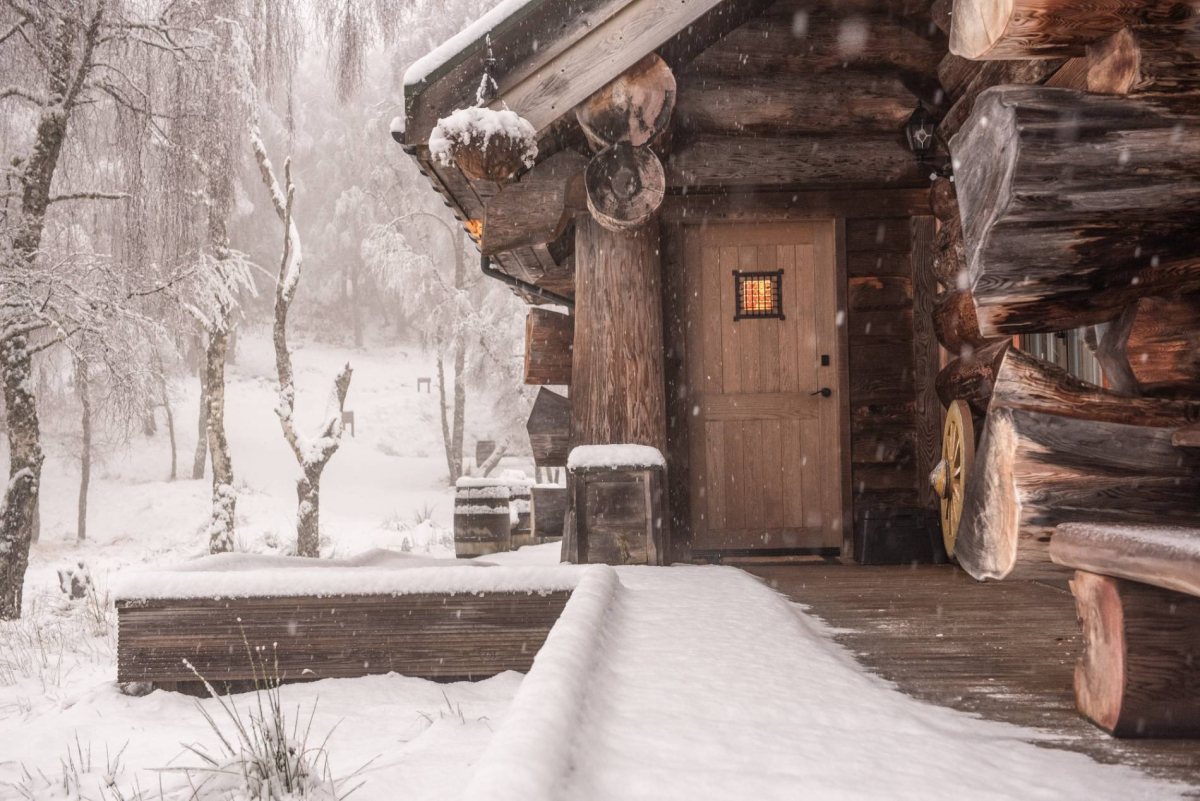
Escape to Eagle Brae, a secluded collection of Highland log cabins near Beauly. Handcrafted cedar, big skies, and deer on the hillside, with a fireside welcome that makes it easy to slow down.






 Sign in with Google
 Sign in with Email