
Eight things to see and do in Shetland
A short stay in Shetland, from the volcanic cliffs at Eshaness to Lerwick’s old town.
Words by Laurie Goodlad
There are so many reasons to visit Shetland, and guests can often feel conflicted about what to prioritise during their stay, particularly if they are only visiting for a few short days.
This guide covers a few of the best places to visit and experience, ensuring that you will enjoy a little of the unique culture, landscape, wildlife and history.
Walk on the flank of a volcano
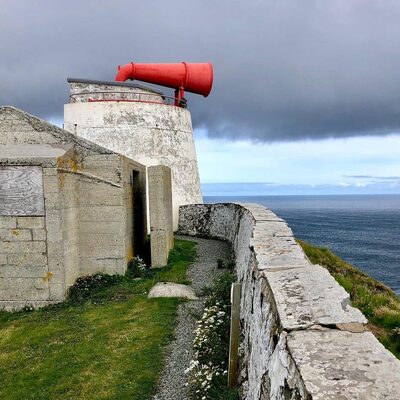
Shetland has over 1,000 miles of coastline to enjoy. The islands, flanked by the North Atlantic to the west and the North Sea to the east, offer a wealth of walking opportunities with hidden corners to discover in perfect solitude. One of the best coastal walks is found in Shetland’s dramatic northwest corner, where the Atlantic Ocean makes landfall at the impressive volcanic cliffs on the Eshaness peninsula. About an hour’s drive from Lerwick, the walk begins in the car park at the Eshaness lighthouse. The lighthouse, built in 1929 by the famous Stevenson family, was the last Stevenson light to be constructed in Shetland. The area itself is geologically fascinating. It formed about 360 million years ago when Shetland lay close to the equator and sat within a landscape of volcanoes shaped by fire and lava. The cliffs show a series of lava flows that date back millions of years, and the black cliffs are beautifully framed against the water surrounding them. The coastal walk from the lighthouse takes in Calder’s Geo, the Hol’s o’ Scraada, a collapsed sea cave set inland from the sea, and da Grind o’ da Navir, a natural amphitheatre carved out by the ocean. The volcanic landscape around Eshaness is the best example of a section through the flank of a volcano in the UK and is well worth experiencing.
Go island hopping
Shetland is an archipelago made up of over 100 islands, 16 of which are inhabited. There are fantastic transport links between the islands, with nine islands connected by an inter-island ferry service. Highlights include the most northerly island of Unst and on to the island of Fetlar, lovingly known as the Garden of Shetland. For those with a sense of adventure, a trip to the remote islands of Fair Isle and Foula is worth the effort. Moving between Shetland’s islands is relatively cheap as the local council heavily subsidises the ferries.
Step back 5,000 years
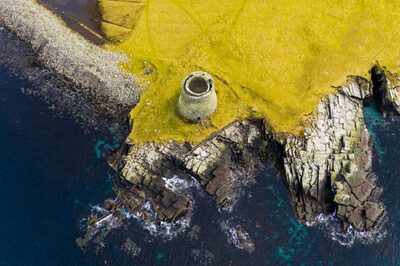
Shetland has been inhabited for around 5,000 years when Neolithic farmers first settled on the islands, turned over the land and introduced livestock. Shetland is archaeology rich and has several impressive sites from the Neolithic, Iron Age, Viking, and Norse periods. One of the reasons that Shetland’s archaeology remains so well preserved is that, in an almost treeless environment, the primary building material has always been stone, which preserves well in the archaeological record. Similarly, Shetland is not known for intensive agriculture, and most of the landscape has been given over to grazing animals, creating minimal impact on any archaeology that survives under the ground.
Discover the wildlife
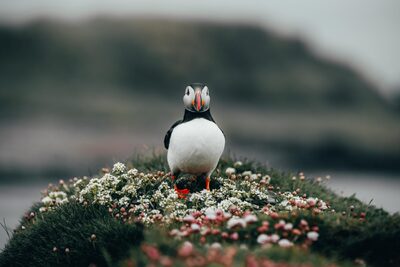
Shetland is an incredible place to view wildlife, and you are never far from it as the islands are teeming with a host of flora and fauna. Wildlife highlights include the chance of spotting offshore cetaceans, including the famous 27s pod that are frequent visitors to Shetland’s shores. Sightings of whales and porpoises are never guaranteed, but it’s certainly worth keeping an eye on the horizon while you’re out walking to see if you can spot any. Shetland has several important bird breeding colonies, and the islands as a whole are a popular place for birders to visit, particularly during migratory periods. Throughout the summer, breeding seabirds return to colonies across the isles, and highlights include:
The storm petrels at Mousa Broch
The puffins at Sumburgh Head
The gannets at Noss and Hermaness
Otters are also a popular attraction, and Shetland is one of the best places to track the Eurasian otter, an elusive and beautiful mammal best seen feeding on the shoreline on either side of low tide.
Discover Shetland’s UNESCO Geopark
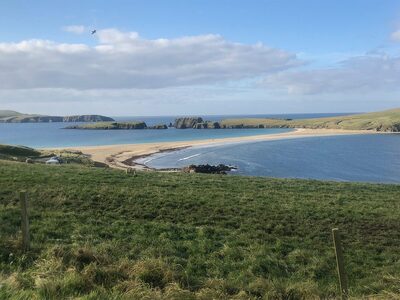
Some of the oldest rocks in Shetland date back some 3 billion years. The islands are internationally recognised for their geology and the landscapes they give rise to, all designated as a UNESCO Geopark, managed for tourism, conservation and education. Shetland’s rocks tell the story of vanishing oceans, continental collisions, ice ages, deserts and volcanoes. The landscape has been shaped over millions of years, and the various parts have been brought together to give Shetland its distinctive changing landscapes and ‘jigsaw’ appearance. Geological highlights in Shetland include the ophiolite in Unst, an area where an ancient ocean called ‘Iapetus’ closed, forcing a section of oceanic crust to the surface. This area, known as the ophiolite, now forms the eastern parts of Unst and much of Fetlar. The many stacks, arches and sea caves show how the power of the sea has shaped the coastline over millions of years, and the impressive sand tombolo at St Ninian’s Isle is the largest active tombolo in the UK. Interpretation boards across the islands help visitors decipher and understand the complex geology throughout the isles.
Enjoy the rural Sunday Teas or pick up a picnic from a local honesty box or cake fridge
One of the most quintessentially ‘Shetland’ things that you can enjoy are the numerous cake fridges and honesty boxes, as well as the famous Sunday teas that can be found all over the islands. Driving around Shetland, you’re likely to see plenty of signs advertising ‘eggs for sale’ or, even better, ‘cakes for sale’. Some of these honesty boxes offer far more than eggs or cakes, and you can expect to find breads, bakes, jams, chutneys and perhaps fresh mussels. They are pretty easy to work; you simply make your selection, tot up the total and note what you’ve purchased in a notebook before leaving the money for the purchase in the cash tin provided. Sunday Teas are another uniquely Shetland experience that you will see advertised by roadside signs. If you are being organised and don’t want to miss a teas, you can check the local newspaper to find out what area is hosting a teas on any given Sunday. Sunday teas are held in local community halls and are organised by a dedicated team of volunteers who are generally fundraising for a local good cause. For a nominal fee of a few pounds per person, you can indulge in the best of Shetland hospitality with fresh baking, steaming soups and plenty of sandwiches. All the offerings are homemade, and the local fare is so good that even Mary Berry wouldn’t dare criticise.
Discover Lerwick’s old town
Often, when we visit a rural area, we skip the main town and head straight to the surrounding country. Some small towns can be pretty uninspiring and simply provide the stepping stone into an area. This is not the case for Lerwick, a thriving town of around 7,500 people with a busy harbour and charming high street lined with gift shops and eateries. Lerwick’s old town is well worth exploring, and the best time to do this is in the evening after a filling meal at Commercial Street’s Dowry restaurant. Explore the waterfront and South Commercial Street. Admire the lodberries, with their foundations built into the sea, and look for Jimmy Perez’s house. Paddle on Bain’s Beach, take in the views from Fort Charlotte, gaze at the Town Hall’s stained glass windows or take a coastal walk around the Knab and watch fulmars glide and soar.
Take a boat trip
Seeing a place from the sea offers an entirely different perspective. Several boat tour operators allow guests to take to the water to experience the landscape and wildlife on offer. The best boat tours are the Mousa Boat, taking guests to the uninhabited island of Mousa where they can explore the 2,000-year-old Iron Age broch and, if joining an evening tour, the enigmatic storm petrels. A boat trip out to the gannet colony on Noss is also well worth taking, and several tour operators operate this daily service throughout the summer months.
 Out now
Twice a year, to your door
One hundred and sixty pages of Scotland, every photograph commissioned, every word written by someone who went. Members get both issues posted and everything on screen.

 The Last Stop Before Nowhere
 A Weekend Exploring the Isle of Mull
 What's On in Scotland: Autumn and Winter