
Beach bagging in Shetland’s North Isles
The beaches of Yell, Unst and Fetlar, from West Sandwick’s white sand to stony Funzie.
Words by Laurie Goodlad
A guide to the beaches of Shetland’s trio of North Isles.
Shetland’s North Isles are accessible by ferry; a one-ferry hop to Yell and a further ferry will take you to Unst and Fetlar.
Yell
Of these North Isles, Yell is the first island you will reach and the largest of the three. Yell has a varied coastline and is a great place to look out for otters.
West Sandwick
Heading north from the ferry, West Sandwick is about six miles from the ferry terminal at Ulsta and sits just off the main road on the island’s west side. This beach is one of five in Shetland included in the national Beach Awards, part of the Keep Scotland Beautiful charity.
The pristine white sand is tucked away underneath the dunes, just a short stroll from the car park and affords spectacular views across Yell Sound towards Northmavine.
Sands of Breckon
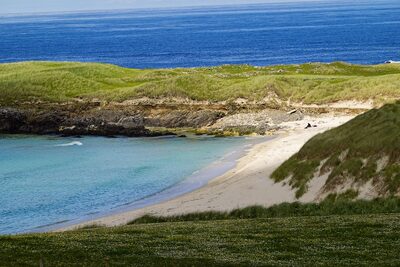
Continuing north, the Sands of Breckon are 21 miles from Ulsta on the island’s northernmost point. This beach, also in the top five for cleanliness and beach management, gives a tantalising glimpse into Shetland’s early settlers with archaeological remains close to the beach spanning millennia. This is an area of almost continuous habitation since prehistoric times, but the confused and chaotic stratigraphy of the site may leave you scratching your head and wondering at length about past societies that lived here.
Unst
Moving on to the island of Unst, Shetland’s most northerly, there is no shortage of inspiring beaches to visit. A few of the best are:
Sandwick Beach
The Sandwick beach, known as the Eastings, sits on the east side of Unst, just a few miles northeast of Uyeasound along the Uyeasound to Muness road. The walk down to the beach from Hannigarth, a self-catering property, gives fantastic views across the wide, sweeping bay. At the head of the bay lies the excavated remains of a Norse longhouse. The evidence of past people here is striking. Archaeologists discovered two Pictish burials in this area and the remains of an Iron Age house. Several interpretation boards helpfully depict the archaeology. If you feel like walking a little further, follow the coast to the graveyard at Framgord, where distinctive rectangular slabs or hogback stones mark Viking graves.
Skaw & Norwick Beaches
Unst’s most northerly beaches are a delight to visit. Both have stunning views, sweeping sands and that ‘edge of the world feeling’.
To get to Skaw beach, follow the road towards Norwick before branching off along the Holsten’s road for a few miles until it ends. The road, an unclassified track, is rutted and worn in places, and along the way, you’ll enjoy fantastic views down to the Norwick beach, passing ruined crofthouses and military remains from the Second World War Lamba Ness radar station. Today, the site is home to an ambitious space project.
Norwick Beach is more sedate than its northern neighbour, Skaw. Picture-perfect, the white sands flank a picturesque bay dotted with traditional white houses and fertile green fields. Norwick is a favourite for artists and photographers wanting to capture the essence of Shetland.
Fetlar
Known as the garden of Shetland, Fetlar is the smallest and most remote of the North Isles, with a population of around 60 people.
Tresta Beach
Outstandingly beautiful and flanked by the steep slopes of Lambhoga, Tresta Beach is another of Shetland’s five award-winning beaches. It commands uninterrupted views across the Wick of Tresta and the North Sea beyond. The spectacular beach dominates the area with Papil Water behind – an excellent spot for trout fishing. When the tide is in, the beach is narrow and rocky, but as the sea moves out, the beautiful sandy shores are revealed, offering a large expanse of beach with the spectacular cliffs of Lambhoga to the west. Nearby is the Kirk, which was built in 1790 and has memorials to both the Nicolson and Cheyne families (prominent families in the islands) and several graves from the Second World War. Picnic benches placed at the head of the beach invite people to stay and enjoy the sights and sounds of a summer evening. This is a popular place for camping, although there are no facilities nearby.
Funzie Beach
Funzie, pronounced ‘Finnie’, is on Fetlar’s southeast corner. This is the only beach in this guide that’s made up of stone rather than sand. The beach itself is relatively exposed and is made up of larger rocks and boulders that are millions of years old and have been buried and partially melted, causing what is known as the Funzie conglomerate – a rock that gets geologists excited. From here, there’s a fantastic walk to The Snap, an outstanding natural arch in the cliffs.
 Out now
Twice a year, to your door
One hundred and sixty pages of Scotland, every photograph commissioned, every word written by someone who went. Members get both issues posted and everything on screen.

 The Last Stop Before Nowhere
 A Weekend Exploring the Isle of Mull
 What's On in Scotland: Autumn and Winter