
Andy Scott - Scotland’s Leading Sculptor
Sculptor Andy Scott is behind some of Scotland’s most recognisable public artworks, including The Kelpies and The Heavy Horse. Working in steel and bronze, his large-scale sculptures are shaped by local history, mythology, and community identity. This article traces Scott’s career and the stories behind his most iconic Scottish installations.
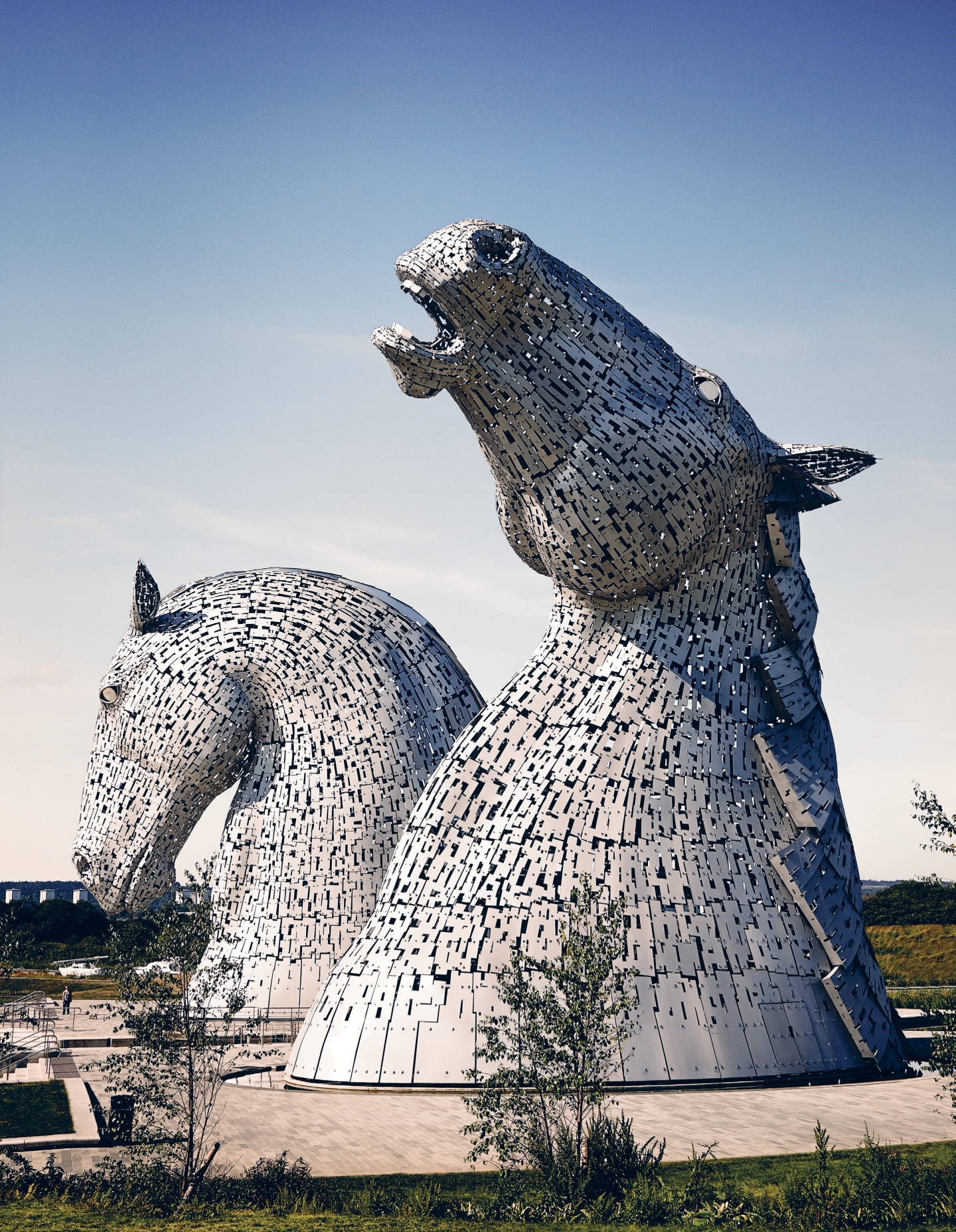
In 2014, a spectacular new landmark graced the Scottish landscape of the Forth estuary: The Kelpies. These two 30-metre-tall horse heads have become beloved both in Scotland and beyond, drawing visitors from all over the world and representing the history, mythology, innovation and creativity of Scotland. Behind these galvanised steel behemoths is the internationally renowned sculptor, Andy Scott. For many, Andy’s name will be automatically associated with The Kelpies – and for good reason – but his career in public art since 1997 has seen an incredible portfolio of his sculptures installed across Scotland and around the world. In Scotland, Andy’s sculptures reside in some of its busiest cities, towns, and roads, planting a legacy of galvanised steel and bronze that remains with all who come across them.
When identifying some of the most memorable and impressive works of Scotland’s leading sculptor, it seems right to begin with his most well-known achievement. “They [The Kelpies] are the star of the show,” Andy agrees, “for their sheer size, and ongoing presence and impact in and outside of Scotland.” The Kelpies could not be described better. At 30 metres high and weighing a whopping 300 tonnes each, these sculptures dominate the Falkirk-Grangemouth region and are a jaw-dropping spectacle beside the M9 and within the Helix Park. A project spanning eight years from its conception, design, fabrication, and construction, the concept of The Kelpies originated from the folk tales of the mythological beasts found in bodies of water in the Scottish Highlands. However, when Andy took on the project, he saw the design of the sculptures move towards the more relevant historical elements of equines in the Falkirk and Grangemouth areas. The intense agricultural and industrial history of this region of Scotland involved the crucial role of heavy horses, particularly in the drawing of boats along the canal networks of Scotland. For Andy, this was all the more relevant with the project site being the new canal lock on the Forth and Clyde Canal. The Kelpies, modelled on the Clydesdale horse, are thus an incredible tribute to the key equine contributors of Scotland’s history. The immense Scottish and international response to The Kelpies was life-changing for Andy and his wife, Hanneke. “Despite the scale and kudos, we are a small operation – it’s just me and Hanneke,” Andy explains. “It’s amazing the impact that those two horses have had on our lives.”
Andy’s artistic interest in equine sculpture and emergence onto the stage of public art came with The Heavy Horse – a four-metre-tall sculpture of the mighty Clydesdale horse. Standing proud and steadfast over the bustling commuters of the M8, The Heavy Horse acts similarly to The Kelpies as a symbol of the historical significance of heavy horses in the agricultural and industrial history of In 2014, a spectacular new landmark graced the Scottish landscape of the Forth estuary: The Kelpies. These two 30-metre-tall horse heads have become beloved both in Scotland and beyond, drawing visitors from all over the world and representing the history, mythology, innovation and creativity of Scotland. Behind these galvanised steel behemoths is the internationally renowned sculptor, Andy Scott. For many, Andy’s name will be automatically associated with The Kelpies – and for good reason – but his career in public art since 1997 has seen an incredible portfolio of his sculptures installed across Scotland and around the world. In Scotland, Andy’s sculptures reside in some of its busiest cities, towns, and roads, planting a legacy of galvanised steel and bronze that remains with all who come across them.
When identifying some of the most memorable and impressive works of Scotland’s leading sculptor, it seems right to begin with his most well-known achievement. “They [The Kelpies] are the star of the show,” Andy agrees, “for their sheer size, and ongoing presence and impact in and outside of Scotland.” The Kelpies could not be described better. At 30 metres high and weighing a whopping 300 tonnes each, these sculptures dominate the Falkirk-Grangemouth region and are a jaw-dropping spectacle beside the M9 and within the Helix Park. A project spanning eight years from its conception, design, fabrication, and construction, the concept of The Kelpies originated from the folk tales of the mythological beasts found in bodies of water in the Scottish Highlands. However, when Andy took on the project, he saw the design of the sculptures move towards the more relevant historical elements of equines in the Falkirk and Grangemouth areas. The intense agricultural and industrial history of this region of Scotland involved the crucial role of heavy horses, particularly in the drawing of boats along the canal networks of Scotland. For Andy, this was all the more relevant with the project site being the new canal lock on the Forth and Clyde Canal. The Kelpies, modelled on the Clydesdale horse, are thus an incredible tribute to the key equine contributors of Scotland’s history. The immense Scottish and international response to The Kelpies was life-changing for Andy and his wife, Hanneke. “Despite the scale and kudos, we are a small operation – it’s just me and Hanneke,” Andy explains. “It’s amazing the impact that those two horses have had on our lives.”
Andy’s artistic interest in equine sculpture and emergence onto the stage of public art came with The Heavy Horse – a four-metre-tall sculpture of the mighty Clydesdale horse. Standing proud and steadfast over the bustling commuters of the M8, The Heavy Horse acts similarly to The Kelpies as a symbol of the historical significance of heavy horses in the agricultural and industrial history of Glasgow. Moreover, the artwork’s location in the east of the city is a nod to the stomping grounds of the Clydesdale breed, originally bred in Lanarkshire. But this sculpture is about more than just its historic symbolism to Andy – it is, as he describes, “where it all began”. After graduating from Glasgow School of Art in 1987, Andy’s eventual entry into public art was a result of a competition sponsored by Glasgow’s regeneration committee, which he won in 1996. One year later, The Heavy Horse was installed in Glasgow Business Park on the westbound side of the M8. “It was a big undertaking at the time,” Andy explains. “It was a chance to let people know what I was capable of and ended up being what really opened the floodgates of community-based initiatives in my work.”
Such initiatives became a defining and important theme for Andy across many of his public art sculptures. Although this began in its prevalence with his home city of Glasgow, Andy’s passion for community involvement can be seen in his sculptures across Scotland. “This was about real art for real people,” he describes. “For them, for their neighbourhoods, and for their areas”. In essence, Andy believes that public art is just that – art to be enjoyed by all, and that should hold meaning for local residents. This is particularly evident in the Andy Scott Sculpture Trail in Clackmannanshire, a series of six projects across the region in which Andy took great effort to display various symbols of the county. Lifeline and This Journey’s End both include the crown and gauntlets from Clackmannanshire’s historic coat-of-arms, whilst the foliage on River Spirit and Air Spirit are a nod to the important natural environment of the region. The galvanised steel curves of the River Forth that are clutched in the hands of River Spirit is particularly symbolic for the locals of Clackmannanshire. As with Heavy Horse, Andy also represents the history of Clackmannanshire in these projects: I Can See For Miles symbolises Alloa’s industrial past and its gaze to the future through the grandfather and child figures; Fox Boy honours the children of Menstrie and the foxes that they historically kept as pets. Through this concentrated selection of projects in one region, the communities of the towns and villages of Clackmannanshire were closely integrated into the production of the sculptures and their representation of each individual area of the county. It is no wonder then, to Andy’s delight, that these six sculptures were so warmly welcomed by the local communities.
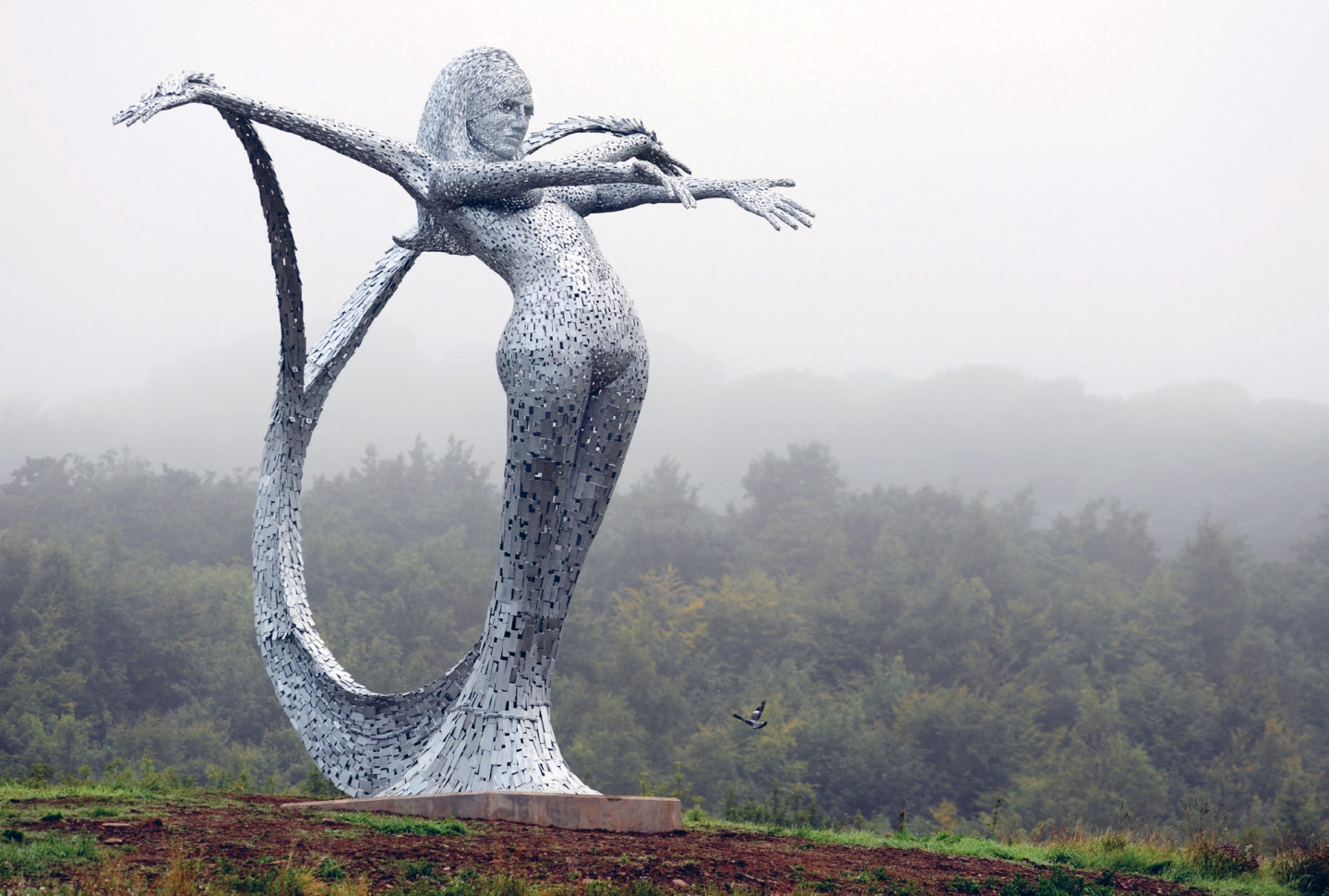
The “real art for real people” concept continues with Arria. Commuters who find themselves passing through Cumbernauld on the M80 will notice the incredible, four-armed sculpture of gleaming galvanised-steel that stands sentinel above. At ten metres tall, Arria greets those travelling to Cumbernauld with two graceful arms outstretched in welcome. The sweeping motions of her other two arms link with great flowing arcs, representing the rivers and streams which give Cumbernauld its Gaelic name: ‘comar nan allt’, meaning, ‘the meeting of the waters’. Cumbernauld’s history is also represented in Arria through her name. Chosen by two local schoolchildren in a community wide competition, Arria was named after the mother of the Roman Emperor Antoninus, who saw the expansion of the northern frontier of the Roman Empire to Central Scotland with the construction of a mighty wall. The Antonine Wall slashes across the Central Belt, with a considerable section driving through Cumbernauld. Clearly, Arria was designed with “real art for real people” in mind and is a positive representation of the town that the community has embraced. Andy feels this embrace through the words he has received from visitors to Eastfield Cemetery, situated beside Arria. “Loved ones who have been to the cemetery, such a personal place for them, have sent me kind letters thanking me for my work. That’s so special. You can’t quantify the feel-good factor in that.”
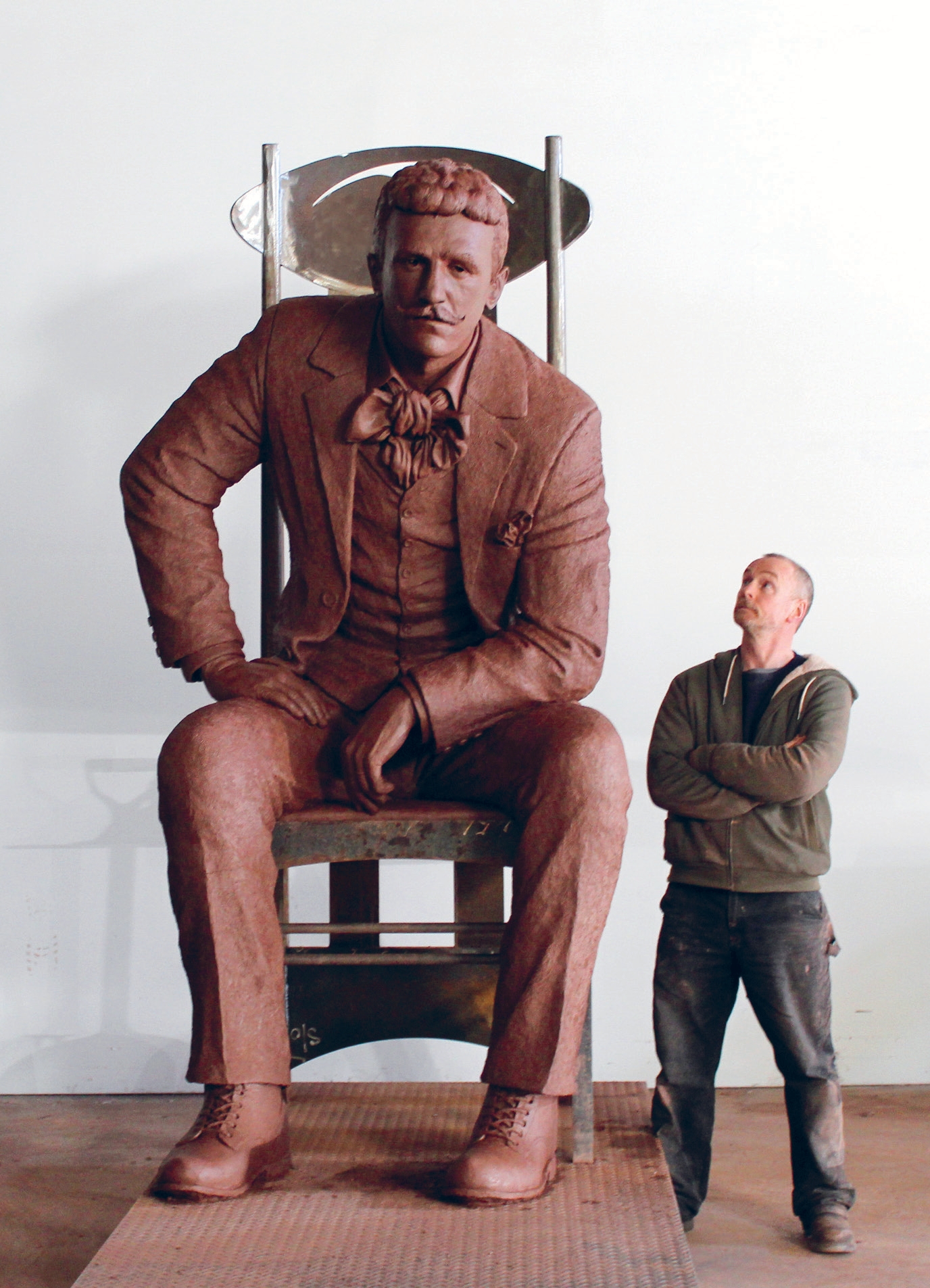
The chance to create a sculpture with local and emotional value to Andy came with the unveiling of his magnificent bronze statue of Glasgow’s beloved Charles Rennie Mackintosh, in December 2018. Mackintosh was a pioneering architect and designer of the 20th century, famous for his modern, Art Nouveau style. In particular, Mackintosh’s impact on Glasgow has left his deeply present legacy across the city. Buildings such as House for an Art Lover and The Willow Tea Rooms are firm testament to this incredible artist, but it is arguably his design of the world-famous Glasgow School of Art that roots Mackintosh’s place in the city’s history and heart. It was Mackintosh’s role in this that made Andy’s commissioning of his sculpture all the more special. “This is a project that I am particularly proud of, because of my own past,” explains Andy, who grew up in Glasgow and is a GSA alumni. “It’s one that I had wanted to do for ages, to celebrate the man who had such a role in the cultural making of Glasgow.” The sculpture, weighing three tonnes and measuring nearly three metres tall upon a two-metre-high plinth, was commissioned by Sanctuary Group as part of a £60m regeneration project in Anderston, Glasgow. Its location in Anderston is close to Mackintosh’s iconic Glasgow School of Art and differs from Andy’s distinctive steel work as a bronze sculpture. The emotional value of this project to Glasgow is highlighted in the statue’s carefully chosen unveiling on the 90th anniversary year of Mackintosh’s death, as well as the 150th anniversary year of his birth. Mackintosh is a revered contributor to Glasgow’s history, but the importance of this sculpture in bringing two of Glasgow’s greatest artists face-to-face is particularly special here. “All the blood, sweat and tears are worth it to see your work become a cultural contribution and part of your home city,” Andy says, the emotional importance of this sculpture clear in his voice.
Andy’s artistic inspirations are drawn from beyond the equine and figurine. In November 2017, Poised was installed in the new £107m Marischal Square in Aberdeen, where Andy was commissioned to make a centrepiece for the buildings. The resultant sculpture was a two-tonne, five-metre-tall leopard of galvanised steel, perched atop a ten-metre-high steel column. Poised took Andy more than a year to fabricate in his workshop, with thousands of complex steel fragments being welded together to form the magnificent shape of the leopard. The leopard may seem an unusual and exotic choice for a city in northern Scotland but it was inspired by Aberdeen’s historic coat of arms, a feature that Andy was particularly struck by and felt had to be represented in his project. The history of the leopards of Aberdeen can be traced back to the early fifteenth century, when James I of Scotland gifted two leopards in thanks for the financial support shown by the burgh during his captivity in England. The mammoth history of Aberdeen represented in Poised was perhaps also reflected in its installation. “The engineering of this was complicated and challenging,” Andy explains with a laugh. “Picture it – a two-tonne cat on a 10-metre-high column in the middle of an atrium! It’s the more complicated ones like Poised that tend to really stick in my mind.”
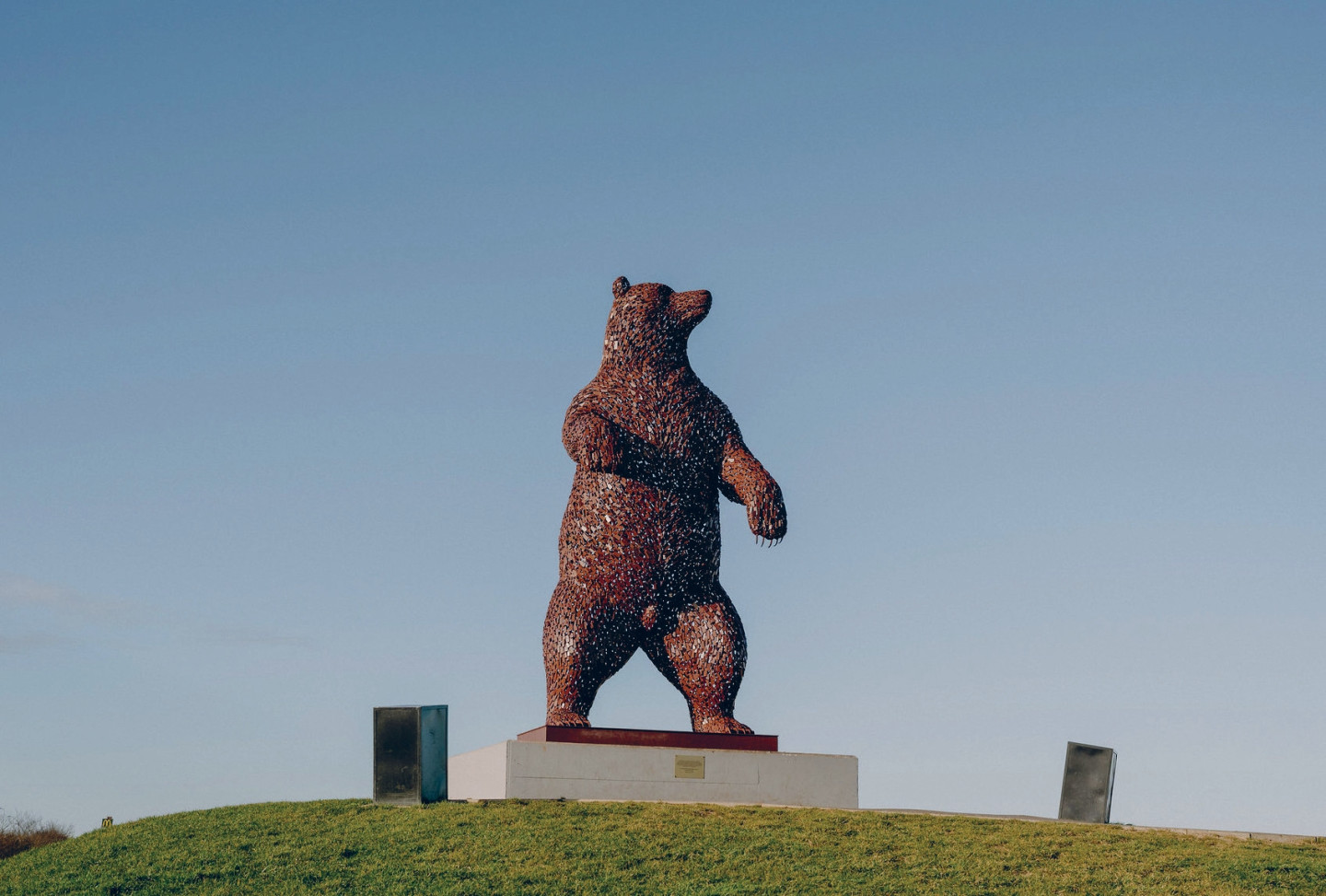
Two years later in November 2019, Andy saw the installation of DunBear. Located beside the A1 at Dunbar, this five-metre-tall sculpture of a brown bear was commissioned as a tribute to John Muir. Known as the ‘Father of the National Parks’, Muir was a Dunbar native who advocated for the preservation of areas of incredible natural environment in the USA. His tireless works in conservation saw the foundation of a series of world-famous national parks in the late 19th century, including Yosemite Valley and Sequoia National Park. With a statue of Muir in Dunbar already commemorating this giant of Scottish and American history, Andy wanted to create a different type of tribute to the famous Scotsman. “I was very aware of Muir’s role in the National Parks in America, and thought that instead of another statue of Muir himself, why not create something to represent the National Parks that he impacted?” And so DunBear was born, an impressive sculpture of welded steel in the low-carbon community of Hallhill which received its name from a local schoolchild in a community wide competition. The striking sculpture dominates its environment and is visible from both the A1 and the East Coast Mainline, making it a sight viewed and appreciated by thousands of commuters - a feature of many of Andy’s Scottish installations. “It is quite a task when you think about it,” Andy says. “These sculptures have a high audience on some of the busiest roads in Scotland!”
Scotland is overflowing with historical and cultural symbolism unique to each individual area – from the towns and cities, to the people that define and honour them. Andy Scott weaves the tales and legacies of the communities of Scotland not in words, but in mighty forms of galvanised-steel and bronze.
andyscottsculptor.com
Promoted Post
Eagle Brae
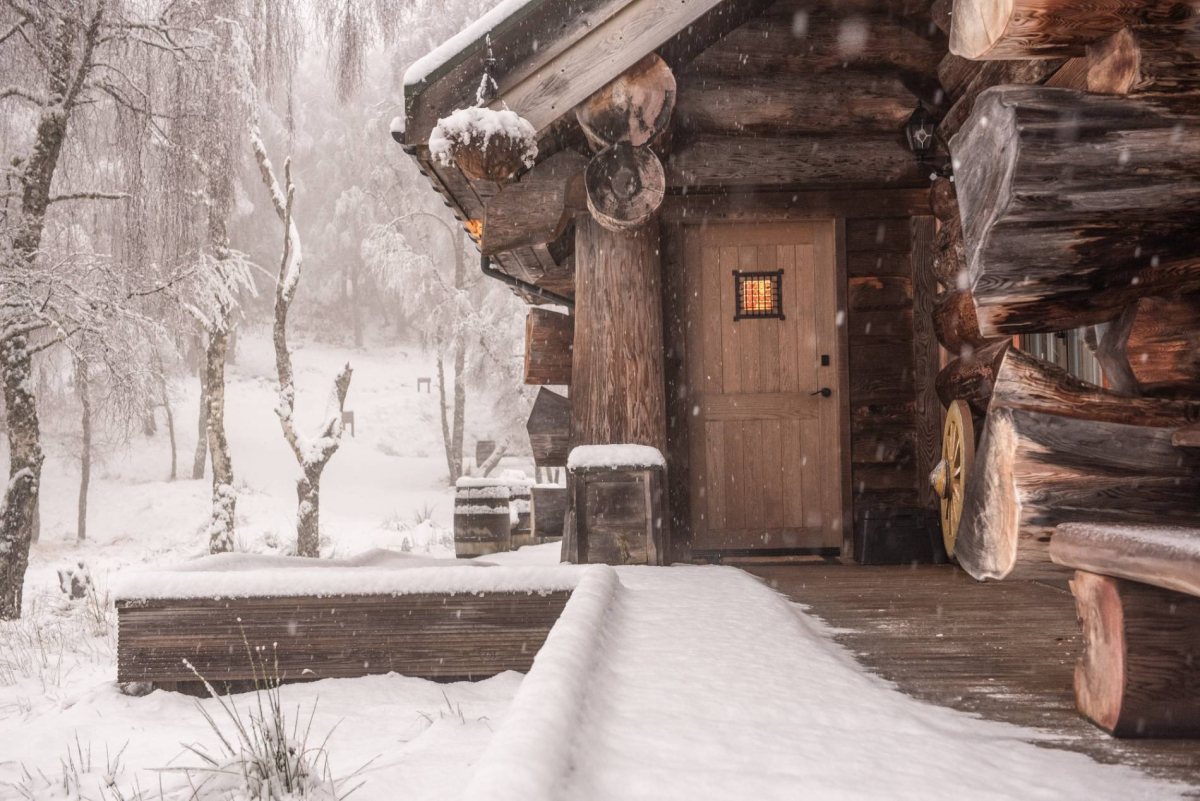
Escape to Eagle Brae, a secluded collection of Highland log cabins near Beauly. Handcrafted cedar, big skies, and deer on the hillside, with a fireside welcome that makes it easy to slow down.






 Sign in with Google
 Sign in with Email