
A day in Fetlar: five things to do
Coastal arches, Viking sites, a beach and otters on Fetlar, the Garden of Shetland.
Words by Laurie Goodlad
Fetlar, one of Shetland’s three North Isles, is known as the Garden of Shetland, and it’s easy to understand why. The stunning landscapes, fertile valleys, and diverse geology give rise to the most incredible flora and fauna display, particularly throughout the summer when Fetlar is at its best. With a population of just over 50 permanent residents and a two-ferry hop from the mainland, a trip to Fetlar needs to be carefully planned around ferries, and it’s likely that you will need to stay overnight to really make the most of all the island has to offer.
Snap Walk
Shetland’s coastline is peppered with dramatic coastal features, and none more so than the natural arch at the Snap. The walk out to the Snap takes in some of Fetlar’s best stretches of coastal cliffs. You can expect to see many seabirds along the way, including terns, skuas, shags and fulmars in the summer. The sea formed the arch as it exploited a natural weakness in the rock, carving out a hollow that eventually became an arch.
Archaeological remains
Fetlar is archaeology-dense, with some islanders and historians arguing that the Vikings’ first landfall was on the beach at Gruting and not in neighbouring Unst as is widely believed. Whatever the truth, Fetlar is filled with archaeological sites to visit, including:
The ruined 2,000-year-old broch at Houbie with deep defensive ditches surrounding the landward approaches.
Steatite carvings. In the geo beside the broch, you’ll see carvings in the steatite (soapstone) with the earliest of these, the circular-shaped marks, showing where the Vikings extracted their soapstone bowls.
The Finnigert Daek, dating to the Bronze Age, slices the island in two as it runs north-south through the isle.
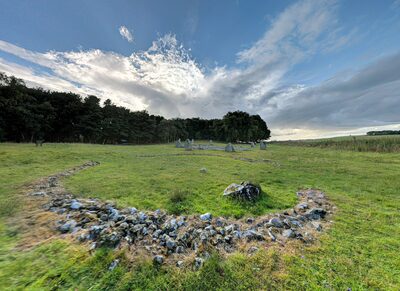
The Haltadans Stone Circle, believed to date to the Bronze Age, is a 38-stone circle with two upright monoliths positioned in the ring’s centre. This unassuming stone circle has several folklore stories associated with it. One suggestion is that the circle represents a fiddler and his wife (the central stones), and those surrounding are trows (trolls) who, whilst dancing, were startled and turned to stone by the rising sun.
Viking boat burial. Reputed to be the final resting place of a Viking man who had washed ashore during a storm. Time Team excavated the site (often referred to as the Giant’s Grave) in 2002, and they discovered a significant number of iron nails, but no skeletal remains were uncovered. An intricate 9th-century tortoise-shaped brooch was found, indicating that this may have been a Viking woman.
Tresta Beach
Flanked by the steep slopes of the neighbouring headland of Lambhoga, Tresta Beach commands uninterrupted views across the Wick of Tresta and the North Sea beyond. Tresta sits in the middle of the island. Tresta Beach has been included in the national Beach Awards, part of the Keep Scotland Beautiful charity. These awards “are the benchmark for quality, celebrating clean, well managed and sustainable beaches.” Those selected “demonstrate excellent beach management and environmental best practice, and maintaining high standards.”
Papil Water sits behind the beach – an excellent spot for trout fishing. Nearby is the Kirk, which was built in 1790 and has memorials to both the Nicolson and Cheyne families (prominent families in the islands) and several graves from the Second World War.
This beach is a beautiful place for a spot of responsible wild camping, or to while away an afternoon enjoying the views.
Searching for serpentine on Aith beach
Fetlar, like neighbouring Unst, is a perfect place to explore some of Shetland’s rich geology. Shetland was awarded Geopark status in 2009 for its outstanding geology, and Fetlar’s rich landscape and fertile soils come simply from the rocks beneath our feet.
You can view the geological wall at Funzie and find out about the area’s conglomerates and the rare Oceanic crust that has been thrust from the bottom of the sea and is visible in parts of Fetlar. Or, you can spend an hour on the beautiful beach at Aith searching for the distinctive, sea-polished fragments of brightly coloured green serpentines. Please remember that as Shetland is a National Geopark, stones must be left in situ and not removed.
Looking for wildlife
Fetlar is rich in wildlife, and as well as the usual birds and seals that you would expect to see in Shetland, Fetlar is a fantastic place to look out for otters and red-necked phalaropes.
Fetlar is an excellent place to spot the enigmatic and often elusive otter. Shetland has the highest density of Eurasian otters of any place in Europe, and Fetlar’s coastline is a great place to view them from. The best time to see otters is several hours on either side of low tide when the wind is blowing onshore, ensuring that your scent isn’t carried to the otter who has a highly-sensitive sense of smell and scares off easily.
 Out now
Twice a year, to your door
One hundred and sixty pages of Scotland, every photograph commissioned, every word written by someone who went. Members get both issues posted and everything on screen.

 The Last Stop Before Nowhere
 A Weekend Exploring the Isle of Mull
 What's On in Scotland: Autumn and Winter