
What’s the weather like in Shetland?
A Shetland tour guide on the islands’ weather: mild winters, cool summers, gales and sea fog.
Words by Laurie Goodlad
Climate is one of the things that I am asked most about in my job as a tour guide and it is also a topic that locally precedes every conversation – probably because we experience a lot of weather. The most common questions I’m asked are: how hot does it get, do you get much snow, and how cold is the sea?
Despite sitting on the same latitude as St Petersburg, Helsinki, and Anchorage, Alaska, Shetland doesn’t experience the same extremes of temperature and weather. We are about 9℃ milder than St Petersburg to the east in winter and experience very little prolonged snowfall. Our temperate, mild winters are thanks to the warming effects of the North Atlantic Drift that pass through the islands, keeping the climate relatively temperate. This warm current originates in the Gulf of Mexico and passes through Shetland and on towards northern Norway and Russia. As well as the North Atlantic Drift, another warming current, the Continental Shelf current, comes north from a little closer to home, from the latitudes of Spain and Portugal. Shetland is therefore also about 10℃ warmer than the southern point of Greenland, lying to the west, with which we share a latitude line.
The downside of these warming winter currents, keeping prolonged frosts at bay, is that the ocean surrounding our small landmass keeps us cooler in summer. Shetland has a very small temperature range of about 10℃ from summer to winter, with average temperatures in February sitting at about 5℃ and rising to 15℃ in August. This is where our St Petersburg comparison comes in again; in summer their average temperature is about 20℃, and they experience a much greater temperature range of about 25℃. Similarly, compared to the south of England, we have far fewer frosty days but a far narrower range of temperatures, and as temperatures in England frequently reach the mid 20s℃, Shetland is lucky to break the 15℃ mark.
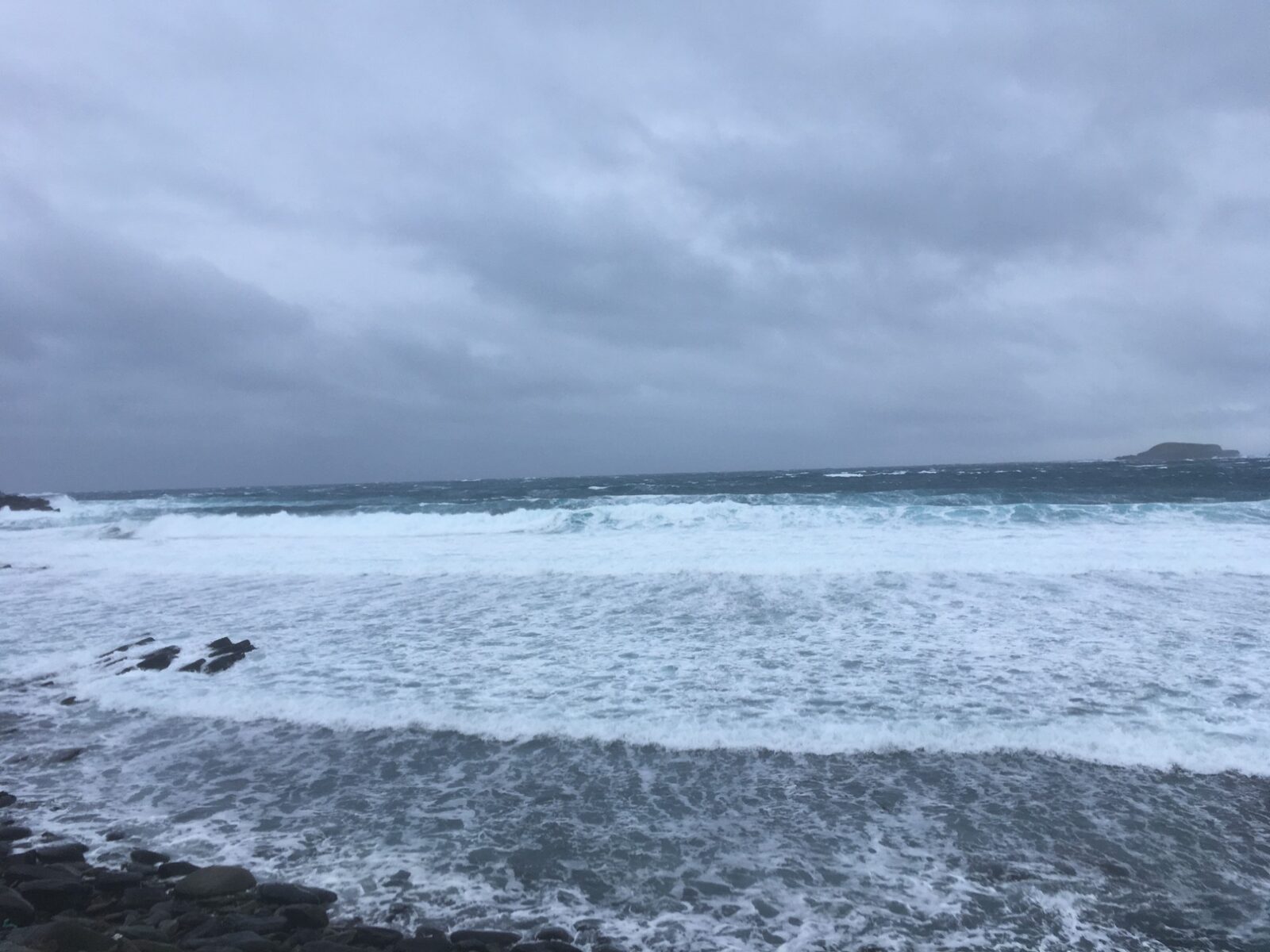
Shetland experiences many violent storms. The warming effect of the sea also produces cyclonic weather systems that build to the south-west and give us unsettled periods of low pressure. The Lerwick Observatory records an average of 42 gale days a year, with no month free of gales. January is the windiest month with an average of eight gale days (gale force eight or above).
In terms of rainfall, Shetland is no wetter than other areas of the western UK and, in fact, is drier than Glasgow. Lerwick records 1256.8mm of rainfall annually. And although drier than Glasgow, Shetland is less sunny. Shetland has 1,109.9 hours of sunshine where Glasgow enjoys 1,348.1 hours. So, although Glasgow is wetter, it is also sunnier than Shetland.
(1)-full-1749388268.jpg)
Shetland’s summers are punctuated by periods of low-lying sea fog that can cause much disruption to flights in and out of the isles, as well as blotting out the summer sun from the sky. Periods of fog are most prevalent on the east coast, which has led to the common saying of ‘West is best’. Many a summer day sees the east coast cloaked in a shroud of mist and, to the west, blue skies and higher temperatures blaze down on the landscape. This is mainly due to the topography of the islands and a low-lying range of hills that make up the spine of the Mainland Shetland, running from north to south, they provide a break between east and west. Sea fog is initially formed, generally as southern parts of the UK and Europe enjoy high temperatures. This creates warm, moist air that travels north and condenses as it passes over the cooler sea, creating droplets of moist fog.
 Out now
Twice a year, to your door
One hundred and sixty pages of Scotland, every photograph commissioned, every word written by someone who went. Members get both issues posted and everything on screen.

 The Last Stop Before Nowhere
 A Weekend Exploring the Isle of Mull
 What's On in Scotland: Autumn and Winter